Open the box for a sun tunnel and the part that surprises people is the tube. The dome on the roof and the diffuser on the ceiling look much the same from one kit to the next, but the tube between them comes in two quite different forms: straight sections of stiff, polished metal that slot together, or a concertina of foil-lined sleeve that stretches out and bends like a tumble dryer hose. Both are sold as sun tunnels, both fit through the same small round openings, and both are called light pipes in some catalogues. They do not behave the same once they are inside a loft.
This guide sets the two side by side: what each tube is made of, why that decides how much daylight survives the trip, which loft routes suit which tube, and how the choice is settled on a real roof. If you are still deciding whether a tube is right for the room at all, the sun tunnel installation page is the better place to begin.
What each tube is actually made of
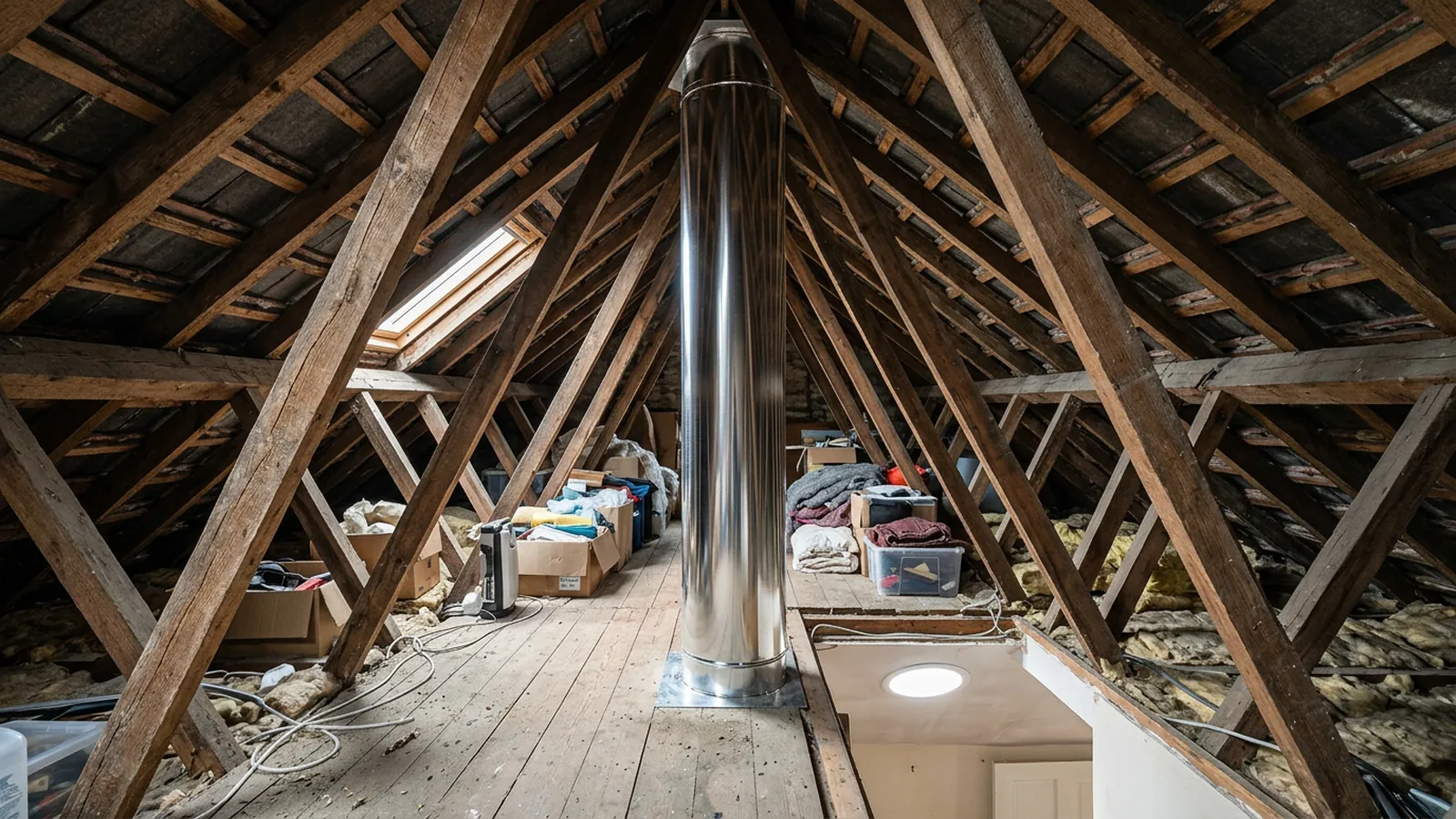
A rigid tube is a series of short metal cylinders, usually aluminium, with the inside face given a highly polished, mirror-like finish. The sections push or clip together to reach the length needed, and where the route has to change direction an adjustable elbow joins two sections at an angle. The finished tube holds its shape without support at every point, keeps a smooth inner wall from end to end, and is fixed to the roof flashing collar at the top and the ceiling ring at the bottom.
A flexible tube is a single length of reflective foil laminate wrapped around a spiral wire frame. It arrives compressed, and it is drawn out to length on site. Because the foil is gathered into ribs to let it stretch and curve, the inner surface is never quite smooth: there is always some ripple, even when the tube is pulled out as far as it will go. What it gains in return is the ability to follow a curve without any separate fittings at all.
Put simply, the rigid tube is built like a periscope and the flexible one like a duct. That one difference drives everything else in this guide.
How a sun tunnel brings daylight down
- Clear dome on the roof slope, catching daylight from the sky
- Flashing, weathered into the tiles so rain runs round the dome
- Daylight reflecting off the mirror-finish lining all the way down
- Reflective tube, here a rigid straight run through the loft
- Loft insulation laid up to the tube, with an insulated sleeve round it to limit condensation
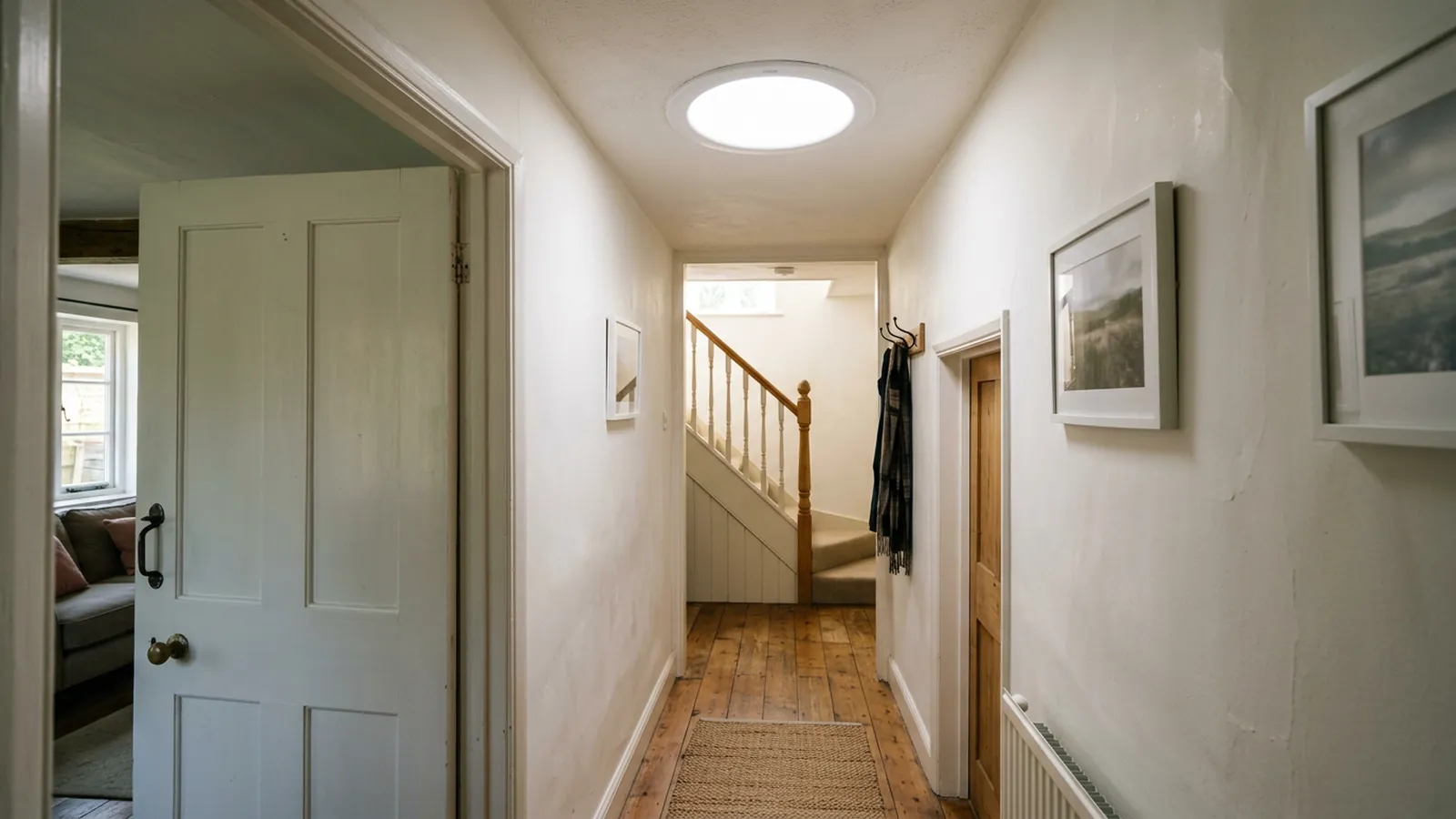
- Ceiling diffuser, spreading the light across the landing below
- Shown faint: angled elbows let the tube step round a truss or purlin, at some loss of light
Why the inner surface matters more than the shape
Daylight does not flow down a sun tunnel like water down a pipe. It enters through the dome, strikes the inside wall, and bounces its way down to the diffuser. Every bounce hands on most of the light and loses a little of it. The number of bounces, and how cleanly each one reflects, decides how bright the ceiling disc looks in the room below. Our guide on how a sun tunnel carries daylight into a room explains that journey in more detail.
A polished, smooth wall sends each ray on in a tidy line, so the light keeps its strength over a longer distance. A ribbed foil wall scatters it: some of each reflection heads back up, some sideways, and more of it is lost along the way. Over a short, straight run that scattering hardly shows. Over a long run, or one with a bend, it adds up quickly.
The tube is not a container for daylight; it is a long chain of mirrors, and a chain is only as bright as its roughest link.
This is why the two types are not simply a cheaper and a dearer version of the same product. They carry light differently, so each one suits a different kind of loft.
Rigid and flexible tubes compared
The table below puts the practical differences in one place. It describes the tube types in general terms; the exact figures for any particular kit come from its manufacturer and are checked against the loft at the survey.
| Point to compare | Rigid tube | Flexible tube |
|---|---|---|
| Inner surface | Smooth, polished, mirror-like metal | Foil laminate gathered into ribs over a wire spiral |
| Light over distance | Holds its brightness well on longer runs | Falls away faster as the run gets longer |
| Changing direction | Adjustable elbows at set points, with straight sections between | A gentle curve along its own length, with no separate fitting |
| Suits | Deep lofts, long drops and routes that can be kept fairly straight | Short, shallow runs and awkward offsets in a tight space |
| Fitting in the loft | Sections passed up and assembled in place, then supported | One sleeve drawn out, pulled taut and fixed at each end |
| Over the years | Keeps its shape; the finish is protected inside the sealed tube | Must stay taut; a sagging sleeve loses light at every dip |
Neither column wins outright. A rigid tube is the stronger performer when the distance is long; a flexible one is the neater answer when the distance is short and the route is cramped.
Where a rigid tube earns its place
The case for a rigid tube grows with the depth of the loft. A steep roof on a two-storey house can leave a tall void between the tiles and the ceiling, and a single-storey house with a deep plan may need the tube to travel a fair way across as well as down. In both cases the smooth wall pays for itself, because the light has further to go and more chances to be lost.
Rigid tubes also suit the rooms where brightness is the whole point: a hallway that has no other light, a windowless bathroom in the middle of the house, or a kitchen corner under an extension roof. If a room on the far side of a bungalow is the target, our guide to sun tunnels in bungalows with deep plan rooms looks at how a long rigid run is laid out to reach it.
The trade off is that a rigid tube needs a route it can follow in straight lines. It can turn, but each turn is made with an elbow, and every elbow adds reflections. So the survey looks first for a way to keep the tube as close to vertical as the roof allows, then uses elbows only where a truss web, a binder or a water tank genuinely stands in the way.
Where a flexible tube makes sense
A flexible tube comes into its own when the run is short and the space is tight. A shallow loft over a low pitched roof, a narrow gap between a tank and the eaves, or a room where the best roof position sits a little to one side of the ceiling opening can all be met with a sleeve that curves gently from one to the other. There is no need to cut sections to length or set elbows to an angle; the tube takes the offset in its own shape.
That same flexibility is the reason it has to be handled with care. Left slack, the ribs bunch up, the sleeve sags between its ends and the light has to climb over every fold. Pulled out fully and fixed at both ends, it performs as well as its surface allows.
The rule: a flexible tube is fitted fully stretched, kept as short as the route permits and given the gentlest curve that will do the job. The exception: if the route needs a long run or more than a mild bend to reach the room, that is the signal to change to a rigid tube with elbows rather than asking a flexible sleeve to work harder.
The shorter answer on how far a tube can turn before the light suffers is in can a sun tunnel bend around obstacles in the loft?
Getting either tube past estate trusses
On the trussed roofs that cover Popley, Brighton Hill, Chineham and the other post-war estates around Basingstoke, the loft is crossed by W shaped webs, long binders and diagonal braces, and none of them is there by accident. Whichever tube is chosen, it goes round those timbers and never through them. The dome sits in a gap between two trusses on the slope, the diffuser sits in a gap between two ceiling ties, and the tube joins the two.
Here the two types part company in a useful way. Where the roof gap and the ceiling gap line up, or nearly so, a rigid tube can drop almost straight down and give its best. Where they sit in different bays, a rigid tube crosses over with a pair of elbows, while a flexible one can make the same move in a shallow curve if the distance is short. The full method for planning that path is in our guide to routing a sun tunnel through a trussed roof void.
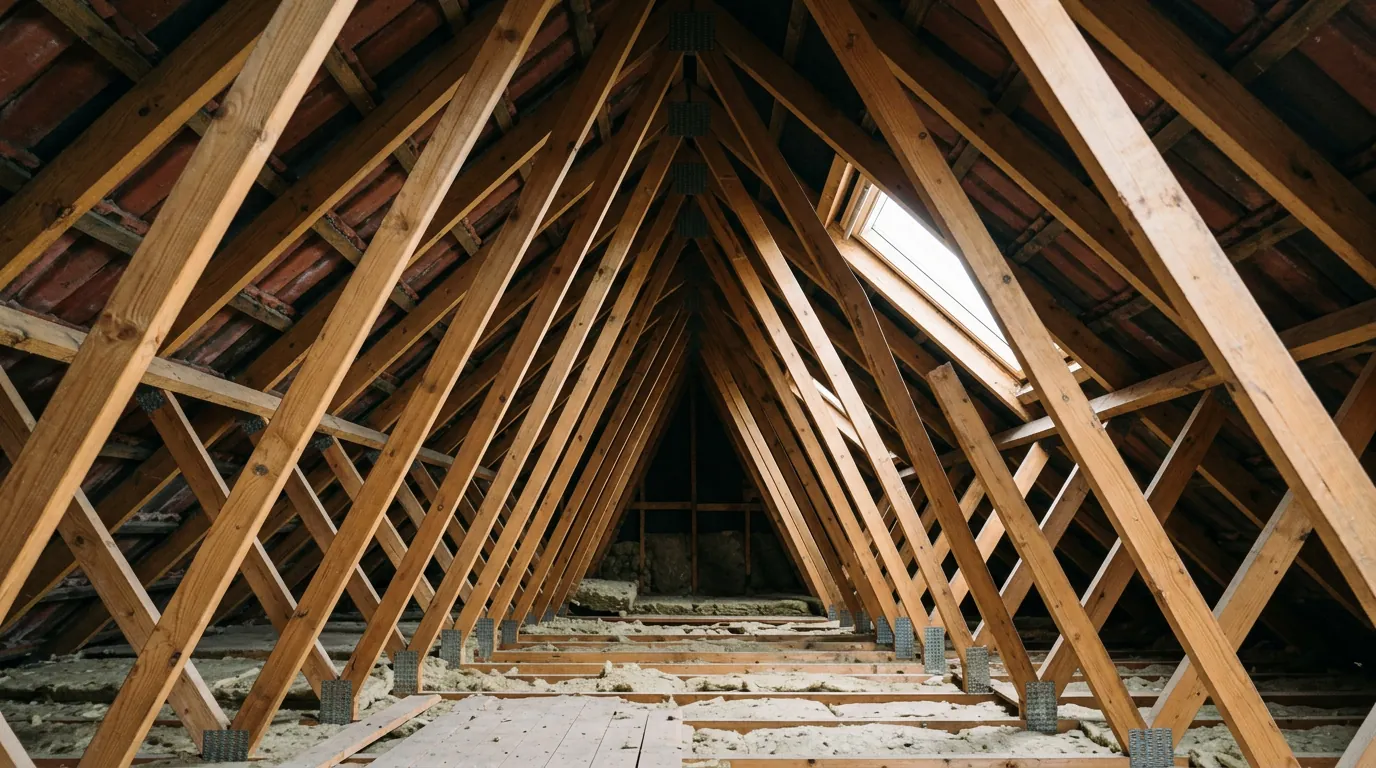
The older cut rafter roofs in the village centres are more open inside, with purlins and struts in place of webs, so a straight drop is often easier to find there. The choice of tube still follows the same logic: distance and bends first, then the space to work in.
Length, bends and the light that arrives
How long the tube is, how wide it is, and how many times it turns all act on the same thing: the light that reaches the diffuser. A wider tube lets each ray travel further between bounces, so a bigger diameter partly offsets a longer run. A bend adds bounces, so each one takes a share. On a flexible tube those effects start sooner, because every bounce is already a little less clean.
That is why a flexible tube is generally kept to short runs and a rigid one is chosen when the length grows. Manufacturers publish their own limits for each tube type and diameter, and a proper specification stays inside them. Our guide to tube diameter, length and how much light arrives goes through how width and distance trade against each other. For the short answers, see how long can a sun tunnel be? and how much light does a sun tunnel give?
One practical point follows. If two routes are possible, a slightly longer straight one in a rigid tube can deliver more light than a shorter route with several turns in a flexible one. The shortest line on paper is not always the brightest.
Insulation, warmth and condensation
The tube passes through the coldest part of the house. Below it is a heated room; around it is a loft kept cold by the insulation laid over the ceiling. Warm, moist air rising into a cold tube can leave droplets on the inside of the dome or the tube wall, so the section of tube that crosses the loft is wrapped in insulation and the joints are sealed, whichever type is used.
A rigid tube gives a firm surface to wrap, and its joints are clear to see and seal. A flexible tube is usually sold with an insulating sleeve, or one is fitted over it, and it matters that the sleeve does not drag the tube into dips. Either way, the insulation over the ceiling is made good around the tube so the loft stays as warm, or as cold, as it was before. Our guide on insulating a sun tunnel through a cold loft covers the detail, and do sun tunnels get condensation? gives the direct answer.
How the tube is chosen at the survey
The choice between rigid and flexible is not made from a catalogue. It is made in the loft, with a tape measure and a torch, because the route is what decides it. The survey before the quote follows a fixed order.
- The room. We agree where the light should land on the ceiling, usually over the middle of a landing, a bath or a stair.
- The ceiling gap. From the loft we find the space between ceiling ties above that spot, and note wiring, pipes and insulation around it.
- The roof gap. We look for the nearest clear bay on the slope, checking the pitch, the covering and which way the slope faces.
- The route. We measure the distance between the two openings and count the turns needed to pass webs, binders, braces and tanks.
- The tube. A short, near-straight run can take a flexible tube; a longer run, or one that needs real turns, is specified in rigid sections with elbows.
- The quote. You get a written specification naming the tube type, the diameter and the route, with the reason for each.
Where the work is notifiable, the Building Control side is sorted by us as part of the job; do sun tunnels need Building Regulations approval? explains when that applies.
Choosing for your own house
If there is one question to ask about a sun tunnel quote, it is which tube it includes and why. A good answer ties the tube to your loft: flexible for a short hop in a cramped roof, rigid for a long drop or a route with turns. A quote that names only the dome and the diffuser leaves out the part that decides how bright the room will be.
A sun tunnel is one way to bring daylight down from the roof; a rooflight or a skylight in the slope is another, and for a room directly under the roof it often gives more. The wider choice across both is set out on our page about skylight and rooflight installation around Basingstoke. For the tube question itself, the sun tunnel service page shows how the whole fit runs from survey to finished ceiling, and every fitting comes with our 10-year workmanship guarantee, which is not insurance backed.
When you would like the loft looked at and the tube named in writing, arrange a survey of your roof and we will trace the route with you.