Replacing a misted or failed rooflight in Basingstoke
A misted or failed rooflight replaced as a new pane or a new window in the same opening, surveyed first and guaranteed for 10 years.
Will a replacement fit the opening between my trusses?
On the trussed rafter roofs around Basingstoke, trusses usually sit at 600mm centres, and the existing opening was set out when the old rooflight went in. Keeping the replacement within that opening leaves the structure as it is. Here is how the common choices compare, and the survey confirms the opening on your roof before we quote.
| New pane in the existing frame | The frame, flashing and opening all stay, so nothing structural changes at all. |
|---|---|
| Same-width window between trusses | The new window goes back into the same bay between two trusses, with the trusses left whole. |
| Same-width window in a trimmed opening | The trimming done when the old window went in is checked at the survey and reused as it is. |
| Wider window than the original | This is a new opening in structural terms, so the trimming is designed before any work starts. |
How it works
Misted rooflight replacement in Basingstoke
A rooflight that has gone cloudy between its panes is still a working window. It still lets daylight in, it still keeps the rain out, and it still opens if it opened before. What has changed is the sealed unit: the two or three sheets of glass bonded around their edges with a spacer and a sealant, and the dry gas held between them. Once moist air finds its way into that cavity, it condenses on the inside faces of the glass, and no amount of cleaning from either side will reach it. That is the point where a rooflight stops being something you look through and becomes something you look at.
This page covers replacing a misted or failed rooflight around Basingstoke from start to finish: why sealed units fail, how to tell a failed unit from ordinary condensation, when the glass alone can be changed and when the whole rooflight should go, what it means for roof windows, flat rooflights and roof lanterns, how the new one goes into the old opening, flashing and the finish inside, the weather, Building Control, and what decides the cost. We survey the roof before we quote, and every replacement we fit carries a 10-year workmanship guarantee. If you would rather someone looked at it with you, book a roof survey.
Why a rooflight's sealed unit fails
Every modern rooflight, whether it is a roof window in a tiled slope, a flat glass rooflight on an extension or the panes of a roof lantern, is glazed with a sealed unit. The edge seal is the part that does the work. It keeps the cavity dry and holds the gas that gives the unit its insulating value. Inside the spacer bar there is usually a desiccant, a drying agent that soaks up the small amount of moisture that creeps in over the years. While the desiccant has capacity left and the edge seal holds, the cavity stays clear.
A rooflight has a harder life than a wall window. It faces the sky, so the glass heats up more in summer sun and cools further on a clear winter night. Each swing makes the glass and frame expand and contract, and each cycle works at the edge seal. Rain sits on it rather than running straight off, especially on low pitches and flat roofs. Over time the seal loses its grip in places, the desiccant fills up, and moist air in the cavity starts to condense when the glass is cold. At first the misting comes and goes with the weather. Later it stays, and a white bloom or a faint tidemark appears where minerals have been left behind on the inner faces.
We go into the physics properly in why a rooflight's sealed unit mists between the panes, and the list of things that speed it up (poor drainage at the frame, standing water on a flat unit, a frame that has moved, age) is in what makes a rooflight sealed unit fail? There is no fixed date on the box: the working life of a unit depends on the product, the pitch, the exposure and how well it was installed, which is why how long does a rooflight sealed unit last? describes the factors rather than promising a number.
The rule: misting between the panes means the edge seal of that sealed unit has failed, and it does not reverse. The exception is condensation on the room side of the glass, which is a ventilation matter and clears when the air in the room is managed. Telling the two apart is the first job.
Skylight, rooflight, roof window or VELUX: the names are used interchangeably, and for this purpose it does not matter. The failure is in the glass, not in the name. What changes with the type is the route to replacing it, and that is where the survey earns its place.
Misted between the panes, or condensation on the glass?
Before anything is ordered, it is worth being sure what you are looking at. Condensation on the inside face of a rooflight is common in bathrooms, kitchens and loft bedrooms, because warm, moist air rises and the glass overhead is the coldest surface in the room. It looks alarming on a cold morning, it can drip, and it can leave dark marks on the lining. None of that means the sealed unit has failed. A few simple checks usually settle it.
- Wipe the room side. On a morning when the glass is fogged, wipe a small area with a dry cloth. If it clears, the moisture was on the surface in the room, not inside the unit.
- Check the outside. If you can see the outer face safely, from a window or a flat roof you are allowed on, look for dew. Outside condensation on a cold, clear morning is a sign the unit is insulating well.
- Look for a tidemark. A faint white line, streaks or a milky area that stays through a dry, sunny afternoon points to a failed edge seal and mineral deposits inside the cavity.
- Watch it over a day. Misting inside the unit often clears as the sun warms the glass and returns as it cools. If the pattern follows the weather rather than cooking or showering, the unit is the likely cause.
- Note where water appears. Drips from the glass in a steamy room point to condensation. Water running down the lining from the top of the frame on a rainy day points to the frame or the flashing, which is a different question.
Our guide to telling condensation on the glass from a failed unit has more detail, including what to do about room-side condensation if that turns out to be the answer. The short direct answers sit in why is my rooflight misty between the panes? and is water dripping from a rooflight always a failed unit?
Black mould on the reveal or the lining around a rooflight belongs in the same conversation. It grows where warm moist air meets a cold surface for long periods, and around an older rooflight that often means a cold spot at the frame edge, poor insulation behind the lining, or a room that needs more ventilation. It can point to a failed unit, but just as often it points to how the opening was finished inside. Why is there black mould round my rooflight? explains the usual causes and what a replacement changes.
Does a misted rooflight actually matter?
A misted unit is not a hazard in itself. The glass is as strong as it was, and the rooflight will keep the weather out as long as the frame and flashing are sound. So the honest answer is that it depends on what you want from the window, and on whether the misting is the only thing going on.
| Question | Failed unit | What it means for you |
|---|---|---|
| Daylight | Scatters and dims it as the misting and deposits build up | The room still gets light, but it is flatter and the view of the sky goes |
| Heat loss | The insulating gas has been replaced by ordinary moist air | The unit performs below its original rating, and the glass runs colder on the room side |
| Weathertightness | Unaffected by the misting alone | Water inside the room points to the frame, flashing or condensation instead |
| Safety | The glass itself is unchanged | Cracked glass is a separate and more pressing matter |
| Reversing it | The edge seal cannot be restored in place | A new sealed unit or a new rooflight is the lasting answer |
Two effects are easy to underrate. The first is light. A misted skylight over a landing or a galley kitchen was often put there because it was the only daylight that space gets, and a milky pane turns it into a lamp rather than a window. Does a misted rooflight let in less light? goes through why the loss feels bigger than it measures. The second is warmth. Once the gas fill has gone, the unit is working as ordinary double glazing with damp air in it, and the cold inner pane drives more condensation in the room below. Does a misted rooflight lose more heat? sets out what changes.
If you are weighing up whether to act now or leave it, is a misted rooflight a problem? gives the plain answer. And before you spend money on a product that promises to clear the glass, read can misted rooflight glass be cleared? It explains why drilling and drying a unit may improve the look for a while but does not restore the edge seal or the gas, which is what the unit was bought for.
Replacing the sealed unit or the whole rooflight
This is the decision that shapes the job. Some rooflights are designed so the glazing can be changed on its own, from inside or outside, and the frame, flashing and lining stay where they are. Others have the glass bonded into the frame, or are old enough that the frame, the seals and the flashing are all nearing the end together. In that case changing the glass alone would leave you with new glass in a tired window.
| Rooflight | Glass only | Whole rooflight |
|---|---|---|
| Current roof window with a replaceable pane | Often possible where the frame is sound and a matching pane is available | Worth weighing where the frame, seals or flashing are also ageing |
| Older timber roof window | Sometimes, if the sash is sound and a pane can be sourced | The usual answer where the timber, gaskets and hinges are worn |
| Flat glass rooflight | Depends on whether the unit is bonded to the frame | Common where the unit is bonded or the upstand needs attention |
| Roof lantern | Individual panes can often be changed in a sound frame | Where several panes have failed or the frame has aged |
| Plastic dome | Not a sealed glass unit to change | Replaced with a glazed rooflight on the same or an adapted kerb |
Our guide to replacing the sealed unit or the whole rooflight walks through the points we weigh at the survey: the age and condition of the frame, whether a matching unit can be obtained, the state of the flashing and seals, and whether you want something the old rooflight cannot give you, such as better insulation, an electric opener or a blind. For VELUX roof windows specifically, misted VELUX glazing and the replacement pane route covers how pane replacement works on those frames, and can just the glass be replaced in a VELUX? gives the direct answer.
It also helps to know that one misted pane does not always mean the whole rooflight has failed. On a lantern or a pair of windows, a single unit can go while the rest are sound. Does a misted pane mean the whole rooflight has failed? explains how we judge that, and why we would rather tell you a pane will do than sell you a frame you do not need.
Failed roof windows on estate houses
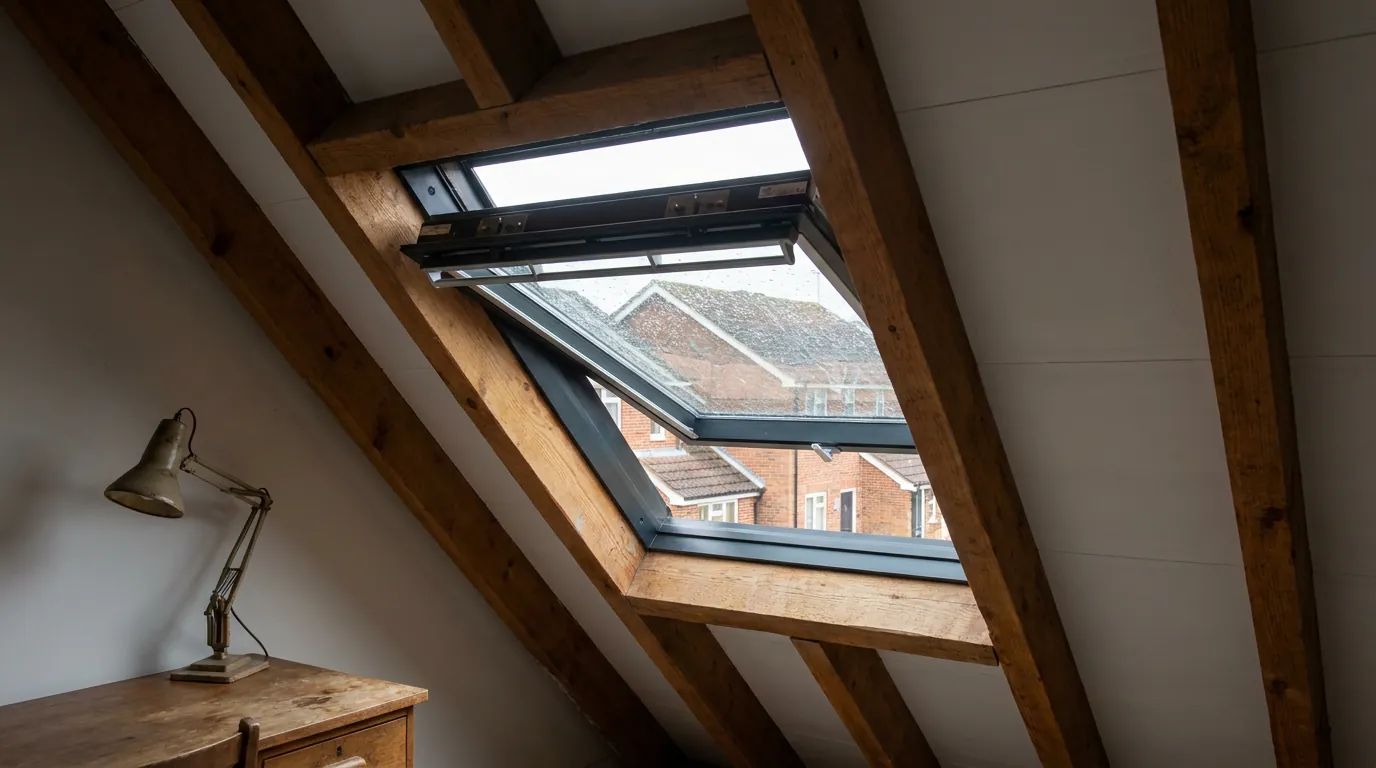
A great deal of Basingstoke was built on trussed rafter roofs, from the 1960s estates in Popley, Oakridge, Winklebury and Brighton Hill to the later building in Hatch Warren, Chineham, Beggarwood and Kempshott. Many of those houses had roof windows added during loft conversions, and the windows from those conversions are the ones now reaching the end of their working life. The misting is often the first sign, followed by stiff hinges, worn gaskets, flaking finish on timber sashes and a draught along the top of the frame.
On a trussed roof the good news is that the opening already exists and was sized when the window first went in. If the original window sat between two trusses at 600mm centres, a replacement of the same width goes back into the same bay without anything structural changing. If the original opening crossed a truss, the trimming was done at the time, and the survey checks that it is still sound before the new window goes in. The rule that applies to a new opening still applies here: a truss is never cut on judgement on the day.
Our guide to failed roof windows in 1980s estate houses looks at the windows typical of that era: timber sashes, the gaskets and seals they used, and the replacement sizes that line up with the original openings. When the whole window is being changed, the new one is specified exactly as a new installation would be, which is why our roof window installation page is worth reading alongside this one.
Basingstoke grew from a market town into a London overspill town from the 1960s, and most of its estates were built by volume housebuilders to repeated house types on trussed rafter roofs. Houses of the same type on the same street often had their roof windows added in the same way, which means the original opening sizes tend to follow a pattern too.
The perished seals on older windows are a story of their own. The rubber and foam gaskets that close the sash against the frame harden and shrink with age and sun, and a window that closes onto a hard, cracked gasket lets in draughts and wind-driven rain even when the glass is fine. Perished frame seals and gaskets on older rooflights explains how to spot them and when they tip the decision towards a whole new window.
Flat rooflights and roof lanterns
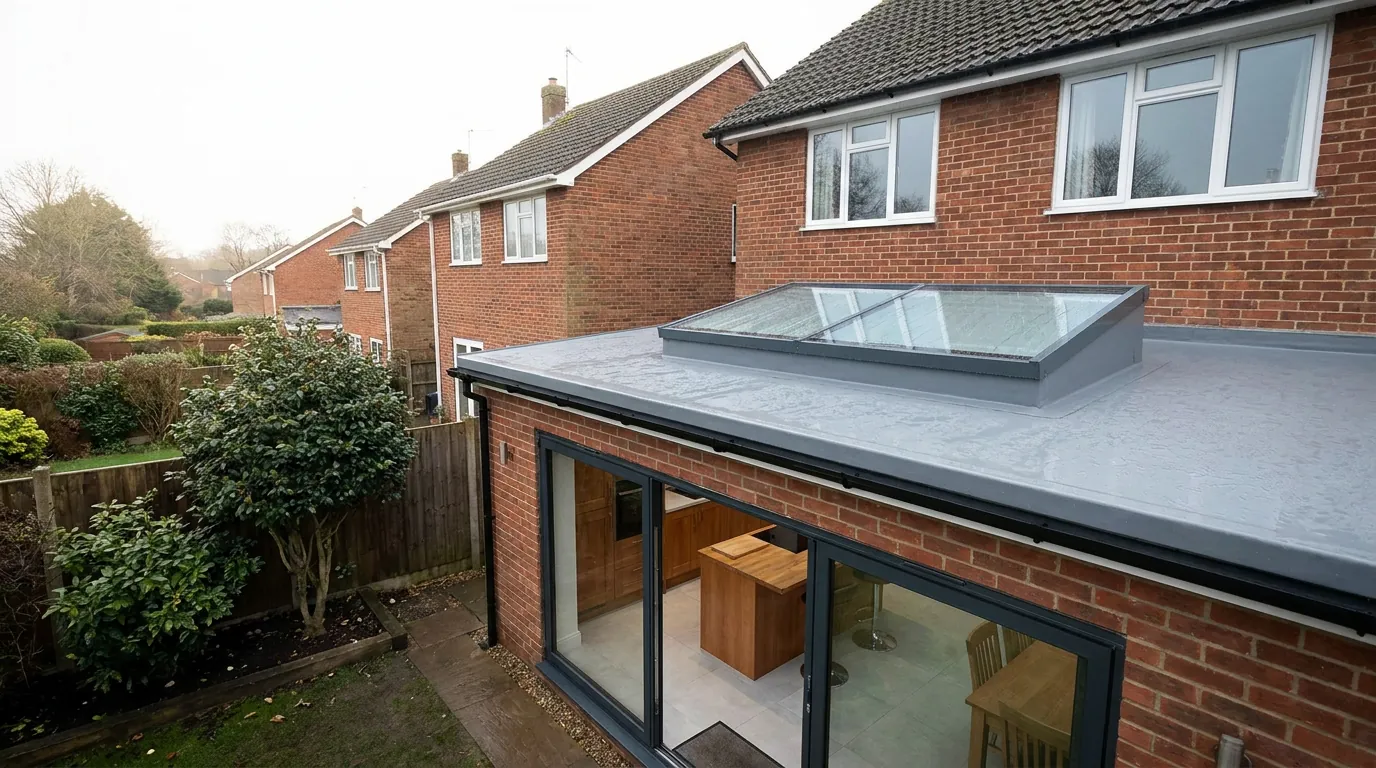
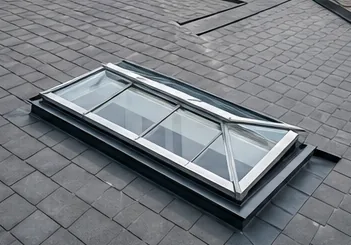
Flat roofs ask more of a rooflight than a pitched slope does. Water drains slowly, sits against the frame and, on a unit laid too flat, ponds on the glass itself. Over years that puts steady pressure on the edge seal, and the seals between the rooflight and its kerb or upstand age at the same time. A flat rooflight that has misted is often one where the glass, the frame seals and the upstand all want looking at together.
When a flat rooflight's seals have failed goes through the difference between a failed sealed unit and failed frame seals, and why the fall of the glass matters so much on a flat roof. If the replacement is a chance to move to a better unit, for example a slimmer frame, a solar control coating or a unit laid to the correct fall, our flat roof rooflight installation page covers the choices for extension roofs.
Roof lanterns are built from several sealed units held in a frame of glazing bars, so one pane can fail while its neighbours stay clear. That is often good news: in a sound frame, the misted pane can usually be measured and replaced on its own. It is less straightforward where several panes have gone, where the glazing bars or cappings have aged, or where the lantern is an older design whose units are no longer standard sizes. Misted panes in a roof lantern covers the options, and can one misted pane in a roof lantern be changed? is the short answer.
- Identify the pane. We note which units have misted, look at the rest for early signs, and check the glazing bars, cappings and end seals.
- Measure it. Each unit is measured for size, thickness and edge detail, because lantern panes are often made to order.
- Check the frame. A new pane only makes sense in a frame that will outlast it, so the frame and its seals are checked before anything is ordered.
- Recommend a route. One pane, several panes or a new lantern, explained in plain terms with the reasons, in the written quote.
Where a new lantern is the better answer, it is specified as a new installation on the existing kerb or a new one, and our roof lantern installation page covers sizes, frames and glazing.
Staining, cracked glass and other signs of a failed rooflight
Misting is the most visible sign that a rooflight is tired, but it is rarely the only one. When we survey an older rooflight we look at the whole assembly: the glass, the frame, the seals, the flashing on the roof, and the lining inside. Several signs are worth checking before you book, and what should I check on an old rooflight before booking a survey? turns them into a short list you can work through from the room below.
| What you see | Likely source | What the survey checks |
|---|---|---|
| Milky glass or a tidemark between the panes | Failed edge seal on the sealed unit | Whether the unit alone can be changed or the rooflight is due |
| Brown staining on the ceiling or lining | Water getting past the frame or flashing, or long-running condensation | Flashing, frame seals, the lining and the insulation behind it |
| A crack in the glass | Impact, stress at the edge or thermal stress | Which pane is cracked and how quickly a replacement is needed |
| Draughts or whistling round the sash | Hardened or shrunken gaskets | Gasket condition, hinges and how well the sash closes |
| A sash that will not open or close properly | Worn hinges, swollen timber or a frame that has moved | The frame, its fixings and the opening around it |
Staining deserves care because it tells a story that is easy to misread. A brown ring on the ceiling below a skylight could be water coming past the flashing, water from failed frame seals, or condensation that has run down the glass for several winters. Each has a different answer, and only one of them is about the glass. Water staining around an old rooflight and what it tells you explains how to read the marks, and how do I know if a rooflight has failed? pulls the signs together.
Cracked glass sits in a different place. A crack in the outer pane of a sealed unit lets water into the cavity, and a crack in the inner pane is a safety question over a room. How soon it needs replacing depends on which pane, where the crack runs and whether it is spreading. Cracked rooflight glass: what happens next sets out the steps, and how long can a cracked rooflight wait? gives the direct answer. If glass is cracked, tell us when you get in touch so the survey can be arranged with that in mind.
Fitting the new rooflight into the old opening
For most replacements the aim is to reuse the opening that is already there. It keeps the structure as it is, it keeps the inside finish to a minimum, and it keeps the job short. Roof window makers publish their size ranges, and many current sizes line up with openings made for earlier generations of the same product. Where they do not line up exactly, there are usually small adjustments to the battens, the tiles or the lining that make a close match work.
Our guide to replacing a failed rooflight in the same opening covers how we measure the existing opening, how a new frame is set to the old one, and what changes if the replacement is slightly larger or smaller. Will the new rooflight be the same size as the old one? is the short version.
On a trussed roof there is one more reason to reuse the opening. The trusses either side were either left whole, with the old window between them, or trimmed to a design at the time. Keeping the new rooflight within the same opening means that arrangement stays exactly as it is. If you want a larger window as part of the replacement, that is a new opening in structural terms, and it is treated as one: the size that fits between the trusses first, and designed trimming only where a wider window is wanted. The fit check on this page shows how the common choices compare.
The rule: a replacement that stays within the existing opening leaves the roof structure as it is. The exception is a replacement that is wider than the original on a trussed roof, which is planned as a new opening with its trimming designed before any work starts.
On cut rafter roofs in the older villages, such as Old Basing, Overton or Kingsclere, the rafter spacing varies and the opening was trimmed by hand when it was made. The survey measures it, and where the property is in a conservation area and the replacement looks different from the original, a conversation about planning comes before anything is ordered. A like-for-like conservation replacement is a different specification from a standard roof window, and the rooflight installation overview on our homepage shows where that fits among the services.
How we replace a misted or failed rooflight
The order of work is the same whether we are changing a single pane or the whole rooflight. What changes is how many steps apply. The point of doing it in this order is that nothing is ordered until the roof has been seen, and nothing is removed until the replacement is on site.
- Survey. We look at the rooflight from inside and, where it is safe, from outside: the glass, the frame, the seals, the flashing and the lining. We measure the opening and the unit, check the roof structure around it and note access for the day.
- Written quote. You get a quote that says what is being replaced and why: the pane, the sash or the whole rooflight, with the flashing, lining and finish spelled out.
- Order. The unit or rooflight is ordered to the measured size. Made-to-order lantern panes and some flat rooflights take longer to arrive, and we tell you that at the quote.
- Protect the room. Floors and furniture below the rooflight are covered, and a clear route is set out for anything coming in or out.
- Remove the old. For a pane, the sash or glazing is opened and the old unit taken out. For a whole rooflight, the flashing, frame and lining are taken out and the opening is checked before anything new goes in.
- Fit the new. The new unit or frame is set level and square, fixed to the structure, and made weathertight with the correct flashing or upstand seals.
- Finish inside. Linings and reveals are made good to meet the new frame, and insulation around the frame is renewed where it is exposed.
- Check and clear up. We check the sash opens and closes fully, test any electrics, clean the glass and take the old rooflight and packaging away.
How long it takes depends on the route. A single pane can be a short visit; a whole roof window with new flashing and lining takes longer; a flat rooflight or lantern on a new kerb longer again. How long does replacing a misted rooflight take? explains what changes the time on the day.
Flashing, seals and the finish inside
A new sealed unit in an old frame keeps the old flashing, so the survey checks the flashing is sound before we recommend that route. A whole new roof window comes with its own flashing kit, matched to the roof covering. Profiled concrete tiles, the usual covering on the post-war estates, need a flashing with a flexible apron that dresses down over the tile profile. Flat clay tiles and slate take a lower-profile flashing that sits with the courses. On a slate roof with thin, even courses the window can often be set lower in the roof for a neater line. Getting the flashing right to the covering matters more to the long-term performance of a replacement than almost any other choice.
Flat rooflights and lanterns depend on the upstand or kerb and on how the flat roof covering is dressed up to it. When a flat rooflight is replaced, the seals between the rooflight and the kerb are renewed, and the covering at the upstand is checked. If the kerb is too low, rotten or not set to the correct fall, the survey says so and the quote covers the work to bring it right, because a new unit on a failing kerb would repeat the problem.
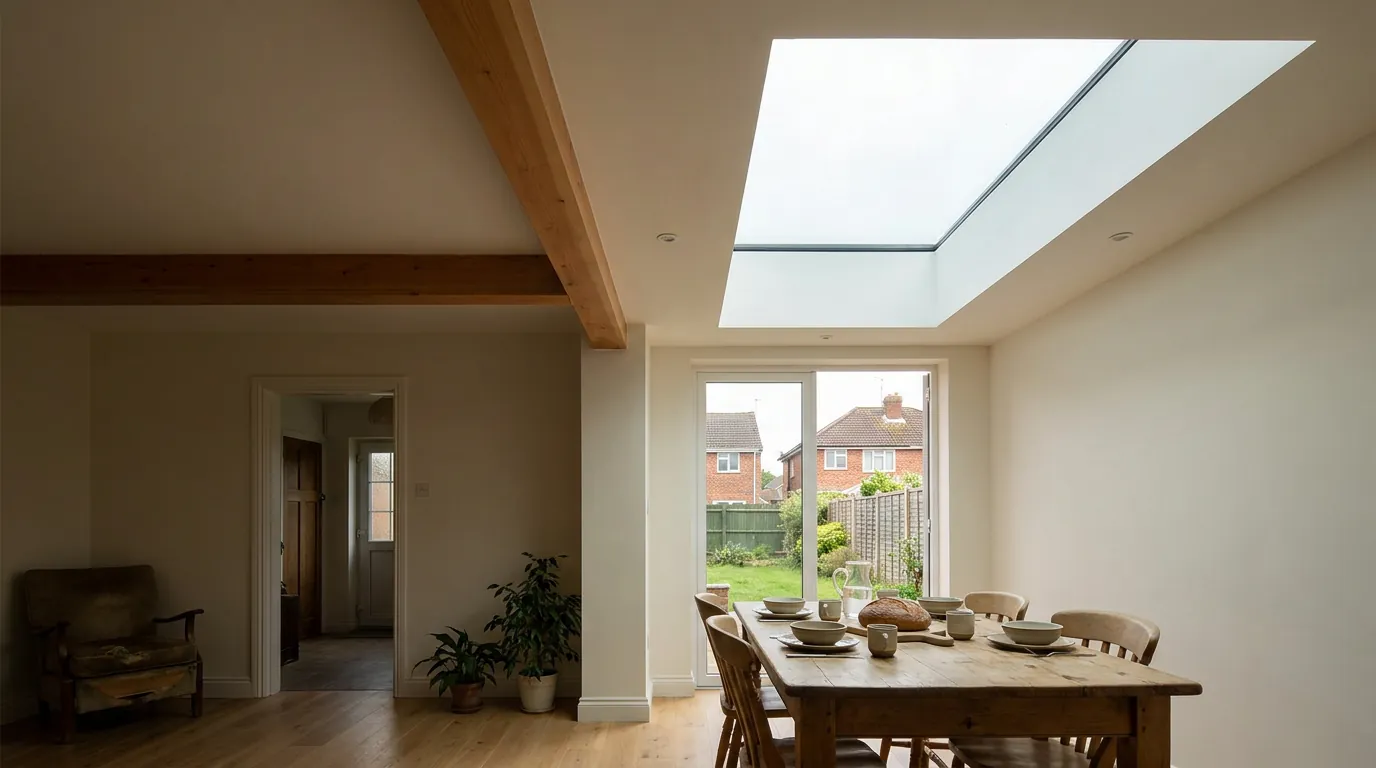
Inside, the lining is where a replacement shows. Older rooflights were often lined with plasterboard straight off the frame and little or no insulation behind it, which is why the reveals feel cold and why mould appears in the corners. A replacement is a chance to put that right: insulation collars or packing around the new frame, a vapour control layer where the maker's detail calls for one, and a clean plastered or boarded reveal. Where the reveal is angled so the top is splayed upwards and the bottom downwards, the daylight spreads further into the room. The finish is part of the job, not an extra.
| Roof covering | Flashing or seal | Finish points |
|---|---|---|
| Profiled concrete tiles | Flashing kit with a flexible apron dressed over the tiles | Tiles cut neatly around the new frame, battens adjusted to suit |
| Flat clay tiles | Low-profile flashing that sits with the tile courses | Handmade tiles set aside and relaid where they came from |
| Slate | Slate flashing for thin, even courses | Window often set lower for a neat line with the slates |
| Flat roof covering | New seals between rooflight and kerb, covering dressed up the upstand | Kerb height and fall checked so water runs off the glass |
Replacing a rooflight around the weather
Changing a rooflight means opening the roof, even if only for part of a day, so the weather matters. It matters less than people expect, though. A pane change can be done in most conditions, because the frame and flashing stay in place. A whole roof window replacement is planned so the old window comes out and the new one goes in within the same working day, with the flashing complete before we leave. A flat rooflight on a new kerb, where the roof covering also has to be dressed, needs a dry spell for the covering work.
We watch the forecast in the days before the job and move the date if it looks wrong. Wind matters as much as rain for large panes and lantern units, because they have to be carried and lifted safely. If a job has to wait, we tell you as early as we can. Replacing a failed rooflight around the weather and the season goes through how we plan around it, and can a failed rooflight be replaced in winter? gives the direct answer: yes, with sensible planning, and often winter is when the misting is most noticeable anyway.
Seasons also affect lead times. Made-to-order sealed units for lanterns and some flat rooflights take time to make, so if the misting is getting worse it makes sense to book the survey early rather than wait for spring. The survey itself can be done in any weather.
Building Control and planning for a replacement
Replacing a rooflight is building work, and the Building Regulations apply to it in England. Replacing the glass in an existing frame is generally treated differently from replacing the whole window, and replacing a whole rooflight with a new one is treated as replacement glazing, which brings in the requirements for thermal performance and, depending on the position, safety glazing and ventilation. Where replacement work is notifiable, it has to be either self-certified by an installer registered with a competent person scheme or notified to Building Control.
The rule: where the replacement is notifiable, we handle the Building Control notification for you, so there is a record that the work meets the regulations when you come to sell. The exception is a like-for-like pane change within an existing frame, which is usually outside the notification requirements; the survey confirms which applies to your job.
Does replacing a failed rooflight need Building Regulations? explains the difference between a glass change and a whole replacement in more detail. The practical point for you is simple: we tell you at the quote whether your job is notifiable, and if it is, the notification is part of what we do.
Planning is rarely an issue for a like-for-like replacement, because the rooflight is already there and the new one looks the same from outside. It becomes a question where the property is listed, where it sits in a conservation area and the replacement will look different, or where a bigger window is planned. In the villages and town centres around Basingstoke, such as Old Basing, Odiham, Overton and Whitchurch, conservation areas are common, and any change to the appearance of a roof there is worth checking with the local planning authority before the order is placed. Any application is assessed on its merits, so we never tell you what the answer will be, but we can tell you which questions to ask. A newer home may also still be under a housebuilder warranty, so it is worth checking what that says about work to the roof before booking.
What decides the cost, and the survey
The price of replacing a misted or failed rooflight depends on things we can only see at the survey. What we can do is tell you what moves it, so the quote makes sense when it arrives.
| Factor | Why it matters |
|---|---|
| Pane or whole rooflight | A sealed unit on its own is a smaller job than a new frame, flashing and lining |
| Type and size | Roof windows, flat rooflights and lanterns use different units, and made-to-order panes cost more to produce |
| Access | A rooflight reachable from inside or from a low roof needs less than one that needs a tower or scaffold |
| Roof covering | The flashing kit and the tile or slate work differ by covering |
| Opening size | A same-size replacement reuses the opening; a larger window means designed trimming |
| Upgrades | Electric opening, rain sensors, blinds and better glazing each add to the specification |
| Finish inside | New linings, insulation and decoration around the frame vary with the room |
If you have a misted VELUX and want a sense of how these factors play out, how much does it cost to replace a misted VELUX window? goes through them for that product without inventing a figure. Upgrades can be worth weighing at replacement, because the opening is already being worked on; current glazing is a real step up in warmth from the units of earlier decades.
The survey is where the guesswork stops. We look at the rooflight from inside and out, measure the opening and the unit, check the flashing, seals and lining, and look at the roof structure around it. Then you get a written quote that says which route we recommend and why: a new pane where that will do, a new rooflight where it will not. Every replacement comes with our 10-year workmanship guarantee. The guarantee covers our workmanship and is not insurance backed; the products carry their own manufacturer warranties as well. We take the old rooflight away and leave the room clean. For a wider view of the skylight and rooflight replacement work we do across the area, the homepage is the place to start. When you are ready, book a roof survey and we will come and look at the roof you have.
How a job runs
Roof survey
We inspect your roof and recommend what will fit and perform.
Installation
Our team installs with care, keeping your home protected.
Sign-off and guarantee
We complete the sign-off and issue your 10-year workmanship guarantee.
Misted and failed rooflight guides
-
 Why a rooflight's sealed unit mists between the panes
-
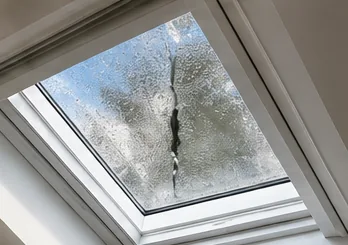 Replacing the sealed unit or the whole rooflight
-
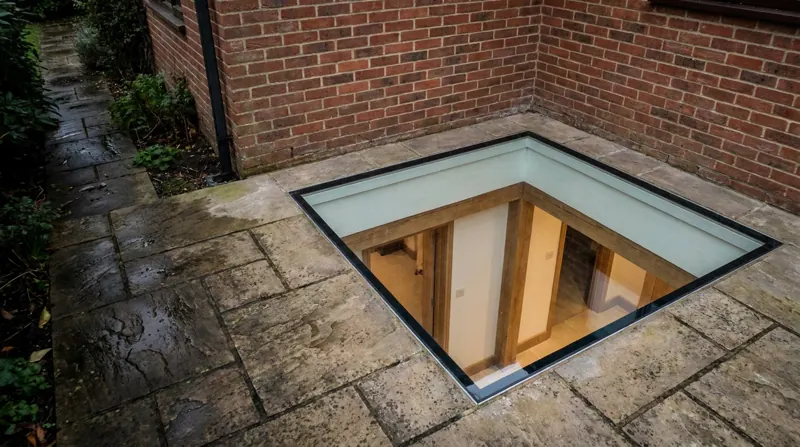 Failed roof windows in 1980s estate houses
-
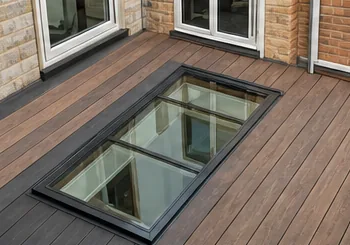 Misted panes in a roof lantern
-
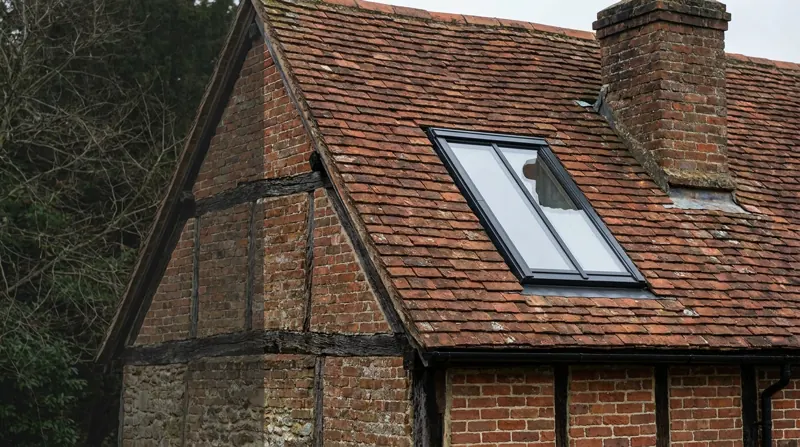 Misted VELUX glazing and the replacement pane route
-
 When a flat rooflight's seals have failed
More guides
- Water staining around an old rooflight and what it tells you
- Replacing a failed rooflight in the same opening
- Cracked rooflight glass: what happens next
- Condensation on the glass or a failed unit: telling them apart
- Perished frame seals and gaskets on older rooflights
- Replacing a failed rooflight around the weather and the season
Questions answered
- Why is my rooflight misty between the panes?
- Can misted rooflight glass be cleared?
- How long does a rooflight sealed unit last?
- Is a misted rooflight a problem?
- Can just the glass be replaced in a VELUX?
- How long does replacing a misted rooflight take?
- Does replacing a failed rooflight need Building Regulations?
- Is water dripping from a rooflight always a failed unit?
- Can one misted pane in a roof lantern be changed?
- What makes a rooflight sealed unit fail?
- Will the new rooflight be the same size as the old one?
- Does a misted rooflight lose more heat?
- Can a failed rooflight be replaced in winter?
- What should I check on an old rooflight before booking a survey?
- Why is there black mould round my rooflight?
- How long can a cracked rooflight wait?
- Does a misted pane mean the whole rooflight has failed?
- How much does it cost to replace a misted VELUX window?
- How do I know if a rooflight has failed?
- Does a misted rooflight let in less light?
Frequently asked questions
Can misted rooflight glass be cleared without replacing it?
Not in a lasting way. The misting comes from a failed edge seal, and drilling and drying the cavity may improve the look for a while without restoring the seal or the insulating gas. A new sealed unit or a new rooflight is the lasting answer. Can misted rooflight glass be cleared? explains why.
Can just the glass be replaced in a VELUX window?
Often, yes, where the frame and sash are sound and a matching pane is available, and the flashing and lining stay as they are. On older windows with worn gaskets or hinges a whole new window can make more sense. Can just the glass be replaced in a VELUX? covers the checks.
Will the new rooflight be the same size as the old one?
Usually the replacement is chosen to fit the existing opening, so the structure and the lining change as little as possible. Current size ranges often line up with openings made for earlier windows, and small adjustments to battens or lining handle the rest. See will the new rooflight be the same size?
Does replacing a misted rooflight need Building Control?
A like-for-like pane change is usually outside the notification requirements, while replacing a whole rooflight is replacement glazing and is notifiable. Where it is, we handle the Building Control notification for you. Does replacing a failed rooflight need Building Regulations? has the detail.
Can a failed rooflight be replaced in winter?
Yes, with sensible planning. A pane change keeps the frame and flashing in place, and a whole roof window is taken out and replaced within the same working day with the flashing complete. Flat roof covering work needs a dry spell. Can a failed rooflight be replaced in winter? explains more.

Free roof survey
Tell us about your roof
- Survey before any quote
- No obligation
- Plain-English advice
Say what you have in mind and where. We survey the roof before we quote, then tell you plainly what fits.
Prefer to talk? 01256 213206
Request my survey