A rooflight rarely picks a good moment to give up. The misting shows on a grey February morning, the cracked pane turns up after a night of hail, the drip onto the landing carpet arrives in the middle of an autumn downpour. The natural reaction is to want the thing out today. This guide is about the other half of that decision: how the weather and the time of year affect when a failed skylight can be swapped, which failures are happy to wait for a dry spell, which are not, and how a replacement is planned so the roof is never left open to the sky.
It sits under our misted and failed rooflight replacement service, which covers the job itself. Here we stay with timing.
Why the weather matters more for a swap than it seems
Taking out an old rooflight means opening the roof. For a while there is a hole where the frame used to be, the underlay around it is exposed, and on a flat roof the waterproof layer has been cut back to the kerb. None of that is a problem on a dry, still day. All of it is a problem in driving rain or a gusting westerly.
The materials care too. Sealants, adhesives and flat roof membranes each have conditions printed on their data sheets: a dry surface, a temperature above a stated minimum, no frost on the substrate. A careful installer reads those and works to them, which is why a fitting date is sometimes moved even when the new unit is sitting in the van. Moving a date is a nuisance; a membrane bonded to a damp deck is a nuisance that lasts for years.
So the question is never simply "can it be done in winter". It is which roof, which kind of failure, and what the forecast says for the specific day.
How a sealed rooflight unit works and fails
- Outer and inner glass panes, with the outer pane facing the weather
- Low-emissivity coating on one inner face, reflecting heat back into the room
- Warm-edge spacer bar holding the panes apart, filled with desiccant to soak up trace moisture
- Primary seal against each pane, backed by the secondary seal around the edge
- Dry sealed cavity, the insulating layer between the panes
- Broken edge seal: moist air gets in and the desiccant becomes saturated
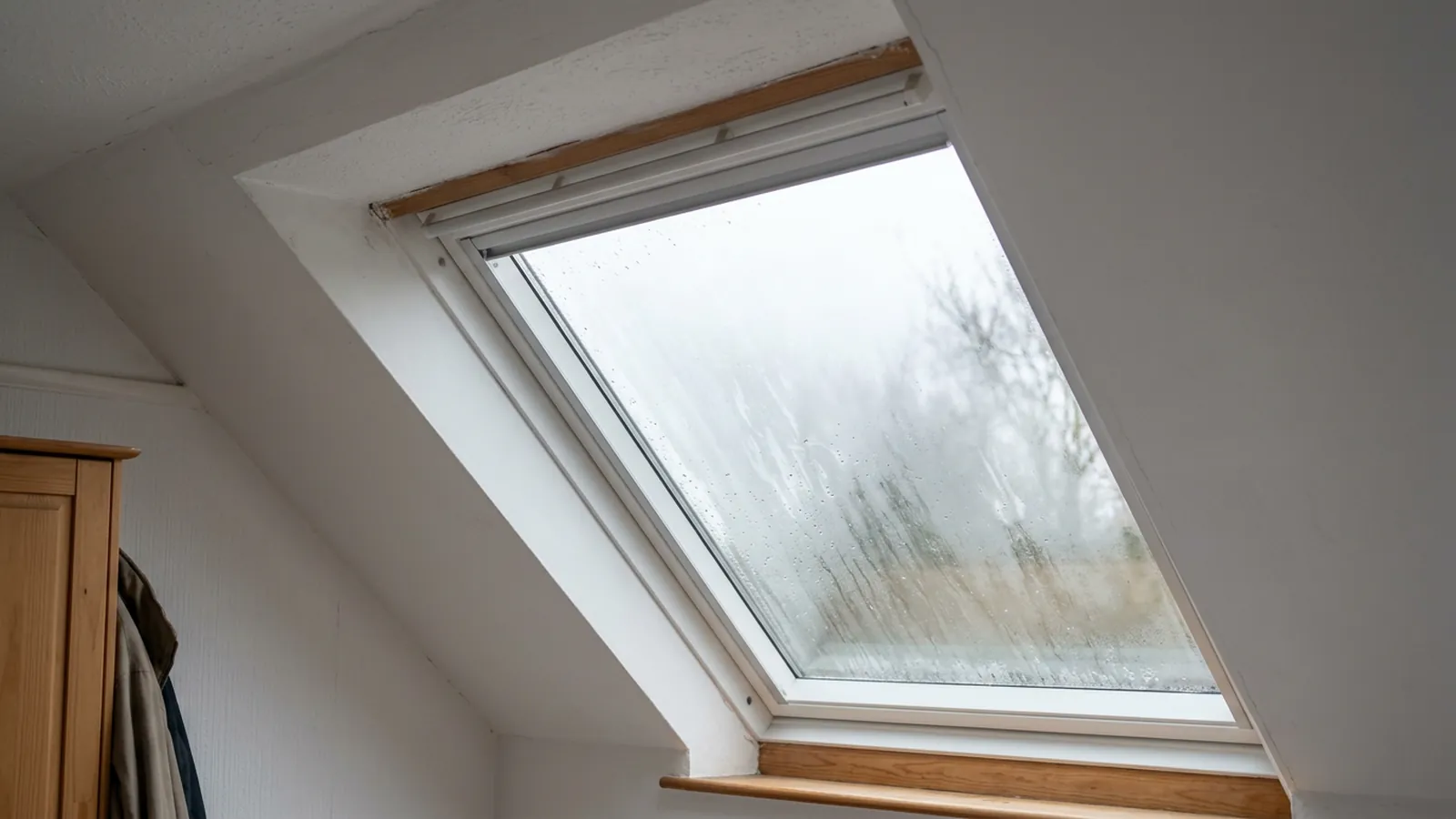
- Mist and droplets trapped between the panes; they cannot be wiped off and the sealed unit needs replacing
- Inset: condensation on the room-side face of the glass is a ventilation or humidity issue, not a failed unit
Which failures can wait, and which should not
Most failed rooflights are an inconvenience rather than a danger, and knowing which kind you have takes the pressure off choosing a date. The table sorts the common failures by how patient they can be. If you are not sure which one you are looking at, our guide to water staining around an old rooflight helps you read the marks, and the answer on whether water dripping from a rooflight is always a failed unit separates condensation from water coming in.
| What you see | Can it wait for a dry spell? | What to do in the meantime |
|---|---|---|
| Misting between the panes | Yes. The outer seal has gone but the roof is still weathertight | Keep the room ventilated and book a survey at your convenience |
| Perished frame gaskets on an old unit | Usually, if no water is reaching the room | Watch the reveal for fresh marks after heavy rain |
| A crack in the outer pane only | For a short while, if the inner pane is sound | Keep the area below clear and get a date booked |
| A crack through both panes, or glass missing | No. The room is open to the weather | Keep people out of the space beneath and ring us |
| Water running in at the frame during rain | Not for long, especially into a ceiling void | Catch the water, turn off lights beneath it and ring us |
The answer on how long a cracked rooflight can wait goes further into the glass cases.
The seasons around Basingstoke, one by one
North Hampshire and the Berkshire border get ordinary southern English weather: mild, often damp, with the odd hard frost and the odd spell of gales. No season rules a replacement out. Each simply asks for different planning.
Spring
Longer days and a drying wind make spring a comfortable time to open a roof, though April showers can come through quickly. A job is planned around the forecast for the morning, when the opening is made, and the old unit is not removed until the new one is ready to go straight in.
Summer
The easiest season for flat rooflights and lanterns, because decks are dry and warm and membranes bond as intended. The trade-off is demand: summer diaries fill with extension work, and the hottest afternoons make a south-facing roof hard work, so starts are early.
Autumn
Autumn is when many owners first notice a problem, because the first proper rain finds out a tired seal. Days are still long enough for a full job, but falling leaves on a flat roof and the first gales need watching. Booking a survey in early autumn gives the best choice of dates before winter.
Winter
A pitched roof window swap is often perfectly practical on a cold, dry winter day. Frost, ice on the tiles and short daylight are what need planning around, and flat roof work has the tightest limits. The answer on whether a failed rooflight can be replaced in winter gives the short version; the sections below give the reasons.
Pitched roof windows: what the day has to allow
On a tiled or slated roof, a like-for-like roof window replacement works from inside the room for most of the job. The sash comes out, the old frame is released, a few courses of tiles around it are lifted, and the new frame and its flashing kit go in with fresh underlay collars. Our guide to replacing a failed rooflight in the same opening walks through that sequence.
For the weather, three things matter. The tiles and battens must be safe to handle, so ice and heavy frost push the start later in the morning. Rain during the short spell when the frame is out lets water onto the ceiling insulation, so the swap is timed for a dry window in the forecast. And the lifted tiles have to be relaid neatly around the new flashing, which is slow and fiddly with numb hands in a biting wind. A cold, bright, still day is better than a mild, wet, blustery one.
A cold, still, dry morning suits a roof window swap far better than a mild day of squally showers.
Flat rooflights and lanterns: the dry deck rule
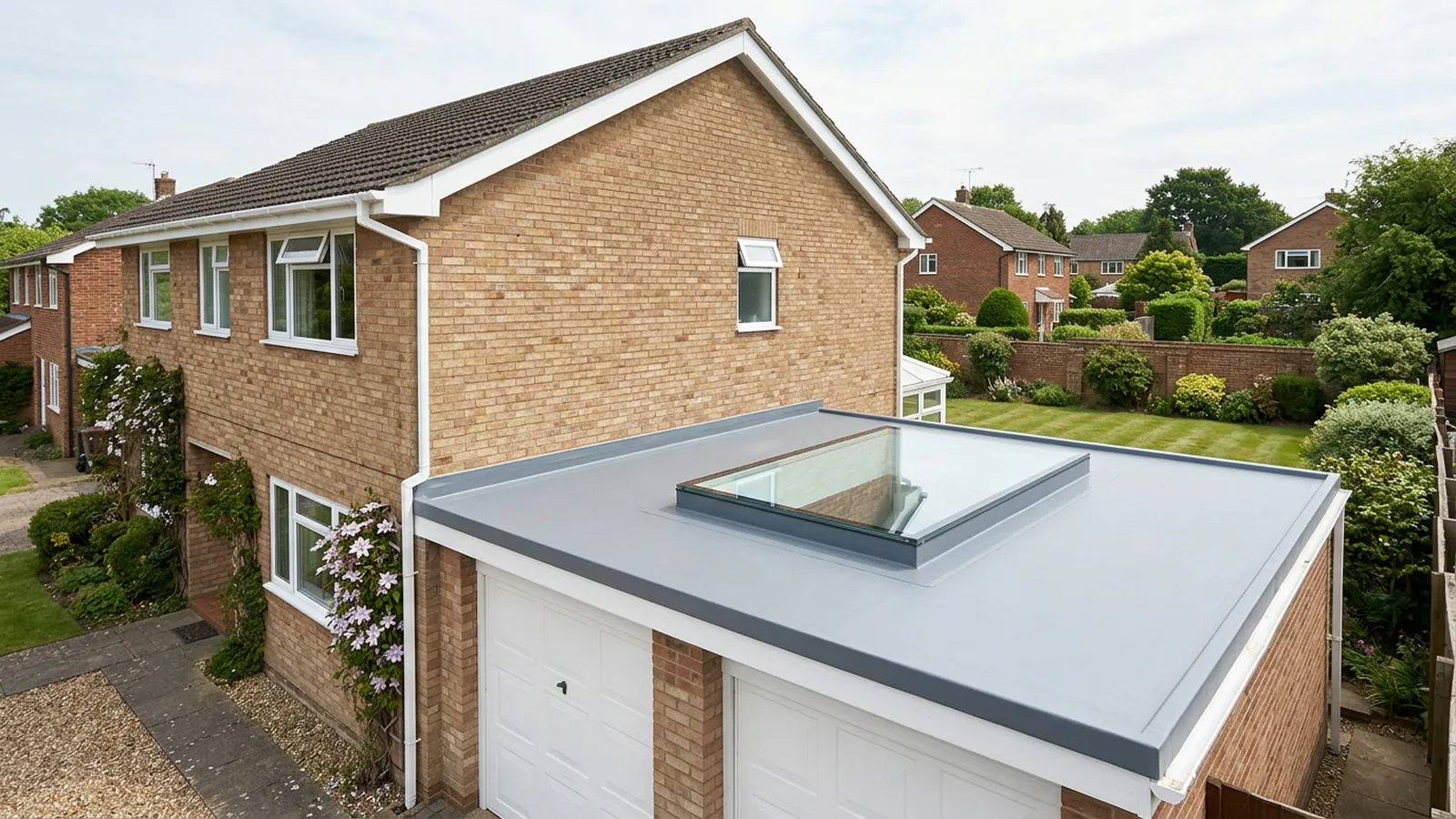
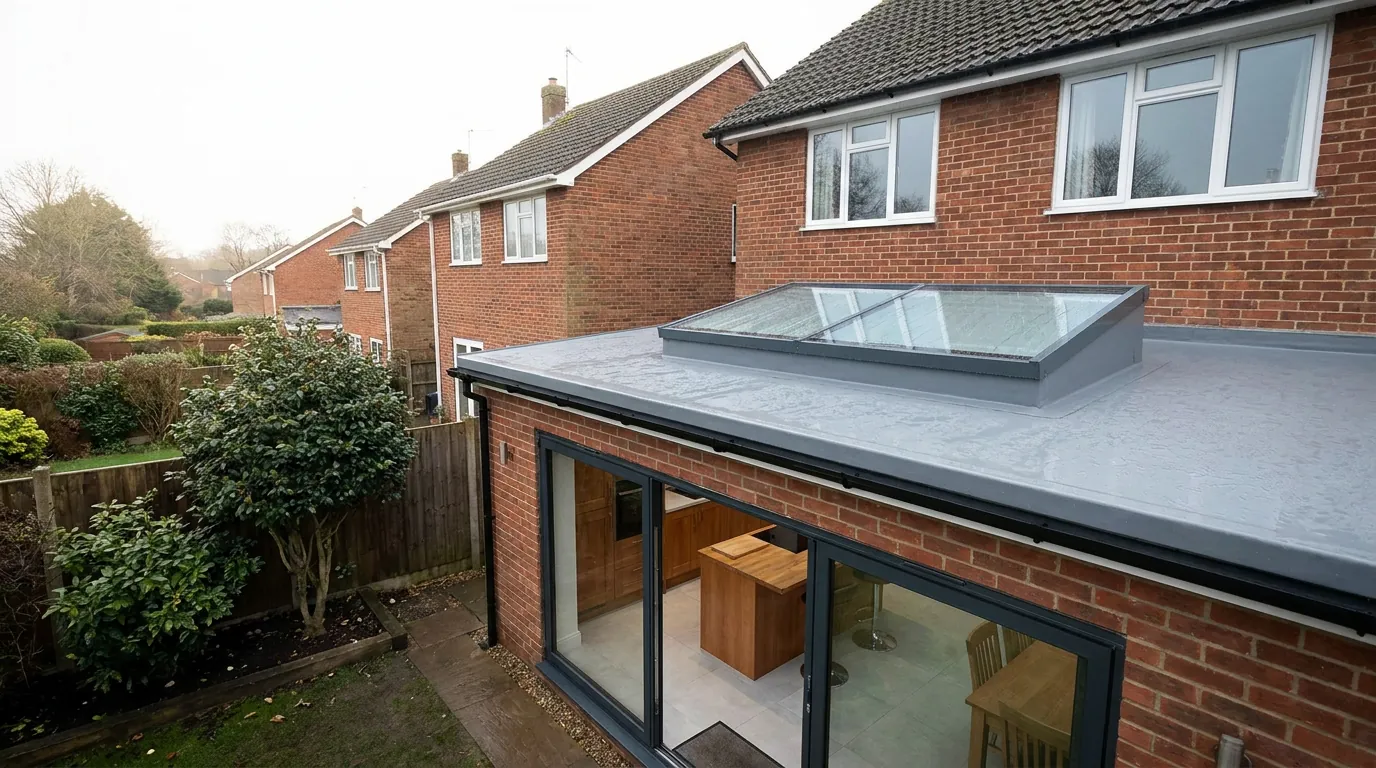
Flat roofs are where the season bites hardest. Replacing a flat rooflight or a lantern usually means cutting the roof covering back around the kerb and making it good again once the new unit is fixed. Whether the roof is felt, a single-ply membrane or glass fibre, that final layer has to bond to a clean, dry surface within the temperature range its maker sets. Our guide to flat rooflight seals that have failed covers what the job involves, and the flat roof rooflight service page covers the kerb and covering in detail.
The rule: a flat roof is only opened on a day when it can be dried, sealed and finished before the weather turns. The exception: where the new rooflight sits on an existing kerb and the covering does not need to be disturbed, the swap is closer to a pitched roof job and a cold day is far less of an obstacle.
Dew is the hidden problem. On a clear winter night a flat roof can be soaking by morning with no rain at all, and it may not dry until late morning, if at all. That shortens the working day more than the clock suggests, which is why flat roof replacements in the darkest months are often planned for a settled spell rather than a fixed date.
Wind, ladders and scaffold
Wind is the weather factor people forget. A rooflight pane is a large, flat, heavy sheet, and carrying one up a ladder or across a roof in a gust is not something any sensible installer does. On two-storey estate houses around Basingstoke a roof window can often be changed from inside, but the external flashing still needs safe access, and that means a tower or scaffold on the higher or steeper roofs.
If scaffold is needed, it is booked for a set period, so the fitting date and the scaffold date are tied together. A good forecast window matters twice: once for putting the scaffold up safely and once for the work itself. On an exposed site, such as a house on the chalk ridges towards Kingsclere or a top-floor flat roof, a windy forecast can move the date even when it is dry.
Short days and closing the roof by dusk
A replacement is planned so the roof is weathertight at the end of every working day. On a summer day there is time in hand. In December, with the light going mid-afternoon, there is much less, and a job that runs long cannot simply carry on into the dark on a wet roof.
That is why winter jobs start as soon as the roof is safe to work on, and why the old unit only comes out once the new one has been checked against the opening. The answer on how long replacing a misted rooflight takes explains what sets the length of the day. If the survey shows the new unit needs a different size of opening, or trimming work, that is planned as a longer job with a proper temporary cover, rather than squeezed into a short winter afternoon.
How a replacement is timed, step by step
Whatever the season, the order that keeps the roof safe is the same.
- Survey first, in any weather. A survey only needs a look at the unit, the roof and the room, so rain or frost does not stop it. It confirms the failure, measures the opening and decides the replacement route.
- Order the unit to the measured size. The new rooflight is ordered and checked on delivery before any date is fixed, so nothing is removed until the right unit is on site.
- Choose a date against the forecast. A pitched roof needs a dry spell for the swap itself; a flat roof needs a dry deck and a temperature the covering can bond at.
- Check again the day before. If the forecast has turned, the date moves. You are told as early as possible, not on the doorstep.
- Protect the room, then open the roof. Floors and furniture are covered, the old unit comes out, the new one goes straight in.
- Close and finish before dusk. Flashing, covering and the inside reveal are completed, and the area is left clean.
Protecting the room below when the weather is marginal
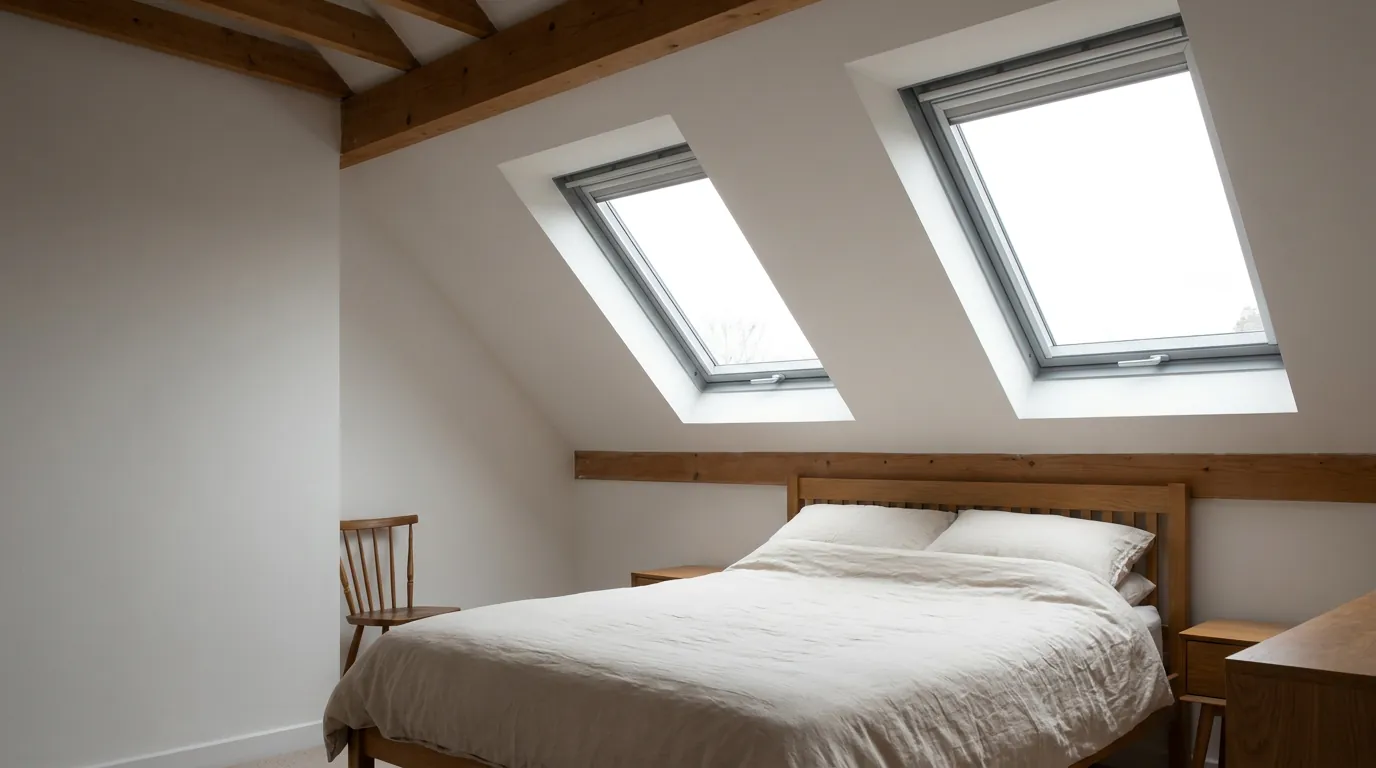
On a showery day the inside of the house is what matters most. Dust sheets go down before anything is loosened, anything that cannot move is covered, and on a loft room the bed and desk are cleared well back from the window. A temporary sheet is ready to go over the opening if a shower arrives while the frame is out.
It also helps to think about the room after the job. A new sealed unit in a cold room can show condensation on the inner pane for the first few mornings, especially in a bathroom or a loft bedroom that has been shut up. That is moisture in the room, not a fault in the new glass, and it settles as the room is heated and aired normally.
Getting ready while you wait for a date
If your failure is one that can wait, the wait is a good time to gather what makes the survey quicker. Note which way the window faces, whether it opens, and whether it has a blind or electric motor. Look for a label on the frame: many roof windows carry the maker and size code on a plate inside the sash. Photograph any marks on the reveal after rain. Our answer on what to check on an old rooflight before a survey has the full list.
Also think about whether you only want the glass changed or the whole unit. On a roof window with a sound frame a new sealed unit may be enough, which is a shorter job with less weather exposure. On an older skylight with tired flashing, a whole new unit is usually the better answer. The guide on sealed unit or whole rooflight helps you weigh that.
Paperwork and the guarantee, whatever the month
Seasons change the date, not the standard. Where a replacement is notifiable, for example because the new unit is not a straight swap, we deal with the Building Control notification ourselves, and our 10-year workmanship guarantee (not insurance backed) covers a February fit exactly as it covers a July one. Every job starts with a survey before any quote is written.
If your rooflight has misted, cracked or started letting water in, ask for a survey date and we will talk through timing with you, or read more about rooflight replacement around Basingstoke and how the roof type shapes the job. The full picture of the failed unit service is on the failed rooflight replacement page.