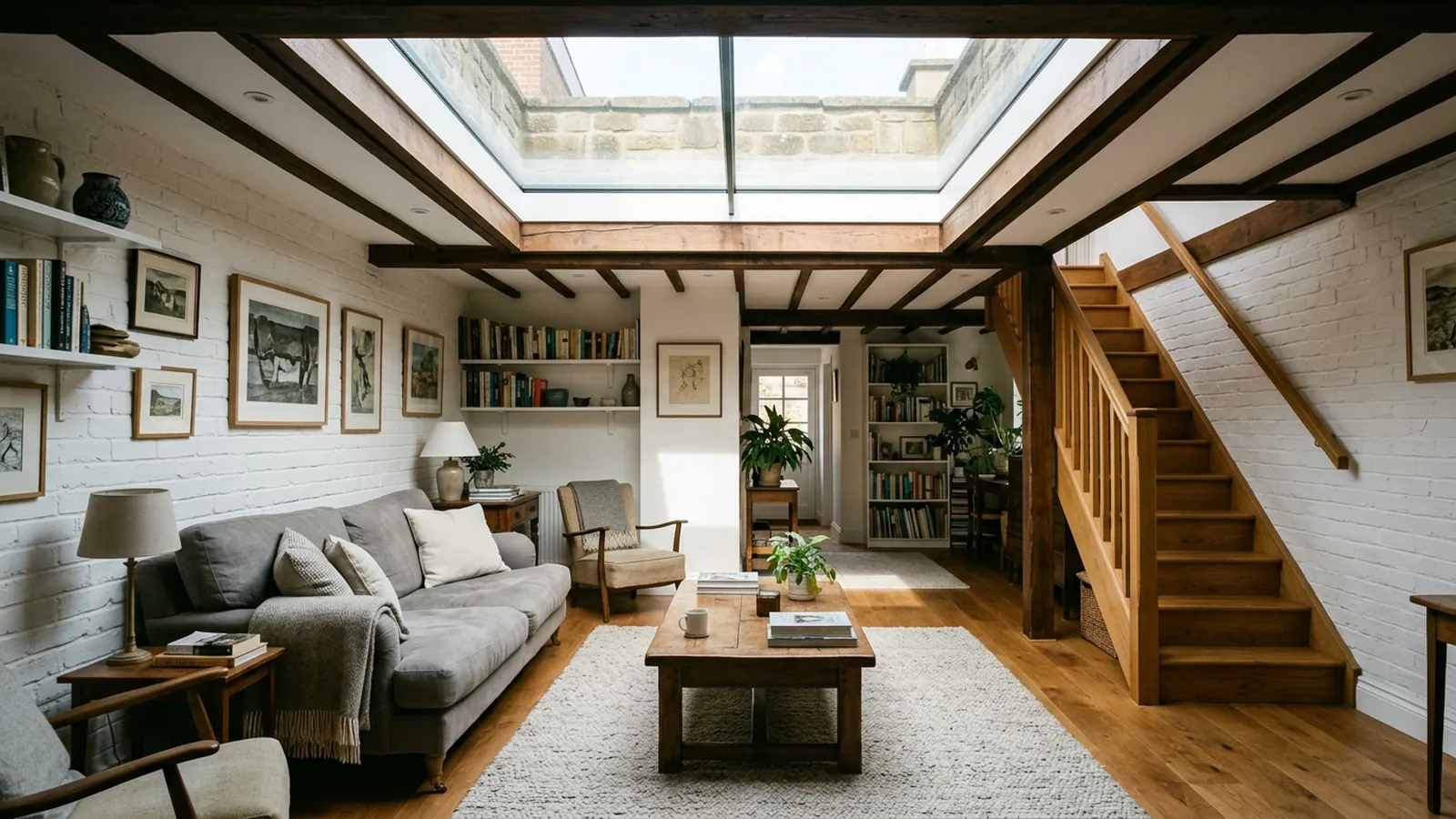
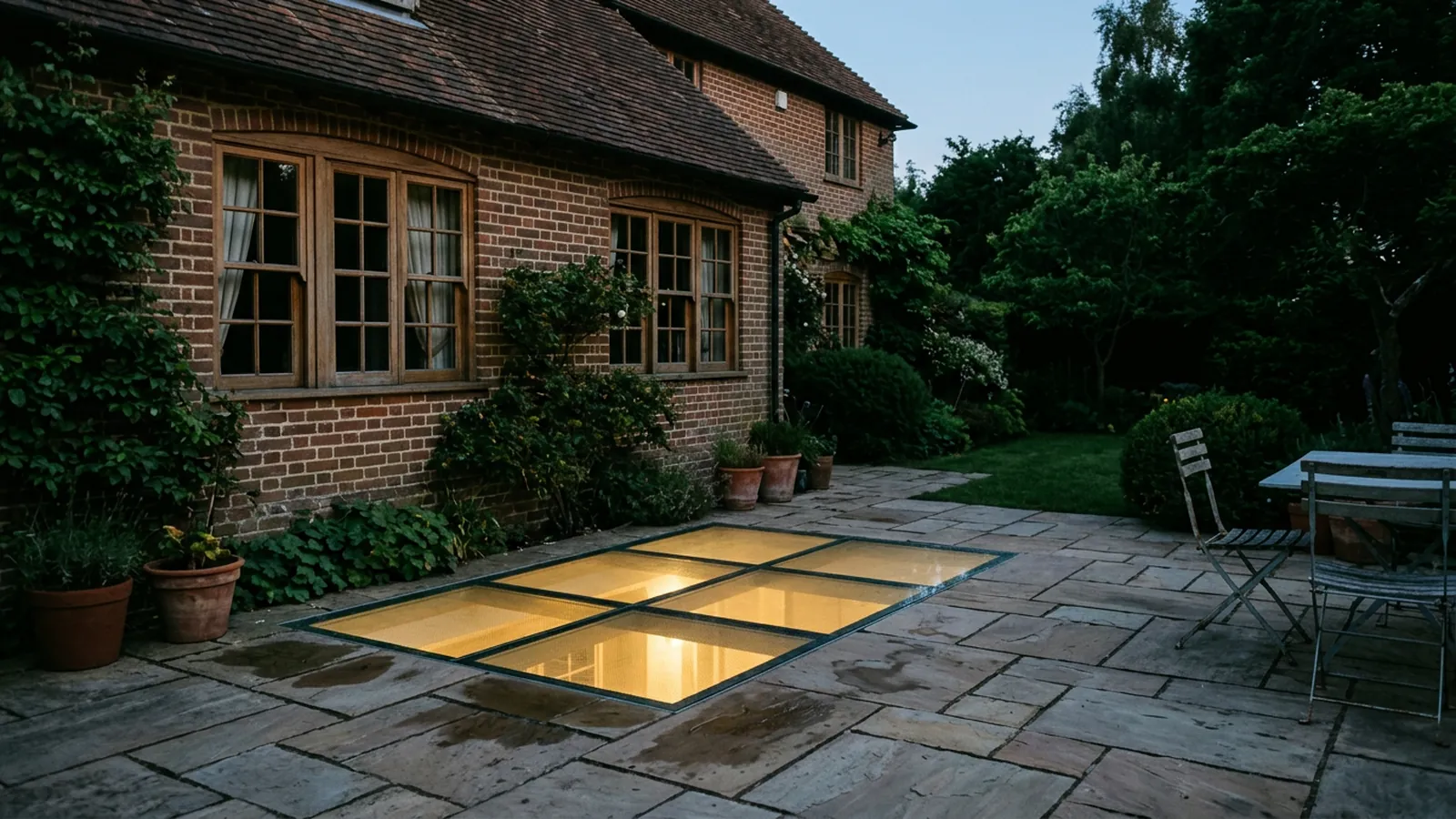
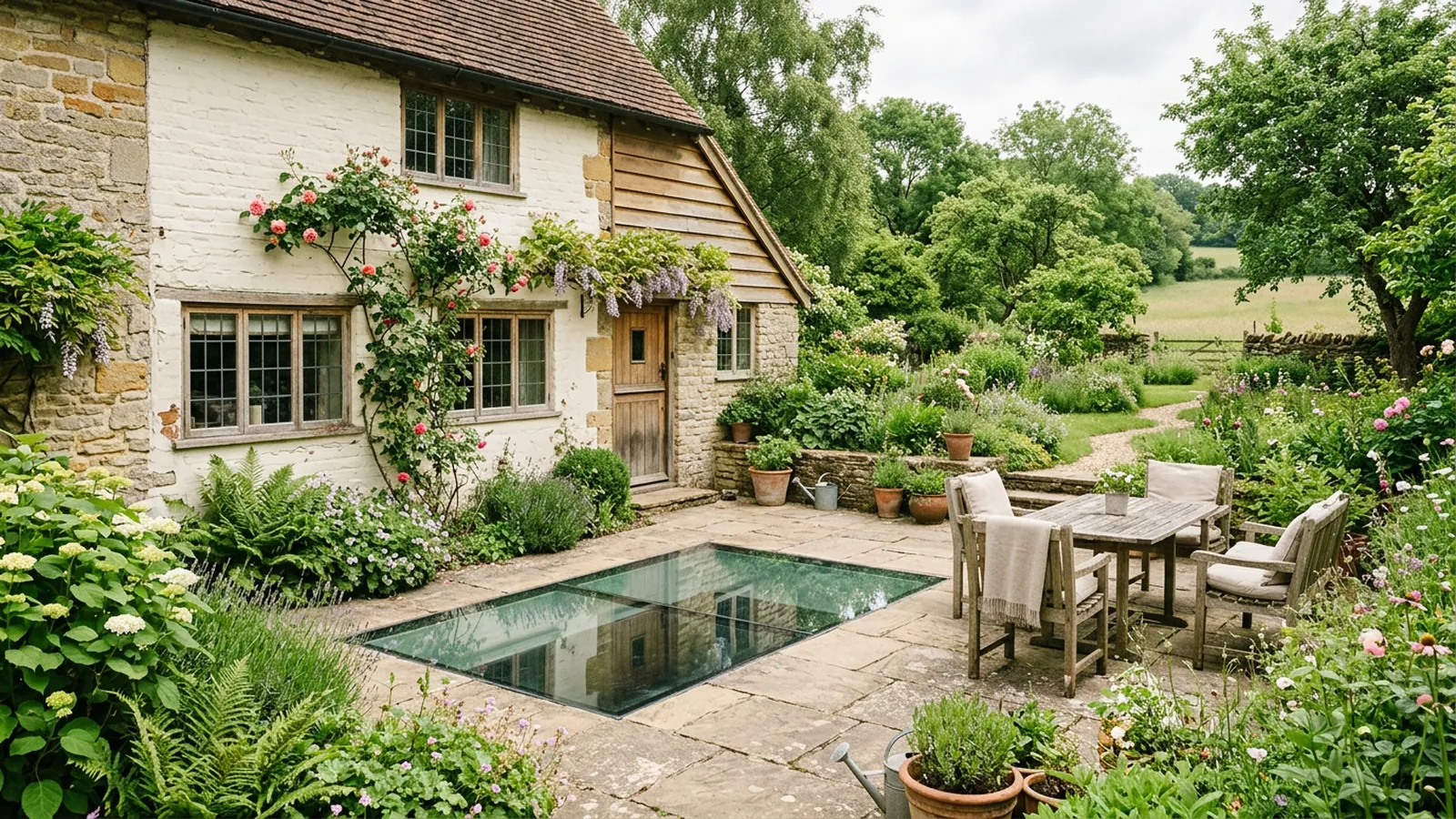
Glass that you walk on starts life as one of the smoothest surfaces in the house. Polished float glass has almost no texture at all, and a film of rain between that surface and a shoe sole behaves a lot like a film of water on a kitchen tile. So every walk-on rooflight, and every glass floor panel indoors, has to answer one practical question before anything else about it is settled: what stops a foot sliding on it when it is wet? This guide looks at the finishes that give walk-on glass its grip, how that grip is tested, what each finish does to the daylight and the view, and how the choice changes between a roof terrace and a hallway floor.
A walk-on skylight is bought for the light it lets down into the room below. The anti-slip finish is the part of the specification that decides whether it is also comfortable to cross on a damp morning, so it deserves the same attention as the load rating and the rest of the walk-on rooflight specification.
Why bare glass loses grip
Slip resistance is simply friction between a sole and a surface. On a dry pane, rubber finds enough contact to hold. Add water and the contact changes: a thin layer of liquid sits between the two, the sole starts to ride on it, and grip falls away sharply. The smoother the surface, the more complete that film can be, which is why a polished pane is at its worst in exactly the conditions a flat roof sees for much of the year.
Texture breaks the film up. Tiny peaks in a treated surface push through the water and give the sole something to bite on, while the valleys between them give the water somewhere to go. Every anti-slip treatment for walk-on glass is a different way of putting those peaks into, or onto, the top face of the pane. The differences between them are about how coarse the texture is, how long it lasts, how much light it takes away and how easy it is to keep clean.
Water is only one contaminant. On an outdoor rooflight you also have fallen leaves, pollen, a green film of algae on a shaded roof, grit carried up on shoes and, in winter, frost. Indoors the list is shorter but not empty: socks, a spilled drink, a dog coming in from the garden. A finish chosen for a terrace in Basingstoke has to cope with the first list; one chosen for a landing floor mainly has to cope with the second.
How a walk-on rooflight sits in a terrace
- Anti-slip fritted top surface, so the glass is safe to walk on when wet
- Laminated glass: several layers bonded with interlayers, so it stays in place if a layer breaks
- Sealed cavity between the laminated glass and the inner pane
- Inner pane, completing the insulated unit
- Frame carrying the glass, sealed at the edges
- Kerb around the opening, bedded to the roof structure
- Waterproofing dressed up the kerb and under the frame
- Paving on pedestals, finished level with the glass
The anti-slip finishes, side by side
Four families of finish are used on walk-on glass. They can look alike in a sample box, so it helps to know what each one is and how it behaves once it is on the roof.
| Finish | How it is made | Effect on light and view | Best suited to |
|---|---|---|---|
| Ceramic frit with grit | A ceramic enamel carrying hard particles is printed on the top face and fired into the glass during toughening | Depends on the pattern: dots or bands leave clear glass between them; full coverage turns the pane translucent | Outdoor terraces and flat roofs where grip in the wet matters most |
| Acid etched | The surface is chemically roughened to a fine, even texture | Diffuses the light and blurs the view, giving a satin look | Indoor glass floors and sheltered positions |
| Sandblasted | The surface is abraded with a fine blasting medium | Obscures more strongly than etching and can mark more readily | Decorative bands and borders more than whole panes |
| Applied anti-slip film or coating | A textured layer bonded to the surface after the glass is made | Varies by product; wears with foot traffic over time | Upgrading an existing indoor panel rather than a new outdoor unit |
For glass that sits outside and takes rain, the fired ceramic finish is the usual choice, because the grit is locked into an enamel that has become part of the glass surface rather than a layer sitting on top of it. Etching gives a softer texture that feels pleasant underfoot and suits an internal floor, where the surface is rarely soaked. Films have their place, but they are a surface layer, and a surface layer on a roof will not last as long as a fired finish.
How slip resistance is tested
Manufacturers publish test results for their anti-slip glass, and those results are the fairest way to compare one product with another. Two tests turn up on data sheets.
The pendulum test swings a rubber slider, shaped and weighted to imitate a heel strike, across the surface, dry and then wet. The energy the slider loses on its way across gives a pendulum test value: the higher the value, the more grip. Because it can be carried out on a finished pane, and even on glass already installed, it is the test most used in the UK, and guidance from the UK Slip Resistance Group sets out how the values relate to the risk of slipping. The ramp test has a person in standard footwear walk on a sample while it is tilted, with oil or water on the surface, until they lose their footing; the angle reached gives a classification. Some products also quote a surface roughness reading, which describes the texture but does not measure grip on its own.
The rule: compare anti-slip glass on its wet pendulum result, taken on the finish you are actually buying. The exception is a sample that has not been tested in the wet at all, which tells you nothing about the conditions a roof terrace lives in, however textured it feels in the hand.
Ask for the test result that matches the finish, pattern and coverage on your drawing. A frit tested at full coverage will not give the same figure as the same frit printed as widely spaced dots, so a result quoted for a different pattern is not your result.
Where the finish sits in the glass
A walk-on rooflight is not a single sheet. Its top is a laminated, toughened walking layer that carries the load, sitting over a sealed insulating unit below. The anti-slip finish goes on the uppermost face of that top ply, the one your shoes touch, and it is applied when that ply is made, before it is laminated and assembled. It cannot be added to the face of a finished unit in the same fired form later, which is why the finish needs deciding at the order stage, not on the day of fitting. The whole stack is described in our guide to the glass build-up in a walk-on rooflight.
Fired frits and etching both change the surface of the glass, and toughened glass cannot be cut or reworked after toughening. That means the size of the unit, the pattern and the finish are fixed together. If a bigger opening is wanted later, it is a new unit, finish and all. It also means the finish carries the same load rating as the pane it is on, with nothing to peel or lift at the edges.
Terrace, balcony or indoor floor
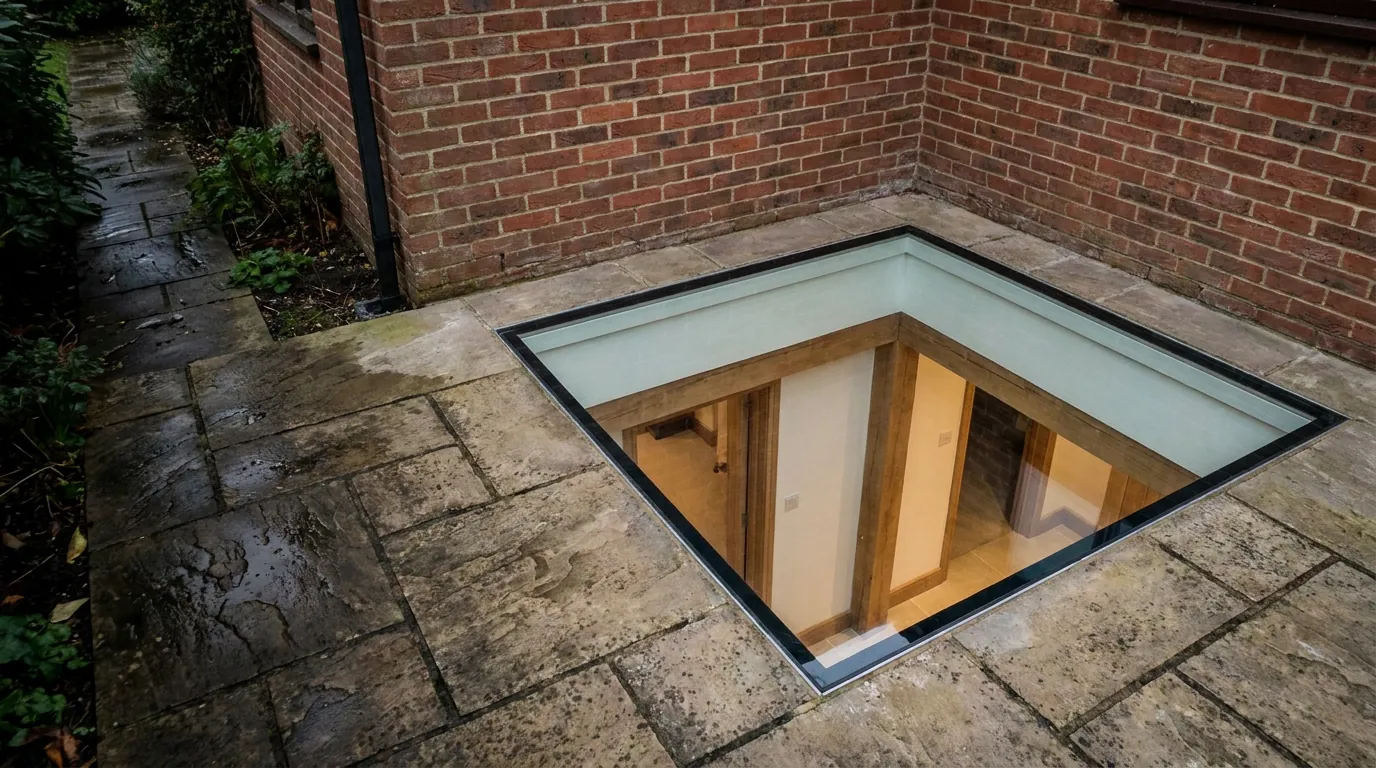
The same question has a different answer depending on where the glass is. A rooflight set into a flat roof that nobody walks on except to clean it needs less grip than one in the middle of a roof terrace used for evening drinks. A panel in a first-floor landing sees socks and slippers, not wet trainers. Matching the finish to the use saves you losing light you did not need to lose.
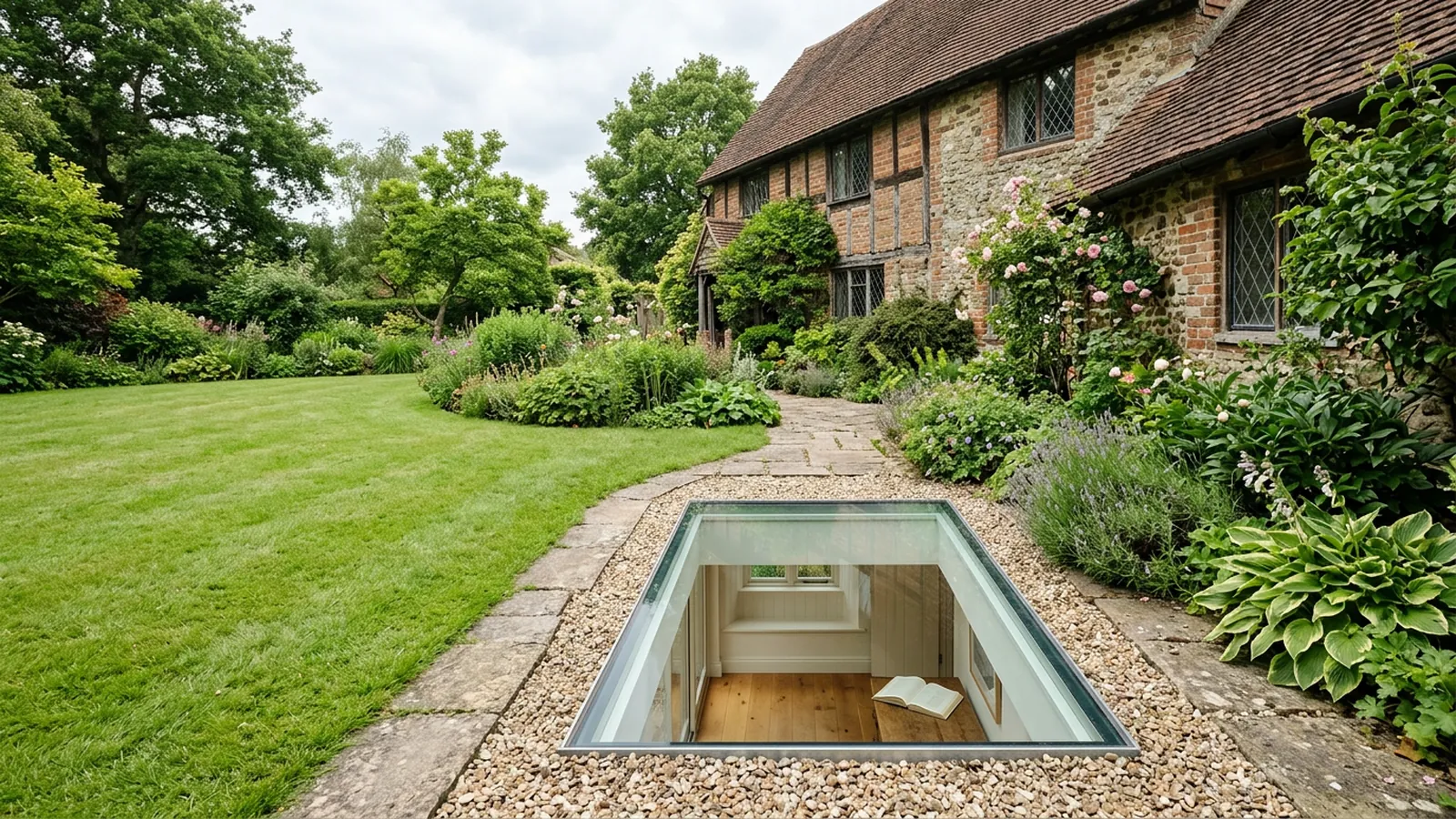
- Roof terrace or balcony. The glass gets rain, leaves and furniture being dragged across it. A fired grit finish across the walking area is the sensible default. Our guide to a walk-on rooflight in a roof terrace or balcony covers the rest of that setting.
- Flat roof with occasional access. Grip still matters for the person cleaning it or reaching a gutter, but a lighter pattern can be enough.
- Indoor glass floor. A fine etched or light frit finish gives a secure feel without the coarse texture an outdoor pane needs. See glass floor panels inside the house for how those are built and supported.
The right anti-slip finish is the one that matches how wet the glass will get and who will be walking on it.
What grip costs in daylight and view
Every texture scatters some of the light that passes through it. That is not always a bad thing: diffused light spreads more evenly across the room below and cuts glare. But a heavy, full-coverage finish will make the room below feel less bright than clear glass would, and it removes the view of the sky that makes a walk-on skylight feel special from underneath.
Pattern is the main lever. A grit frit printed as dots, lines or a border leaves clear glass in between, so you keep much of the light and a broken view, while the feet still meet texture with every step. Full coverage gives the most even grip and the most privacy, at the cost of a translucent rather than transparent pane. For how much of the daylight a walk-on unit passes to the room in the first place, see how much daylight does a walk-on rooflight give the room below?
If you also want to stop people on the terrace looking into the room, the grip and the privacy can be solved with the same frit. Our guide to privacy and obscured glass in walk-on rooflights goes through that trade, and the short answer on patterns and colours is in can walk-on glass be fritted or patterned?
Water on the glass: the detail that helps the finish
No finish can do its best under a standing pool. How the rooflight meets the surrounding roof decides whether rain runs off the glass or lingers on it. A unit set flush with paving or decking needs the roof and the frame laid to a fall so water clears, and an outlet or channel close by so it has somewhere to go. An upstand unit sheds water off its edges but is a step up rather than part of the floor. The two approaches are compared in flush or upstand: how a walk-on rooflight meets the roof.
Shade matters too. A pane on a north-facing terrace, or under an overhanging tree, dries slowly and is the first place algae will take hold. On that kind of roof, the grip you get from the finish depends on the glass being kept clear of green growth, so choose a finish you will find easy to clean. The direct answer to the wet-weather question on its own, without the detail here, is in is walk-on glass slippery when wet?
Keeping an anti-slip finish working
Texture that grips shoes also holds dirt. A gritted or etched surface collects fine grime in its valleys faster than smooth glass, and that grime slowly flattens the texture and dulls the look. Regular washing with water and a soft brush lifts it out; abrasive pads and scouring powders should be kept away, because they wear the very peaks that give the grip. Detergents that leave a greasy film are best avoided for the same reason.
- Brush off loose debris. Leaves, grit and pollen come off first, dry, so they are not ground into the surface.
- Wash with clean water. Use a soft brush worked across the texture, in more than one direction, to lift dirt out of the pattern.
- Treat green growth early. On shaded glass, deal with algae while it is a thin film, using a product suited to glass and the surrounding roof.
- Rinse and let it drain. Leave nothing on the surface that could dry into a slippery residue.
Our answer on how do you keep walk-on glass clean? covers the routine for the whole unit, and does walk-on glass scratch? explains what grit on shoes does to glass over the years.
Children, pets and everyday use
Families often ask about slip resistance with small feet in mind. The finish helps, but the setting counts as much: a flush pane with a clear edge detail and no lip to trip on, glass that drains, and a surface kept clean. For pets, a textured top also stops claws skating across the glass and makes the pane feel less like a hole in the floor to an animal that is wary of it. The wider safety question, including load and edge protection, is taken on in are walk-on rooflights safe for children and pets?
Settling the finish before the glass is ordered
Because the finish is fired into the top ply when it is made, the decision belongs at the survey and the quote, not after delivery. At the survey we look at how the glass will be used, which way it faces, what overhangs it and how water will leave it, then specify a finish and a pattern to suit, with the manufacturer's wet test result for that exact finish. The written quote names it, so you know what is going on your roof before anything is made.
The finish is one line in a longer specification that also covers the load rating, the support and the weathering, all of which are set out on our walk-on rooflight installation page, together with how the notifiable part of the work goes through Building Control. The fitting itself is covered by our 10-year workmanship guarantee, which is not insurance backed. If you are weighing up a glass terrace, a landing floor or a flat roof you can step onto, arrange a survey and we will match the grip to how the glass will be used.