That is the whole answer in brief, and it holds on a single-storey kitchen extension in Brighton Hill just as it does on a garage roof in Chineham. Our flat roof rooflight installation service treats the kerb as part of the rooflight, specified with it, because the glass is only as dry as the frame it sits on.
What follows explains why the kerb exists, which version suits which roof, and the few cases where a skylight arrives with the kerb already built in, so it may look as if there is none.
What the kerb is doing up there
A flat roof is never truly flat. It is laid to a gentle fall so rain drains towards a gutter or outlet, and in a heavy downpour a thin sheet of water moves across the whole surface. Set a glazed unit level with that surface and its edges sit in the flow. Lift it on a kerb and the water passes around the base instead of over the joint between frame and roof.
The kerb also gives the waterproofing somewhere to stop. Felt, GRP and EPDM are all dressed up the outside face of the kerb and finished under the rooflight frame, so the lap faces downhill and water has nothing to climb. Without that upturn the membrane would have to be sealed flat against a frame edge, which is the weakest joint any flat roof can have.
The rule: the rooflight frame sits on top of the kerb and the roof covering turns up its sides. The exception is a unit with an integral kerb moulded into the frame, where the maker's upstand does the same job and the membrane dresses up that instead.
Flat rooflight on an insulated upstand
- Double glazed rooflight, set to a slight fall so rain runs off the glass
- Upstand (kerb): a timber kerb with insulation on its outer face
- Membrane dressed up the upstand and over the top, sealed under the rooflight frame
- Waterproof membrane covering the roof, falling towards the gutter outlet
- Insulation laid over the deck, keeping the structure warm
- Roof deck on tapered firrings, which create the fall
- Joists, trimmed around the opening with trimmer joists
- Plasterboard reveal lining the opening, meeting the ceiling below
Timber upstand or factory kerb
Both routes end in the same shape: a raised, insulated collar around the opening with the glass on top. They differ in who makes it and how it is finished.
| Point | Timber upstand | Factory kerb |
|---|---|---|
| Made where | Built on the roof from treated timber around the opening | Made by the rooflight maker to match the unit |
| Suits | Openings of any size, and roofs being re-covered at the same time | Standard sizes, and quick fitting to a known opening |
| Insulation | Added on site inside and around the timber | Usually built into the kerb from the factory |
| Tilt for the glass | Can be cut to a fall along its length | Often supplied with the slope already formed |
Which suits your roof, and how each one is detailed at the corners, is laid out in our guide to choosing a timber upstand or factory kerb.
How the kerb gives the glass its fall
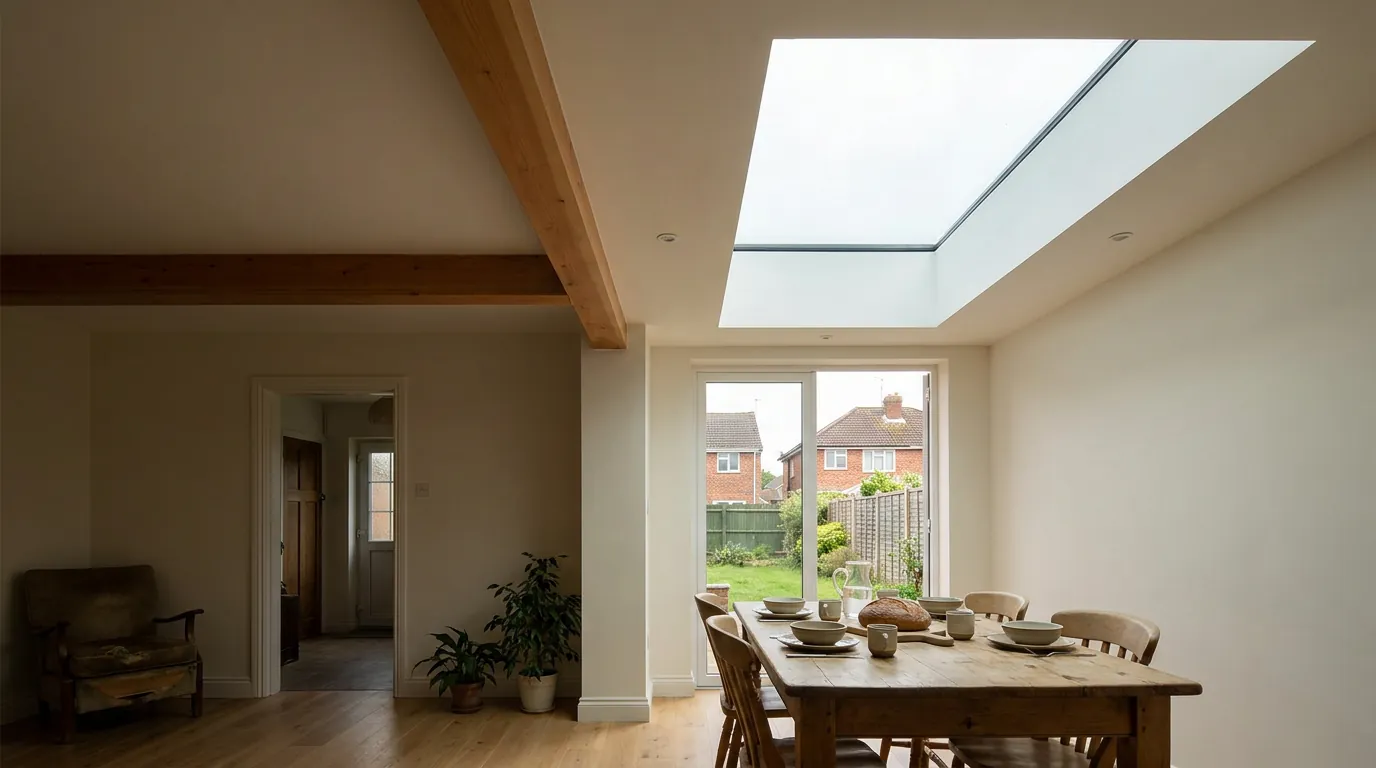
Rain that lands on dead-level glass stays there, leaves marks as it dries, and never quite clears. Flat rooflights are therefore set with a slight slope, and the kerb is usually what provides it: one side a little taller than the other, or a unit whose frame is shaped to tilt. The exact angle is set by the maker, and our answer on the minimum pitch for a flat rooflight gives the short version. If you already have a skylight where water gathers in a pool, why water sits on a flat rooflight explains what is usually behind it.
Height, warmth and the view from below
Kerb height is a balance. Tall enough to keep the frame out of standing and running water and to leave room for the membrane upturn; not so tall that the rooflight looks perched on the roof from an upstairs window next door. The rooflight maker states a minimum height above the finished roof surface, and the kerb is built to that figure measured from the top of the covering, not from the deck.
The kerb is also a gap in the roof insulation. Heat escapes through its sides unless they are insulated as carefully as the roof itself, and a cold kerb is where condensation forms inside the room. Our guide to insulation at the kerb covers where that cold line runs. From the room below, the kerb shows as a short lined shaft between ceiling and glass, which can be finished square or splayed to spread the daylight wider.
Does the roof covering change the answer?
No. Felt, GRP and EPDM each need an upturn, and each is dressed up the kerb in its own way: felt in layers with a capping sheet, GRP laminated up the face in one piece, EPDM folded and bonded with its own corner detail. The kerb is constant; only the finish around it varies. For older mineral felt roofs on 1970s estate extensions, our answer to whether a flat rooflight can go on a felt roof covers when the covering is sound enough to take one.
- Survey. We look at the roof build-up, the fall, the joist direction and the state of the covering before we price anything.
- Opening and kerb. The opening is trimmed between joists and the kerb is fixed around it, level or to its designed slope.
- Covering. The membrane is dressed up the kerb faces and finished under the frame line.
- Rooflight and lining. The unit is fixed down, the inside of the shaft is insulated and lined, and the room is left clean.
What this means for your extension
If a rooflight is being added to a flat roof you already have, the kerb is built into the existing covering and that covering is made good in the same material around it. If the roof is being re-laid at the same time, the kerb goes in first and the new covering is laid up to it in one go, which makes for the neatest detail. Either way, the kerb is part of the price rather than an extra added later, and the written quote shows it as its own line.
The installation is backed by a 10-year workmanship guarantee (not insurance backed), and where the job counts as notifiable building work the Building Control notification is dealt with as part of it. If you would rather see what your own roof needs before deciding, arrange a survey of the flat roof and we will measure the kerb against the unit you have in mind.