A bedroom asks something different of the roof than a kitchen or a landing does. You spend the dark hours there, so the questions are about blackout, warmth, noise and air as much as brightness. For the wider picture of how we plan any new opening in the roofs around Basingstoke, start from our skylight and rooflight installation page; this answer keeps to the bedroom.
Below are the points that decide whether a skylight bedroom works well: where the window sits, how it is darkened, what happens in July and in January, and the extra rule that applies when the bedroom is in a new loft conversion.
Why bedrooms suit a roof window
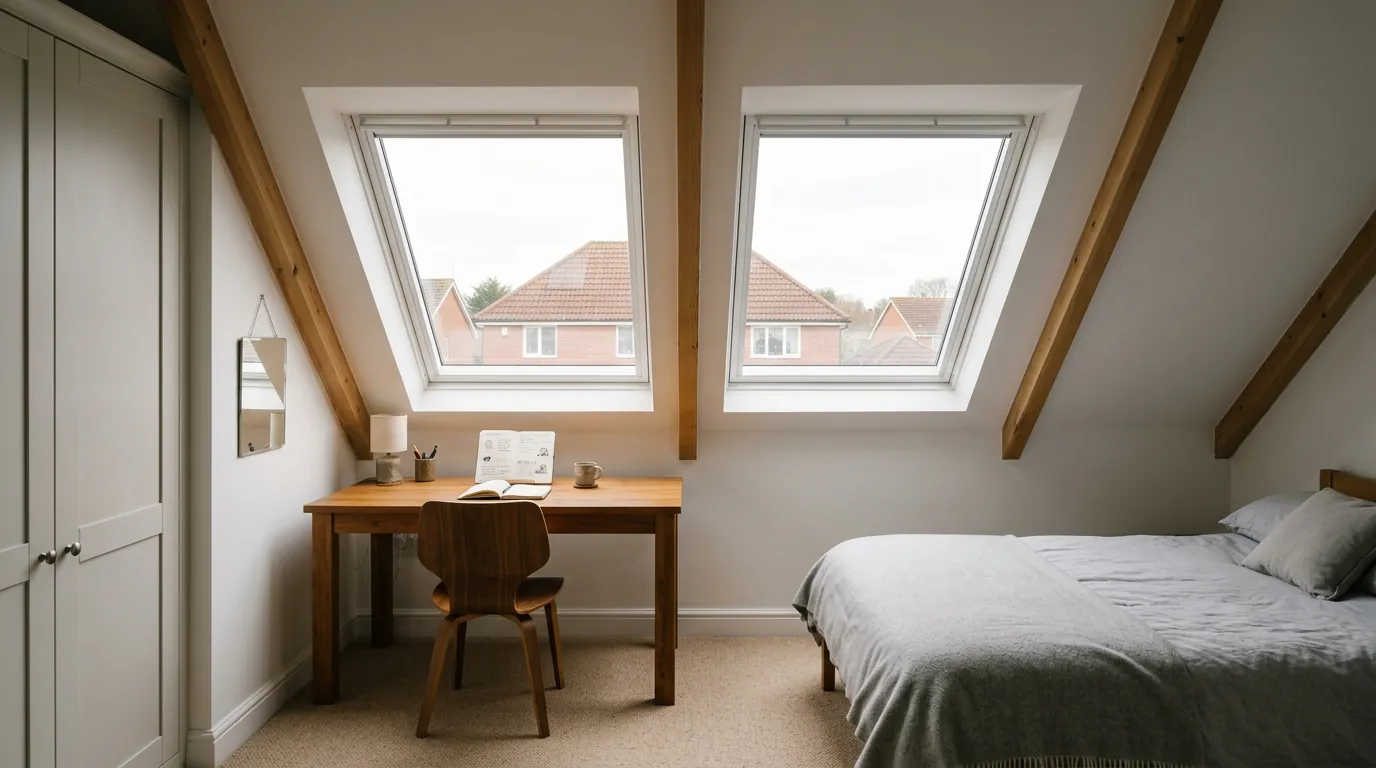
Light from above reaches further into a room than light from a wall of the same size, and it falls evenly. In a sloping loft bedroom, or a back bedroom that only gets a small gable window, that can change how the room feels when you wake and dress. An opening roof window also lets warm air escape from the highest point, where it gathers, which is exactly what a stuffy upstairs room needs on a summer evening.
Privacy is another quiet benefit. A rooflight in a pitched roof looks at sky, not at the house opposite, so a bedroom on a close estate layout can have daylight without net curtains. On the trussed roofs of 1970s and 1980s estate houses the window is usually sized to sit between two trusses; the house-by-house skylight guide sets out what that means for a semi, a townhouse or a chalet bungalow.
Sizing a roof window to the truss bays
- Fink trussed rafter, factory made and designed to work as one whole frame
- W-shaped webs, joined at every node by pressed metal nail plates
- Tile covering on battens over the underlay
- Roof window set in the slope, fitted between trusses so the frame is untouched
- Narrow roof window sitting in the bay between two trusses
- Trusses at even 600mm centres along the roof
- No truss cut: the trusses either side of the window stay whole
- A wider window crosses a truss, so the cut needs designed trimming from an engineer or the truss maker
Where to put it in the room
Position matters more in a bedroom than anywhere else in the house. A few principles make the difference:
- Keep the window off the line directly above the pillow, so the first light of the day is not straight on your face.
- Set it where you can reach the handle and blind from a standing position, or specify an electric or remote-operated unit if the slope is high.
- Place it where the view out works: seated on the bed, a taller window lower in the slope gives sky and treetops rather than only cloud.
- Think about the wardrobe and the bed wall before the opening is fixed, since a roof window takes a bay of the slope that furniture cannot use.
Our answer on where the best place for a skylight is covers position in any room; for a bedroom, the placement rule is simply to plan the furniture first and the window second.
Blackout, glare and early mornings
A summer dawn comes through an unshaded roof window well before most alarms go off. The answer is a blackout blind made for the exact window, running in side channels so light cannot creep round the edges. Fitted at the same visit, it is part of the job rather than an afterthought. Combination blinds that pair blackout with a pleated or venetian layer let you have soft daylight in the afternoon and full darkness at night.
The rule: in a bedroom, order the blackout blind with the window. The exception is a spare room used only for daytime study, where a light-filtering blind may be enough. For brightness during the day, our answer on whether skylights let in too much glare goes further.
Summer heat and winter warmth
An upstairs bedroom under a south or west slope can warm up on a still afternoon. Three choices help: solar control glazing that reflects some of the heat, an external awning blind that stops the sun before it reaches the glass, and an opening sash so the room can be aired before bed. A north-facing slope gives steadier, cooler light and is often the easiest bedroom choice of all.
In winter, a modern double or triple glazed unit with a warm-edge spacer and a properly insulated lining around the frame keeps the room comfortable. Cold spots are almost always about the reveal and insulation around the window rather than the glass, which is why the lining detail is agreed at survey. Our answer on whether skylights make a room cold explains that in more depth.
Noise, rain and fresh air
Rain on a roof window is a sound some people love and others lie awake to. Units with laminated inner panes and certain glazing make-ups are quieter, and an internal blind softens it further. It is worth saying at survey if you are a light sleeper, so the glazing is chosen with that in mind.
For air, a roof window with a ventilation flap lets a small, secure trickle of fresh air in with the sash closed, which helps with the moisture two people produce overnight. Rain-sensing electric windows close themselves when the weather turns, useful if you like to sleep with the window open. Our electric and opening rooflight service covers those units.
Loft conversion bedrooms and escape
When the bedroom is part of a new loft conversion, the Building Regulations fire safety guidance, Approved Document B, comes into play. Depending on how the stair is arranged, a habitable room in the roof may need an escape window, and a roof window can serve that purpose if it meets the minimum clear opening size and sits within the set height from the floor and the eaves. Escape-rated roof windows are made for this job, with a hinge that swings the sash well clear.
- Check the stair. The conversion design shows whether escape relies on a protected stair or on windows.
- Size the opening. The window chosen must meet the escape opening and height rules for that room.
- Notify. The work is part of the Building Control process for the conversion, and Everlight takes care of the notification for its part.
Our guide to what happens at a rooflight survey shows how the survey settles the height, pitch and truss spacing that decide which window can do this.
So, is it a good idea?
For most bedrooms, yes. The rooms that work best have the window set to one side of the bed, a blackout blind from the first day, glazing chosen for the direction the slope faces, and a way to let air through at night. The rooms that disappoint are the ones where the biggest window was fitted over the bed with nothing to darken it.
If you are weighing a roof window for your own bedroom, arrange a roof survey: we measure the slope and the timbers, talk through blinds and glazing, and give a written quote. Work is covered by a 10-year workmanship guarantee.