It is an easy thing to mix up, because a laminated pane is thicker and feels more substantial, and thicker sounds warmer. Our energy efficient rooflights page covers how a whole unit is put together for heat; this answer deals only with the laminated layer and what it does and does not change.
Why the inner pane of a rooflight is laminated
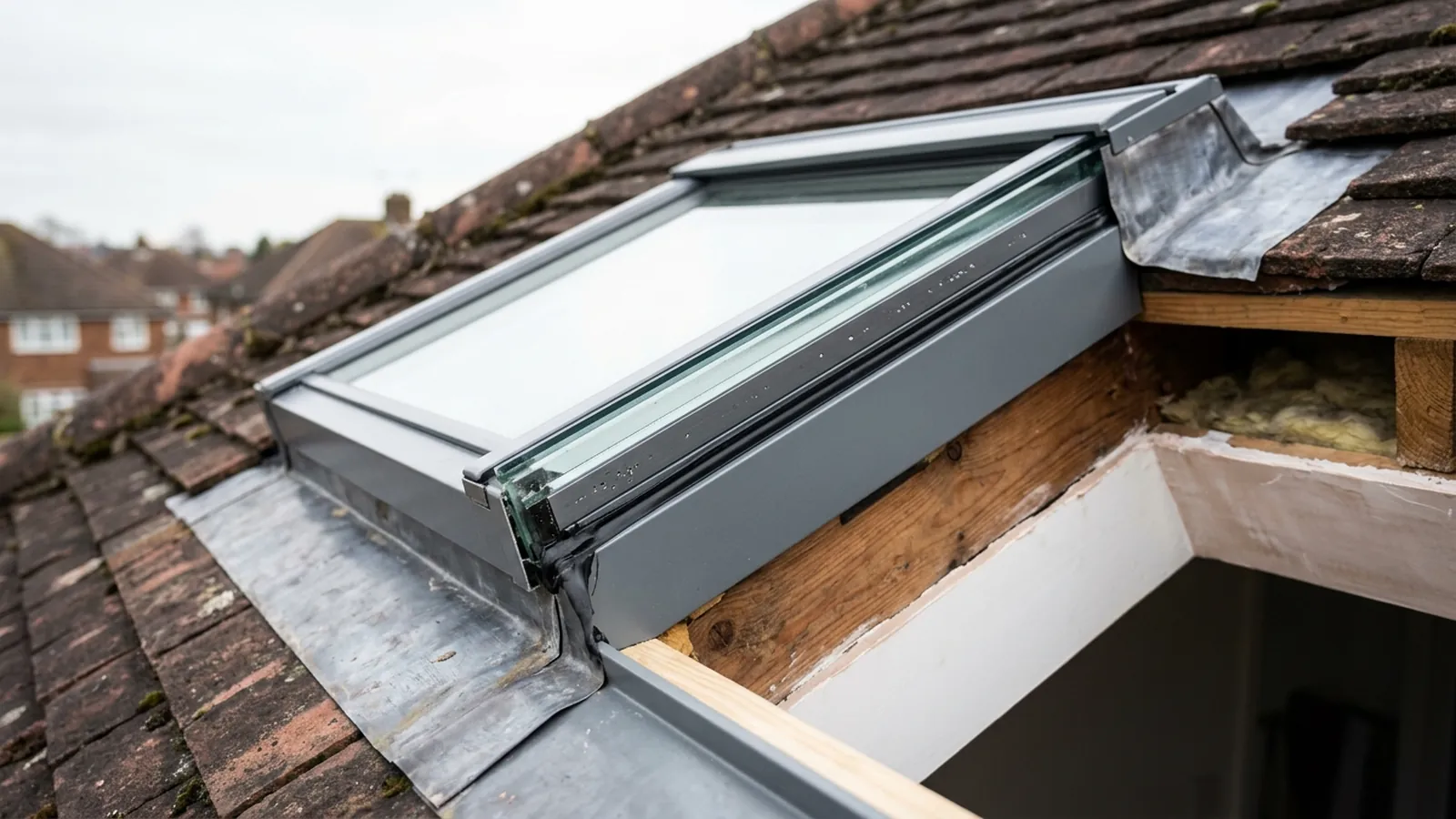
A skylight sits above your head. If a wall window cracks, the glass tends to drop outside or onto a sill; if overhead glass cracks, gravity brings it down onto whoever is underneath. That is why roof window and flat rooflight makers commonly fit a laminated pane on the inside of the unit, facing the room, and a toughened pane on the outside, facing the weather.
The interlayer is usually PVB, a clear polymer film pressed between two sheets of glass under heat. When the glass takes a blow, it cracks in a spider pattern but the film keeps the fragments bonded, so the pane stays in the frame. On a landing in a Brighton Hill semi, above a staircase, or over a kitchen table under a flat roof extension, that is the property you want from the glass nearest your family.
The rule: treat laminated glass as a safety specification and judge warmth from the unit's published U-value. The exception is an acoustic laminate, where the interlayer is chosen to damp sound; it changes how the room sounds under rain, not how much heat escapes.
How a sealed rooflight unit works and fails
- Outer and inner glass panes, with the outer pane facing the weather
- Low-emissivity coating on one inner face, reflecting heat back into the room
- Warm-edge spacer bar holding the panes apart, filled with desiccant to soak up trace moisture
- Primary seal against each pane, backed by the secondary seal around the edge
- Dry sealed cavity, the insulating layer between the panes
- Broken edge seal: moist air gets in and the desiccant becomes saturated
- Mist and droplets trapped between the panes; they cannot be wiped off and the sealed unit needs replacing
- Inset: condensation on the room-side face of the glass is a ventilation or humidity issue, not a failed unit
What actually decides how warm the rooflight keeps the room
Heat leaves through glass mainly by radiation and by conduction across the cavity. Glass itself is a fairly good conductor, so adding a few millimetres of it, with or without a film in the middle, does little. The layers that slow heat down are the ones inside and on the surface of the unit.
| Part of the unit | Main job | Effect on warmth |
|---|---|---|
| Laminated inner pane | Holds broken glass in place above the room | Very small; the film adds little resistance to heat flow |
| Low-e coating | Reflects radiant heat back towards the room | Large; one of the main reasons modern units beat old ones |
| Gas-filled cavity | Slows conduction and convection between panes | Large; argon or krypton does better than air |
| Warm edge spacer | Separates the panes at the perimeter | Moderate; keeps the glass edge warmer and cuts edge condensation |
| Third pane | Adds a second cavity | Noticeable, at the cost of weight and some light |
So when two units list the same U-value, one with a laminated inner pane and one without, they perform the same for heat. The number on the specification sheet already includes whatever tiny part the laminate plays. If you want to read those figures with confidence, our guide to rooflight U-values explained in plain terms walks through them, and the coatings that do most of the work are covered in solar control and low-e coatings.
Where laminated glass does change how a room feels
A laminate does not keep a room warmer, but it can make a room under a rooflight more comfortable in other ways, and those are worth knowing when you compare options.
- Rain noise. Rain on overhead glass is louder than rain on a wall window. The interlayer damps vibration, and acoustic grades are made for exactly this, which matters most in a loft bedroom.
- Fading. The PVB film filters most ultraviolet light, which helps slow fading of floors, rugs and furniture sitting in direct sun under the glass.
- Security. A laminated pane is harder to get through once cracked, which is a sensible property for a flat rooflight over a single storey extension that can be reached from outside.
None of these show up in a U-value, and none of them make the rooflight warmer. They are reasons to value the laminate for what it is.
Does a thicker laminated unit count for Part L?
A new or replacement rooflight has to meet the thermal standard in Part L of the Building Regulations, and that standard is written as a U-value for the whole window, frame included. A laminated pane neither earns nor loses points on its own. What counts is the tested figure the maker publishes for that unit and that size. Our answer on what U-value a new rooflight should have sets out the target, and where the work is notifiable we take care of telling Building Control, so the paperwork follows the glass you choose.
Glass thickness in general is a separate question from warmth too. A unit can be thick because of a laminate, because of a wide cavity or because it has three panes, and only two of those help with heat. If thickness is what you are weighing, see how thick the glass is in an energy efficient rooflight.
If your old rooflight feels cold, the laminate is rarely the cause
On the 1970s and 1980s estates around Basingstoke, in Oakridge, Lychpit or Popley, an older rooflight that feels cold usually has a failed or dated sealed unit, an air-filled cavity with no low-e coating, or a cold frame and upstand. Swapping to a laminated pane on its own would not change that. Replacing the whole unit with a modern specification does, and the laminate simply comes with it as standard on most overhead glazing.
If you are torn between spending more on the glass itself, the answer on whether triple glazing is worth it in a rooflight is a better place to put your thinking. And if the concern is a whole loft room rather than one window, do rooflights make a loft conversion colder? looks at the room as a system.
What to ask for when you choose the glass
- Ask for the whole-unit U-value. Compare units on that figure, not on pane thickness or on whether one pane is laminated.
- Check the inner pane is laminated. For glass over a bed, a stair or a dining table, that is the safety point, and it is standard on most roof windows.
- Decide on acoustics. For a loft bedroom or a rooflight under trees that drip after rain, ask whether an acoustic laminate is available in that size.
- Match the glass to the aspect. A south-facing slope may want solar control on the outer pane; that choice, not the laminate, decides summer heat.
We look at the room, the slope and the existing opening before we put a price on anything, and the fitting is backed by a 10-year workmanship guarantee (a guarantee from us, not an insurance product). To talk through the glass in your own roof, arrange a survey visit and we will bring the specification sheets with us.