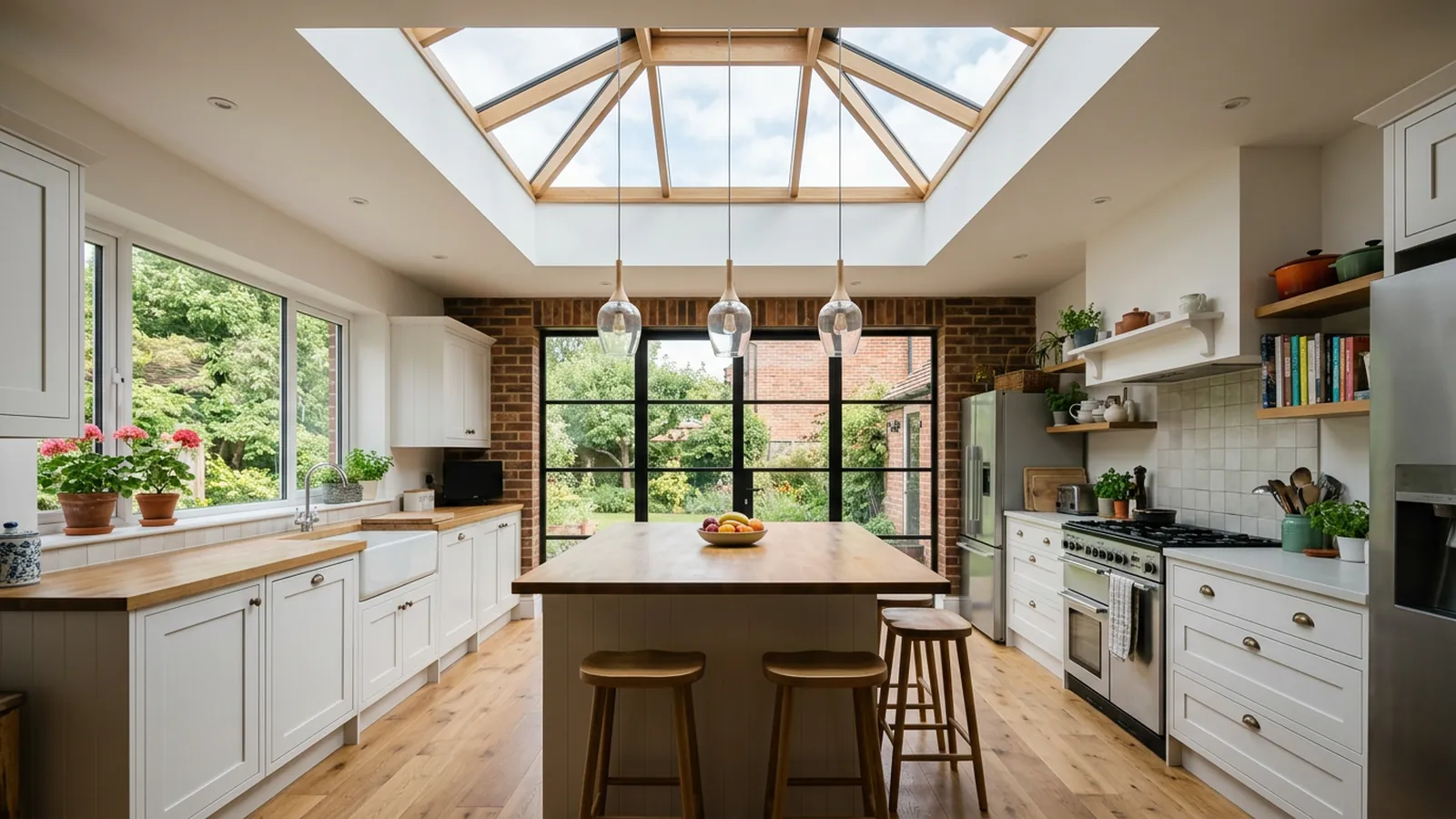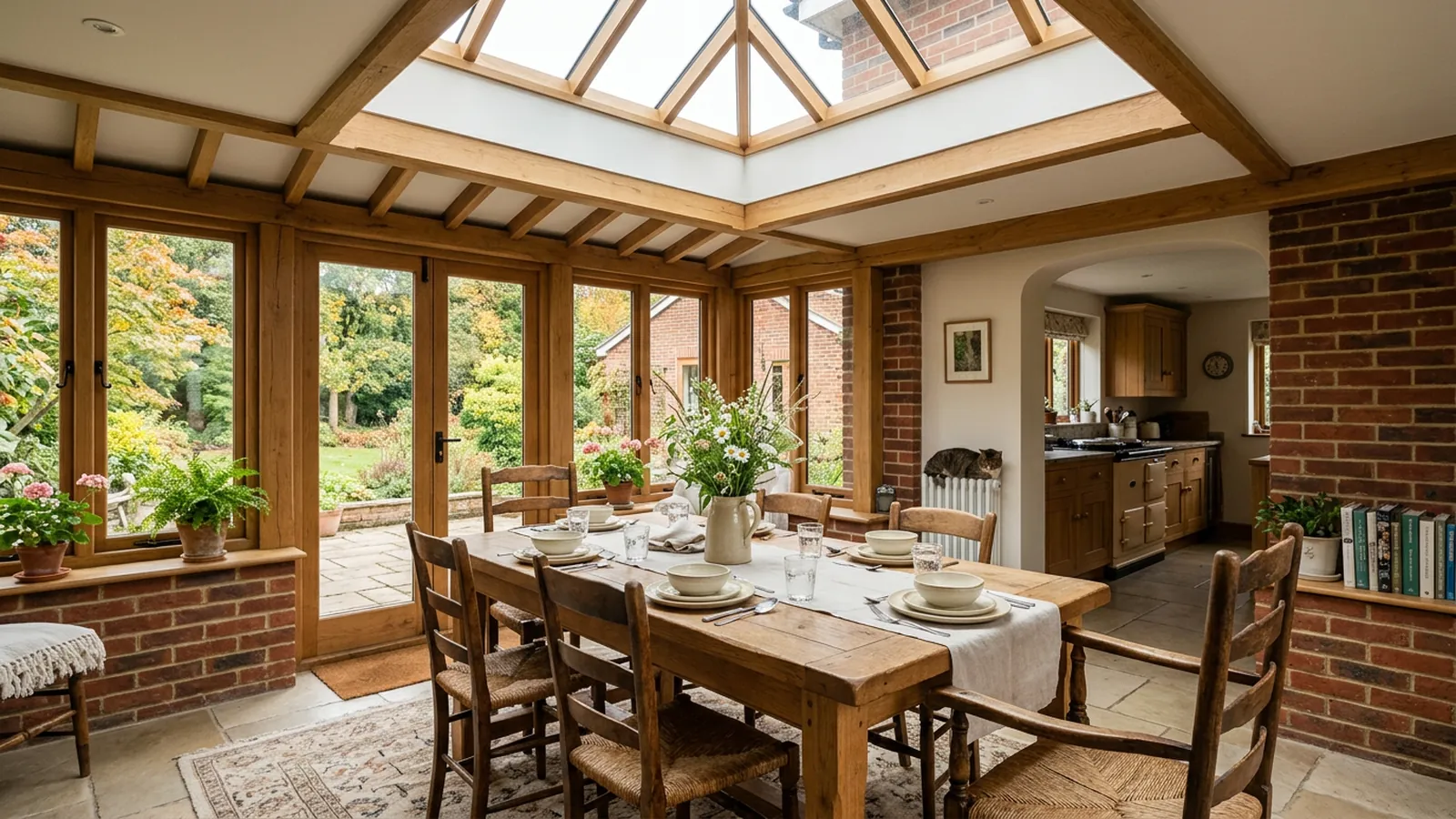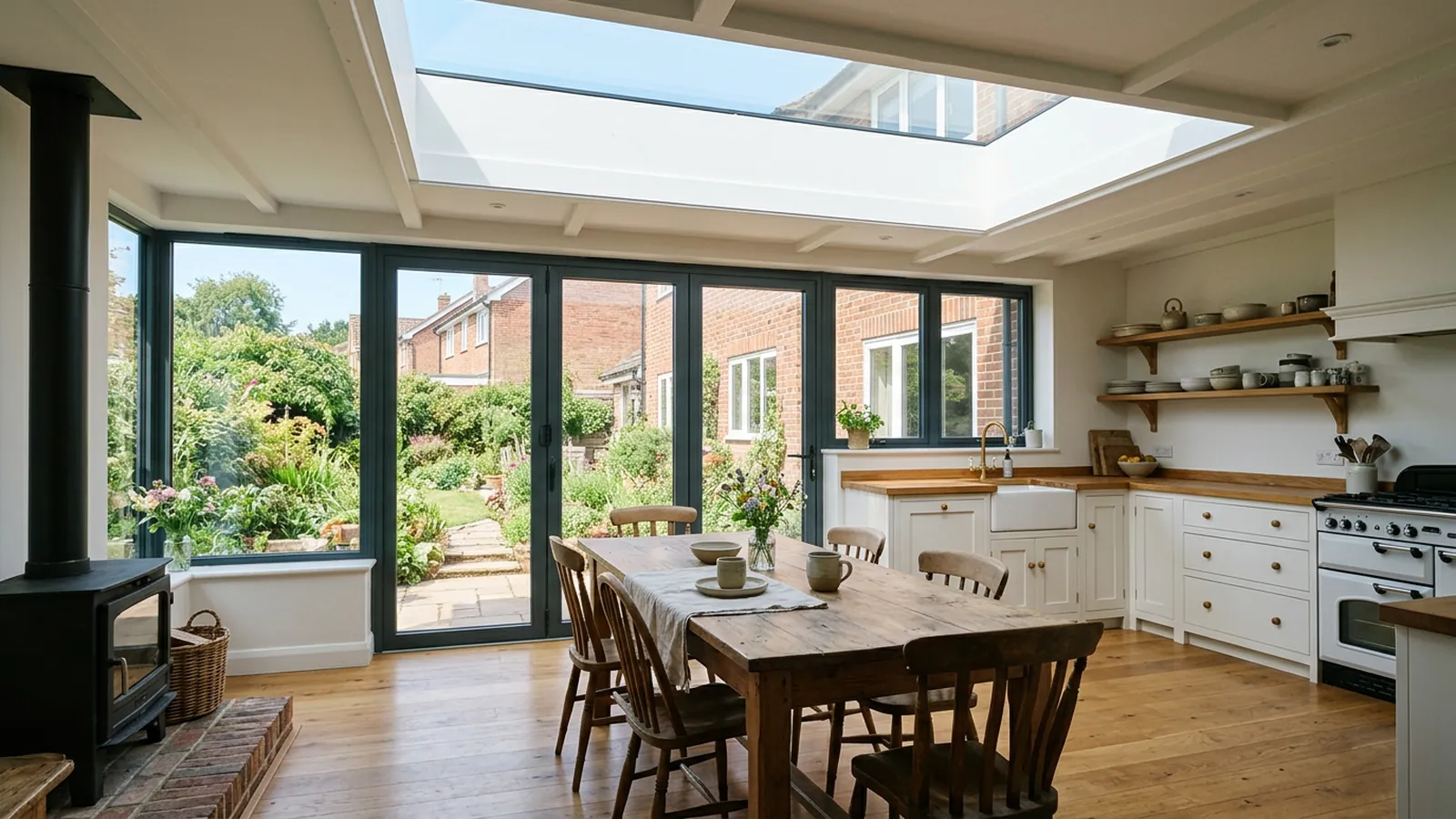
On a bright afternoon in July, a glass roof over a kitchen extension behaves a little like a greenhouse lid. Sunlight comes in at a high angle, lands on the worktops and the floor, turns into warmth and has nowhere quick to go. That is the trade off every roof lantern makes: it brings in far more daylight than a wall window, and with that daylight comes solar heat. Solar control glass is the part of the specification that decides how much of that heat you keep outside.
This guide is about that one decision. It explains what solar control coatings actually do, how they differ from ordinary low emissivity glass, what they change in the look of the room, and where they matter most on the flat roof extensions built onto houses around Basingstoke. For the lantern job as a whole, from survey to fitting, see roof lantern installation.
Why the room under a lantern warms up
A lantern faces the sky, not the horizon. A wall window on a north side sees little direct sun at all, but a glazed roof sees the sun for most of a summer day, from morning to evening, and at midday it sees it almost head on. The glass is also usually the largest single area of glazing in the extension. Put those together and a lantern can admit a lot of solar energy in a short time.
Once sunlight passes through the glass it is absorbed by whatever it lands on: the floor, the island, the sofa. Those surfaces warm up and give that heat back into the room as longer wave radiation, which ordinary glass does not let back out easily. The warm air then rises into the lantern itself, which is the highest point of the room. On a still day with nothing open, the pocket of air in the lantern can feel noticeably warmer than the rest of the kitchen.
None of this means a lantern will make a room unbearable. It means the glass, the ventilation and any shading need to be thought about together at the start, rather than after the first hot spell. The short answer on whether a lantern overheats a room sits on do roof lanterns make a room too hot in summer?; the rest of this page is the detail behind it.
How a roof lantern sits on a flat roof
- Ridge, where the glazing bars meet at the top
- Hip bar, closing each sloped end of the lantern
- Glazing bar, holding the edges of the glass
- Glass panel, sealed double or triple glazed units
- Eaves or perimeter frame, which the whole lantern stands on
- Insulated kerb (upstand), raising the lantern clear of the roof
- Flat roof covering, dressed up the kerb and under the frame
- Plastered reveal, lining the lantern well into the room below
What solar control glass does differently
Every modern lantern is double or triple glazed with sealed units, and almost all of them carry a low emissivity coating on one pane. That coating is about keeping heat in during winter: it reflects warmth from the room back inwards. It does little to stop the sun's energy coming in from outside.
Solar control glass carries a different kind of coating, a very thin metallic layer applied to the glass during manufacture, tuned to reflect a larger share of the sun's energy before it reaches the room while still letting visible light through. The better modern coatings are called selective, because they let through much of the visible light and turn back more of the invisible infrared part of sunlight, which carries a large share of the heat.
Two figures on a glass specification sheet tell you how a unit will behave. The g-value (solar factor) is the share of solar energy that ends up inside the room: lower means less heat. The light transmittance is the share of visible light that gets through: higher means a brighter room. A good solar control unit lowers the g-value without dragging the light transmittance down as far. The ratio between the two is the real measure of a selective coating, and it is worth asking for both figures side by side rather than looking at one alone.
The glass options compared
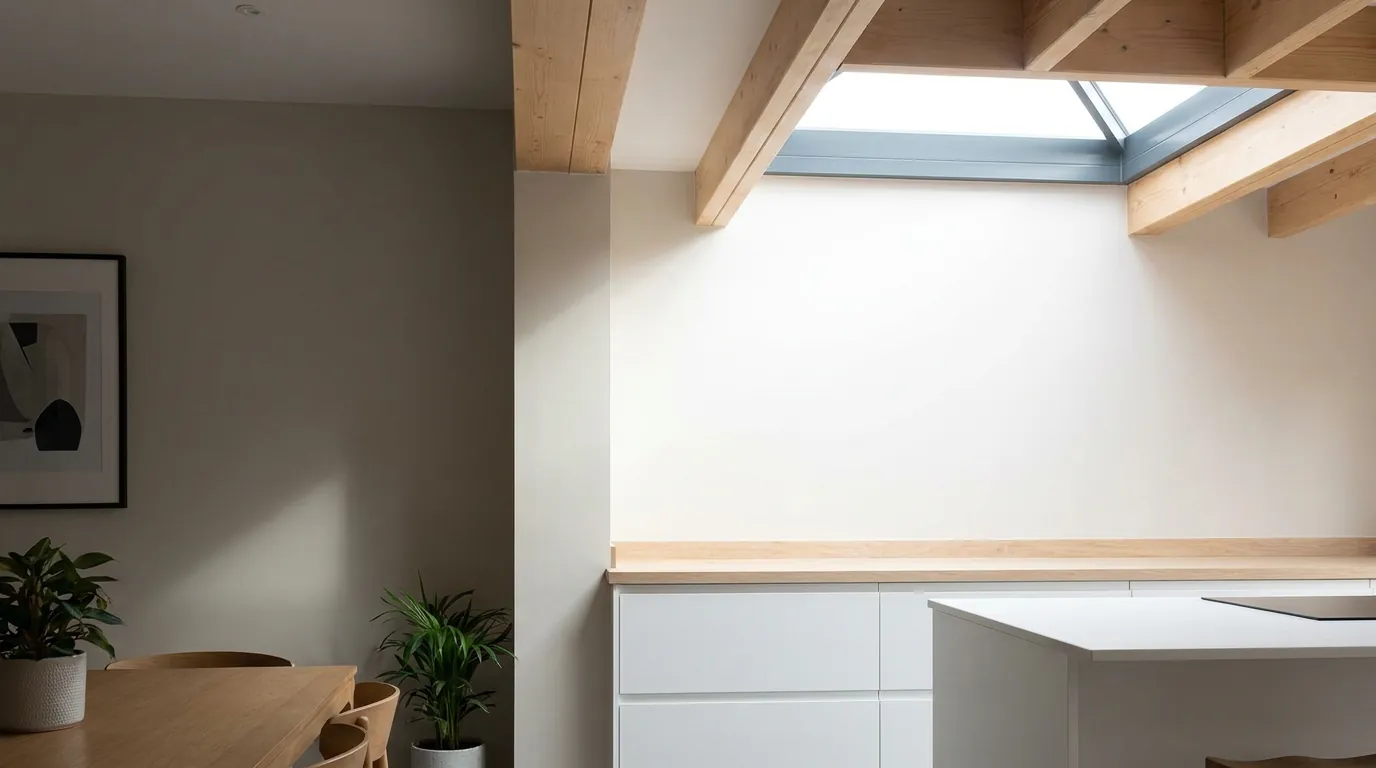
Most lantern manufacturers offer a short menu of glass types for the sealed units. The names vary from brand to brand, but they fall into a handful of families. The table sets out what each one is for.
| Glass type | Summer heat | Daylight and colour | Best suited to |
|---|---|---|---|
| Clear low emissivity | Admits the most solar heat of the options here | Brightest, truest colour | North facing or shaded extensions |
| Neutral solar control | Turns back a large share of solar heat | Slightly less light, near neutral colour | South and west facing kitchens and garden rooms |
| Tinted solar control (blue or grey) | Lower heat gain, plus visible glare reduction | Noticeably darker, with a colour cast | Very sunny aspects where glare is the main complaint |
| Self cleaning outer pane | No effect on its own; paired with another coating | Keeps the view up clearer between cleans | Lanterns under trees or hard to reach |
The self cleaning coating is on the outside face; the solar control and low emissivity coatings sit inside the sealed unit. So a single lantern can combine several of these, and many do. The general question of which glass goes into a lantern at all is covered briefly on what glass goes into a roof lantern?
Which way the extension faces
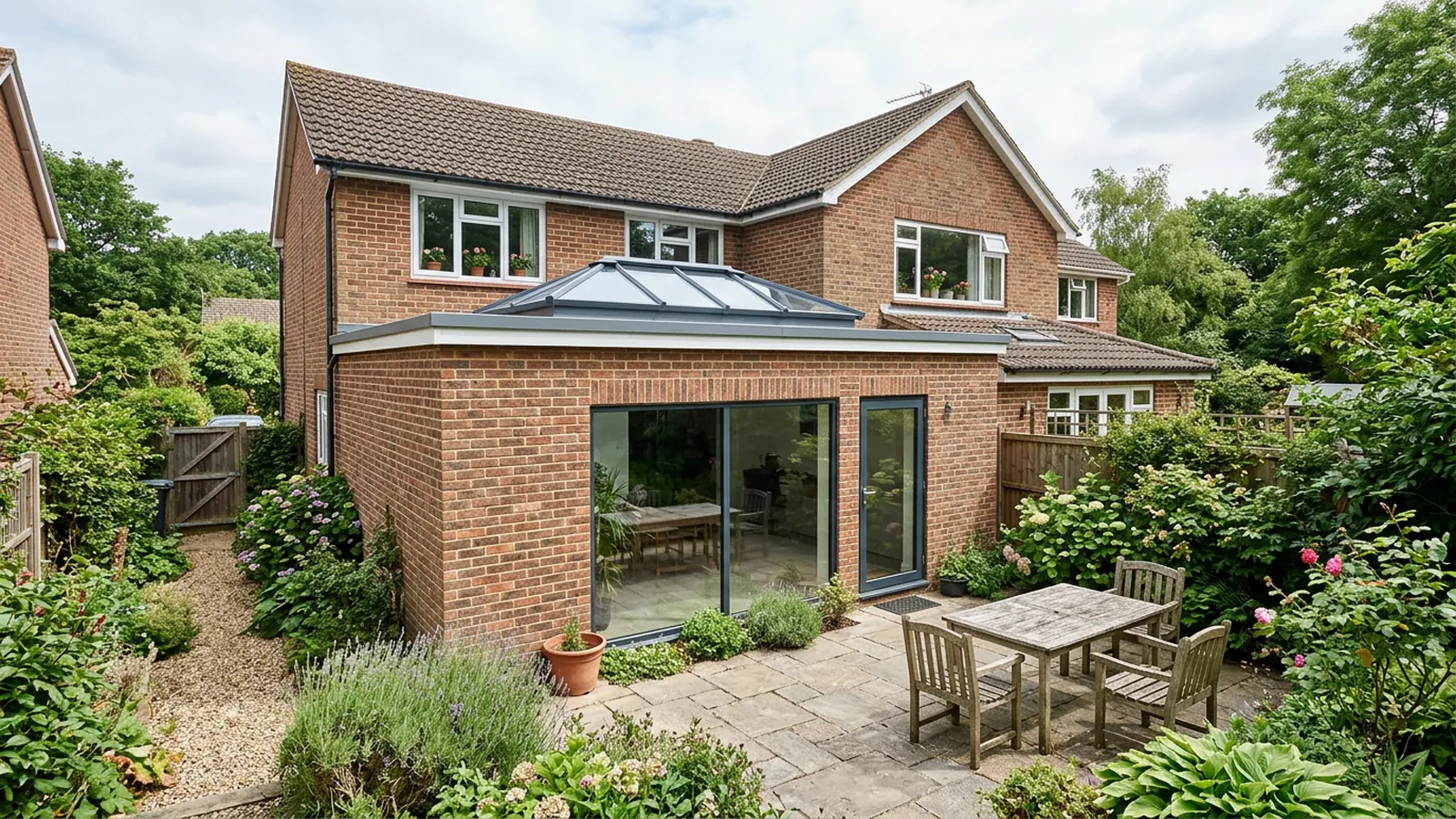
Orientation decides more than anything else whether solar control glass earns its place. A single storey rear extension on a Basingstoke estate house faces whichever way the garden does, and that varies street by street on the same estate.
- South facing. Sun on the glass for most of the day, high in summer. This is where solar control glass makes the clearest difference.
- West facing. Low evening sun that arrives just as the room is being used for cooking and eating, after the building has warmed up all day. Often the aspect that feels hottest in practice.
- East facing. Morning sun, gone by lunchtime. Worth considering if the room is a breakfast space.
- North facing. Little direct sun on the lantern. Clear glass usually gives the brighter room, and the extra daylight is often the whole reason for the lantern.
Surrounding trees, a neighbour's two storey wall or a higher main roof can all shade the lantern for part of the day, which is one reason the survey looks at the site rather than the compass alone.
What tint does to the room
This is where owners are most often surprised. A tinted unit looks fine on a sample, but once it is the whole ceiling of a kitchen the colour cast is on everything underneath: the worktops, the food, the faces around the table. Blue tints make white cabinets read cooler; grey tints make a room look dimmer on an overcast day, and an English summer has plenty of those.
Neutral solar control glass avoids most of this. From inside it looks almost clear, with a faint reflective quality from outside when the light is right. It gives up a little daylight compared with clear glass, but the room still reads as a bright space with true colours. For a kitchen or a dining area, neutral is usually the calmer choice, and tint is kept for spaces where glare on screens or a very exposed south aspect is the bigger concern.
Glass that stops the heat but also stops the daylight has solved the wrong problem.
It helps to see a real sample outdoors, held up to the sky, rather than judging from a brochure photograph or a showroom under artificial light.
Glass alone will not keep a room cool
The rule: solar control glass reduces how much heat comes in, but warm air still gathers at the top of the lantern and still needs a way out. The exception: a small lantern on a north facing, well shaded extension with good cross ventilation through doors and windows may need nothing more than the glass.
For everything else, the three tools work as a set: glass that limits solar gain, ventilation that lets warm air escape from the highest point, and shading for the hottest hours. Relying on the coating alone and keeping the room sealed on a hot day will still leave a warm pocket in the lantern.
Opening vents in the lantern itself are the most direct way out for that air, because they sit exactly where it collects. Manual and electric options exist on most systems, and rain sensors close electric vents automatically. See can a roof lantern be made to open? for what can be specified. The same vents also help with moisture from cooking, which is covered in condensation, ventilation and Part F under a roof lantern.
Blinds, shading and the frame
Blinds are the adjustable layer. Glass is fixed for the life of the unit, but a blind can be drawn on the hottest afternoons and left open for the rest of the year. Some are fitted between the glazing bars, some are made to the lantern's shape and motorised. Whether one suits your lantern, and what it involves, is set out on can you fit blinds to a roof lantern?
The frame plays a smaller part. Slim aluminium bars leave more of the roof as glass, which means more light and slightly more heat; chunkier bars shade a little more. It is rarely the deciding factor for summer comfort, but it belongs in the same conversation, which aluminium or uPVC glazing bars on a roof lantern goes through.
Size is part of the heat question
A bigger lantern admits more sun, full stop. Two lanterns with identical glass will behave differently if one is twice the area of the other over the same room. That is one more reason to size the lantern to the room below rather than to the largest opening the flat roof will take.
A lantern that sits over the part of the room where people eat or cook, sized to that space, gives the light where it is wanted and keeps the glazed area in proportion. The reasoning is set out in full in sizing a roof lantern to the room below, not the roof above. On a trussed estate house the extension roof is usually a separate flat roof with its own joists, so the lantern size is decided by the extension, not the main roof's trusses.
Replacing polycarbonate or older glass
Older conservatory style lanterns built with polycarbonate sheet, or early glass units with no coating at all, are often the ones owners describe as too hot in summer and too cold in winter. Swapping to a modern glazed lantern with a solar control unit changes both, because the new unit brings a low emissivity layer for winter and a solar control coating for summer in one sealed unit.
Whether the existing kerb and roof can take the change, and what the swap involves, is covered on can an old polycarbonate lantern be swapped for glass? The general principles of thermal performance across rooflights of every kind live on the energy efficient rooflights page rather than being repeated here.
Building Regulations and the glass
A new roof lantern on an extension is controlled work under the Building Regulations. The glass has to meet the thermal standard for rooflights under Part L, and safety glazing is required for overhead glass. Solar control coatings sit inside units that already do both, so choosing one does not create a separate approval.
Part O, the rule on overheating, applies to new build homes rather than extensions to existing ones, so it does not govern the glass choice on a typical kitchen extension. Summer comfort is therefore your decision, made with advice, rather than a box ticked by a regulation. Where the lantern work is notifiable, Everlight takes care of the notification to Building Control as part of the job.
Choosing the glass, step by step
- Note the aspect. Which way the extension faces and what shades it at different times of day.
- Decide how the room is used. An evening kitchen on a west side has different needs from a morning breakfast room on the east.
- Size the lantern to the room. Less glass over the right spot is often better than more glass everywhere.
- Compare g-value and light transmittance together. Ask for both for each glass option, and prefer the one that keeps the light up while bringing the heat down.
- See a sample outdoors. Check the colour against the sky before choosing a tint.
- Plan ventilation and shading. Opening vents at the top, and a blind if the aspect is south or west.
- Confirm at survey. The survey checks the roof, the kerb and the site, and the written quote follows that visit.
The glass, the vents and the blind are all fixed at the order stage of a roof lantern fitting, so it pays to settle them before the lantern is made rather than after it is on the roof. The workmanship on the fitted lantern carries a 10-year guarantee, which is a workmanship promise and not insurance backed. If you would rather talk it through with someone looking at the actual roof, arrange a survey of your extension, and for other skylight and rooflight work around the house the Everlight homepage is the place to start.