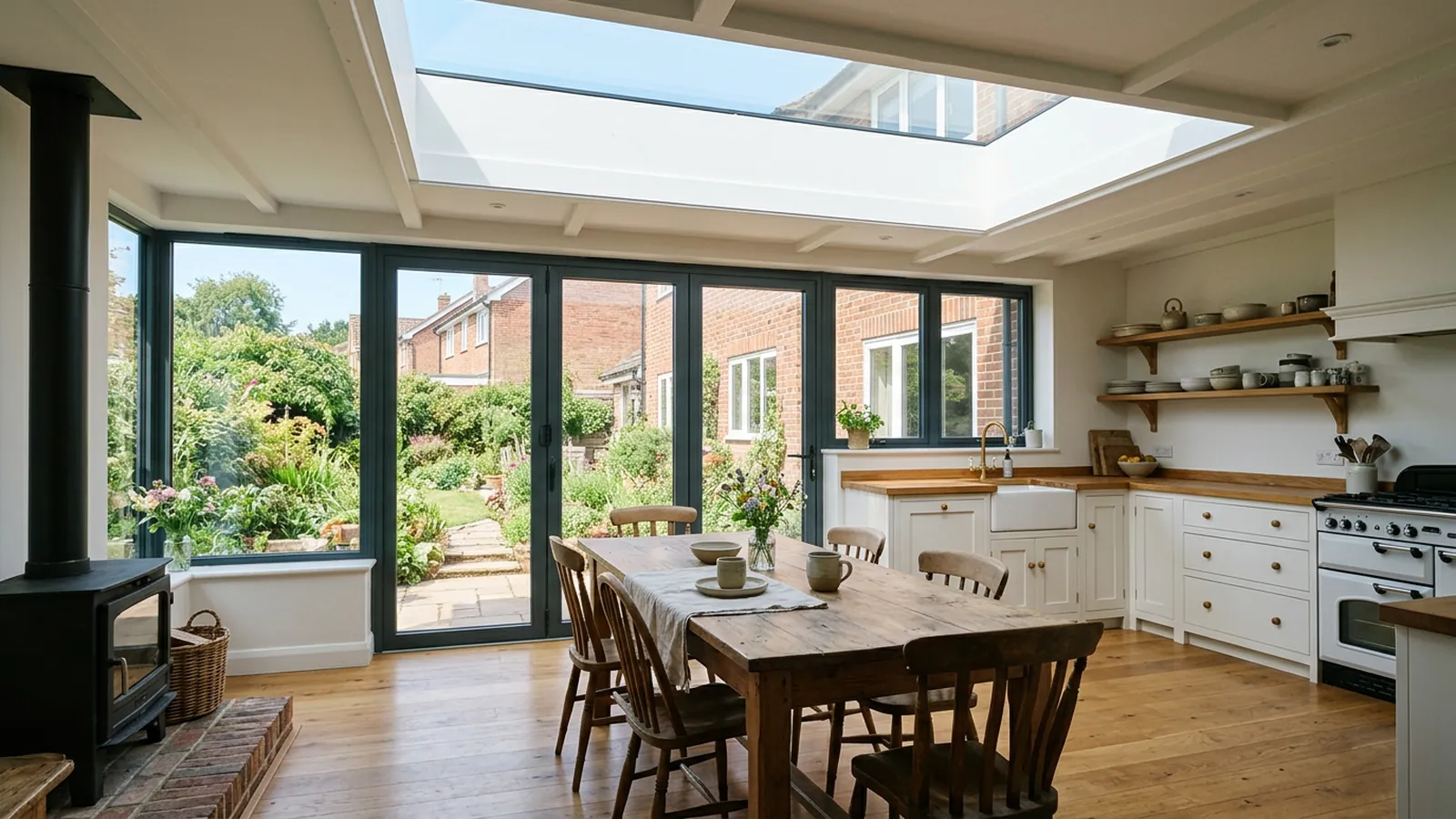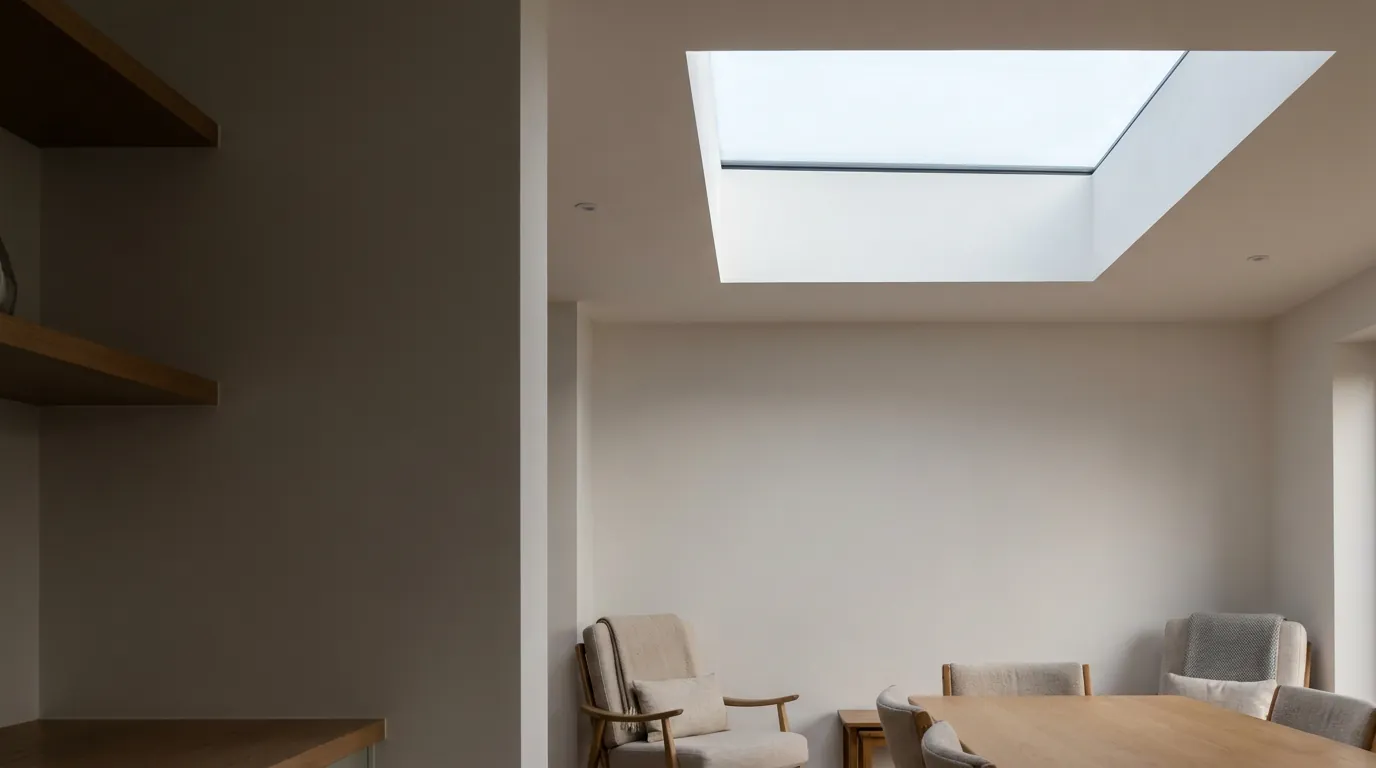
That is the short verdict; the longer one depends on what the plastic is, how many walls it has, and what it sits on. Our energy efficient rooflights page covers the glazed options in full. This page stays with polycarbonate: why people choose it, where it holds its own, and where it lets a room down in a Hampshire winter.
Why polycarbonate ends up on so many flat roofs
Polycarbonate is light, tough and cheap to mould, so it became the standard material for the bubble domes fitted to flat roofs on extensions, garages and kitchen back additions. On the 1970s and 1980s estate houses around Basingstoke, in places like Brighton Hill or Oakridge, a flat-roofed kitchen or single-storey side extension built with the house may still have its original dome of this kind. It is also the usual sheet on conservatory roofs and lean-to covers.
Its selling points are real. It is hard to break, it weighs little, so the kerb and roof deck need no extra strength, and it diffuses light rather than casting a hard beam. None of those points is about keeping warmth indoors, which is where the questions start.
How a sealed rooflight unit works and fails
- Outer and inner glass panes, with the outer pane facing the weather
- Low-emissivity coating on one inner face, reflecting heat back into the room
- Warm-edge spacer bar holding the panes apart, filled with desiccant to soak up trace moisture
- Primary seal against each pane, backed by the secondary seal around the edge
- Dry sealed cavity, the insulating layer between the panes
- Broken edge seal: moist air gets in and the desiccant becomes saturated
- Mist and droplets trapped between the panes; they cannot be wiped off and the sealed unit needs replacing
- Inset: condensation on the room-side face of the glass is a ventilation or humidity issue, not a failed unit
How the number of walls changes things
A polycarbonate skylight holds heat mainly through the air trapped between its layers, not through the plastic itself. More separate skins with sealed pockets between them means slower heat loss. The table sets the common types side by side in plain terms; the exact figure for any product is printed on its data sheet, and a lower U-value on that sheet means less heat lost.
| Type | How it holds heat | Where it sits |
|---|---|---|
| Single-skin dome | One layer of plastic, no trapped air, so heat passes through freely | Weakest of the group; common on older garages and outbuildings |
| Twin or triple-wall dome | Separate moulded skins with an air gap between each | A clear step up from single skin, still behind sealed glass units |
| Multiwall sheet | Many small cells running through the sheet, thicker sheet with more cells does better | Reasonable for a conservatory or covered way, rarely used for a living room rooflight |
| Double or triple glazed unit | Sealed glass panes, low-e coating, argon or krypton fill, warm edge spacers | The usual choice when the room below is heated and lived in |
What polycarbonate does less well over time
Heat loss on the day of fitting is only half the picture. Polycarbonate softens under sunlight over the years, and older domes tend to yellow, haze and go brittle. A hazy dome lets in less daylight, so a room that relied on it gets dimmer, and the lights go on earlier in the afternoon.
The trapped air layers also stop being sealed as the dome ages. Dust and moisture find their way between the skins, and once that happens the cavity no longer works as an insulating pocket. That is why an old triple-wall dome can feel little warmer than a single-skin one. Glass stays clear, and a sealed unit that has failed shows it plainly by misting, which makes the moment to replace it obvious.
The rule: judge a polycarbonate dome by its age and clarity as much as by how many walls it started with. The exception is an unheated space such as a garage or store, where the insulation matters little and a fresh dome may be all the job needs.
Condensation, noise and summer heat
Because its inner face runs colder than a good glass unit, a plastic skylight over a kitchen or bathroom gathers condensation more readily, and drips can land on worktops. Our answer on whether energy efficient rooflights reduce condensation explains why the warmer inner surface of sealed glazing helps.
Rain drums on polycarbonate far more than on glass, which matters over a bedroom or a home office. In summer, clear or lightly tinted domes let a lot of solar heat through without the coatings that modern rooflight glass can carry, so a south-facing flat roof can make the room beneath stuffy. The page on whether a rooflight can keep a room cool in summer covers the glass options that deal with that.
What decides whether to keep it or change it
- Look at the room below. A heated kitchen, bathroom or living space gains most from a glazed unit; an unheated store gains little.
- Check the dome's condition. Yellowing, haze, fine cracks or dirt trapped between the skins all point to its best years being behind it.
- Check the kerb. An uninsulated timber upstand leaks heat around even a good rooflight, so the kerb may need replacing too. The detail sits in our guide to thermally broken frames and cold bridging at the upstand.
- Match the size. A glazed flat rooflight can usually sit on the same opening, which keeps the change to the ceiling inside simple.
If the house is one of the older estate homes and the dome is original, the wider story of how those units perform is told in our guide to heat loss through old rooflights in 1970s and 1980s homes.
Where the rules come in
A new rooflight going into a heated room has to meet the thermal standard in Part L of the Building Regulations, and a like-for-like swap on an existing opening is expected to do the same. The level a new unit should reach is set out in our answer on what U-value a new rooflight should have. Where the job is notifiable, Everlight sends the Building Control notification as part of the work, and the fitting carries a 10-year workmanship guarantee (not insurance backed).
So is polycarbonate energy efficient? For a garage, a lean-to or a covered walkway it can be good enough. Over a room you heat and use every day, sealed glass is the better answer, and a look at the dome, the kerb and the roof deck shows which way your own flat roof points. To have that checked before any figures are put on paper, arrange a survey of the roof, and see the rooflight and skylight installation homepage for the rest of what Everlight fits around Basingstoke.