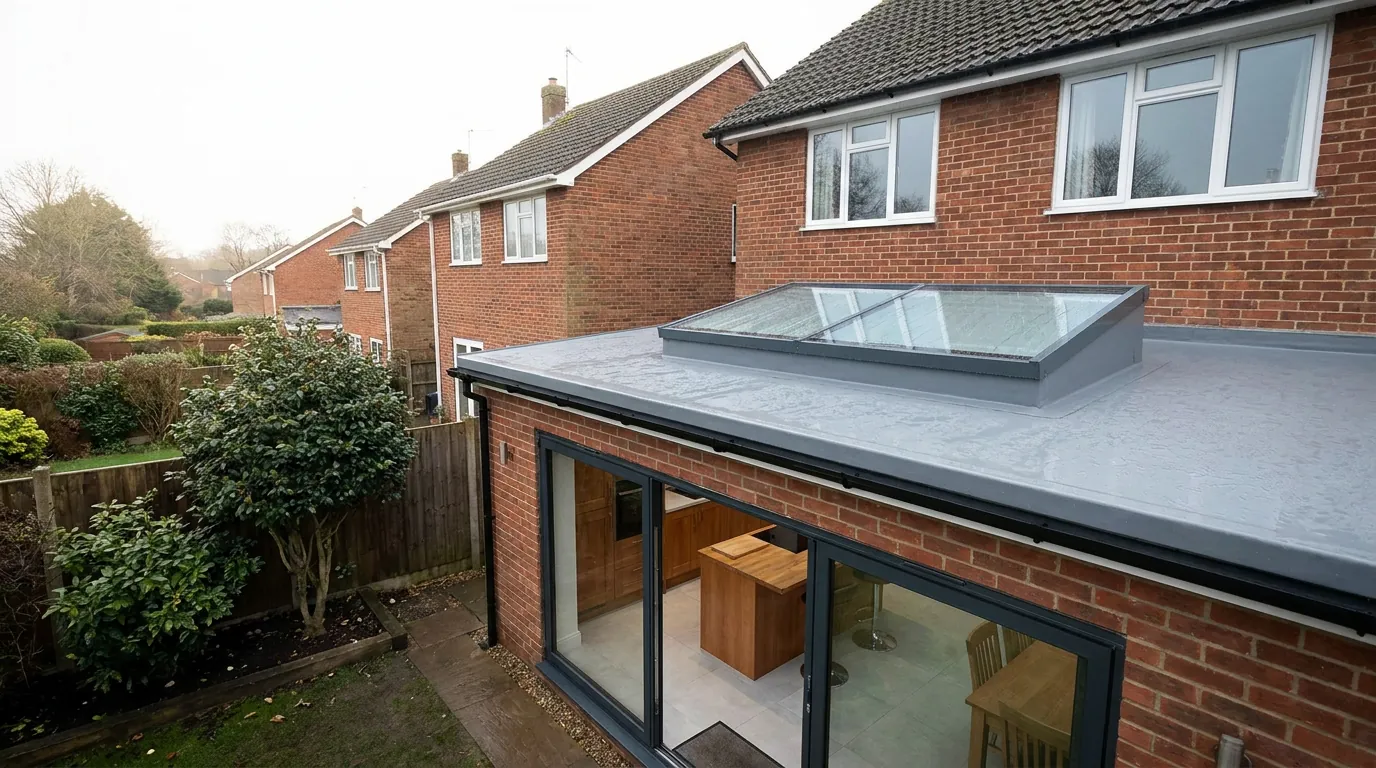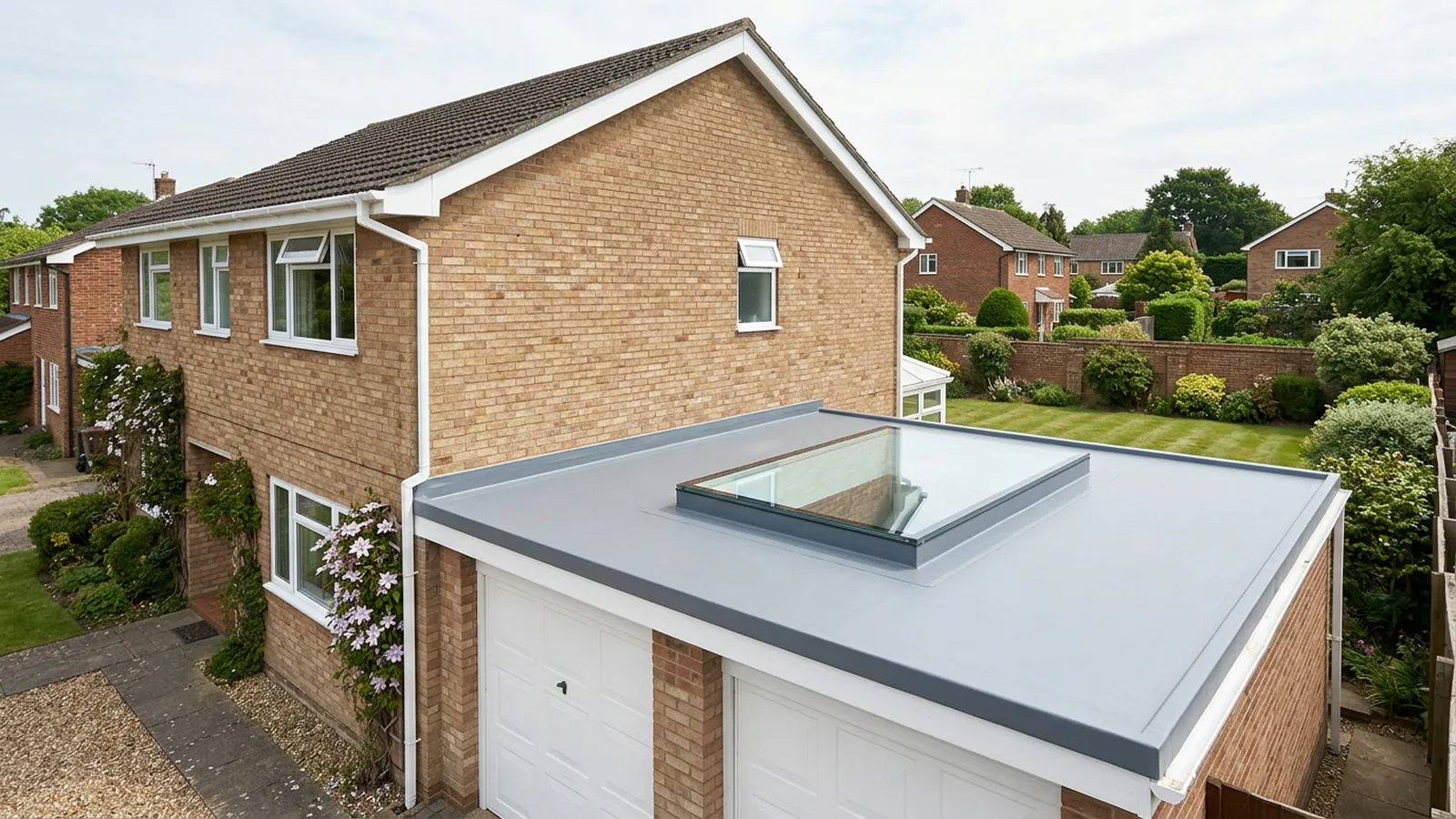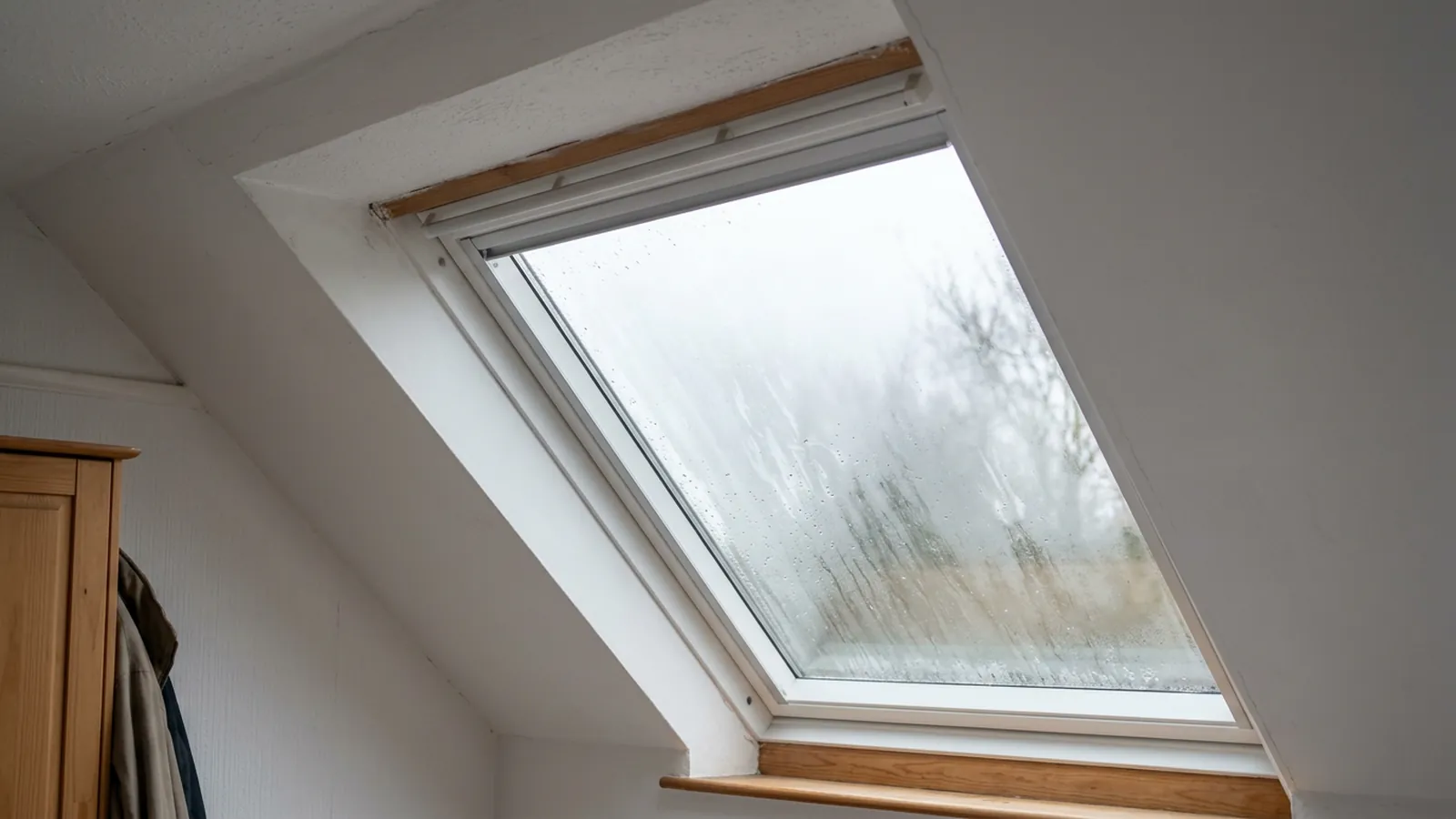
A milky haze that sits between the two panes of a rooflight, out of reach of any cloth, is the glass telling you something specific. The sealed unit has stopped being sealed. Air from outside has found its way into the cavity, brought moisture with it, and that moisture now condenses on the inner face of the outer pane whenever the glass cools. This guide explains how a sealed unit is built, why the seal gives way, why sloping and flat roof glazing is harder on that seal than an upright window in a wall, and what the misting does and does not tell you about the rest of the rooflight.
It is written for the owner looking up at a clouded skylight over a landing, a loft room or a kitchen extension, wondering whether the fog is cosmetic, whether it will get worse, and what the choices look like. For the decision itself, the hub page on misted and failed rooflight replacement sets out the routes; here the focus stays on the cause.
What sits between the two panes
A double glazed rooflight is not two sheets of glass held apart by the frame. The glass is a factory-made sealed unit: two panes bonded to a spacer bar that runs right round the edge, with a closed pocket of dry air or an inert gas such as argon trapped between them. On many roof windows the inner pane is laminated and the outer pane toughened, and one face carries a thin low emissivity coating that reflects heat back into the room.
The spacer bar is hollow and perforated on its inner face. Inside it is a desiccant, a granular drying agent that soaks up any moisture already in the cavity at the time of manufacture and any small amount that creeps in afterwards. Round the outside of the spacer are two seals. The primary seal, usually a butyl compound, is the vapour barrier: it is the layer that keeps water vapour out. The secondary seal, typically polysulphide, polyurethane or silicone, is the structural bond that holds the panes to the spacer and protects the primary seal from the weather.
So a clear sealed unit depends on three things working together: a continuous primary seal, a secondary seal that keeps it in place, and desiccant with capacity left to absorb what little moisture gets past both.
How a sealed rooflight unit works and fails
- Outer and inner glass panes, with the outer pane facing the weather
- Low-emissivity coating on one inner face, reflecting heat back into the room
- Warm-edge spacer bar holding the panes apart, filled with desiccant to soak up trace moisture
- Primary seal against each pane, backed by the secondary seal around the edge
- Dry sealed cavity, the insulating layer between the panes
- Broken edge seal: moist air gets in and the desiccant becomes saturated
- Mist and droplets trapped between the panes; they cannot be wiped off and the sealed unit needs replacing
- Inset: condensation on the room-side face of the glass is a ventilation or humidity issue, not a failed unit
How the fog forms once the seal gives way
Once there is a path through the edge seal, however small, the cavity starts to breathe. Every time the unit warms, the gas inside expands and some is pushed out. Every time it cools, it contracts and draws outside air back in. That outside air carries water vapour. For a while the desiccant mops it up and the glass stays clear, which is why a seal can be compromised long before anyone sees a problem.
When the desiccant is saturated there is nowhere left for the vapour to go. On a cold night, or when rain cools the outer pane, the vapour condenses on the coldest surface inside the cavity. That is usually the inner face of the outer pane. The droplets are too fine to see individually, so the effect is a grey or white bloom. As the day warms the glass it may clear again, which is why a failing unit often looks fine at lunchtime and fogged at breakfast.
Repeat that cycle through enough seasons and the water leaves mineral traces behind on the glass and the low emissivity coating. At that stage the haze stays even on a dry day, and streaks or rings appear that follow the pattern the condensation used to make.
Fog you cannot wipe away means the edge seal has failed; fog you can wipe away is a question about the room.
The stages a failing unit goes through
Misting rarely appears overnight. It tends to follow a recognisable order, and knowing where your skylight sits in it helps when you describe it before a survey.
- Hidden stage. The seal has a path through it but the desiccant is still absorbing the moisture. The glass looks normal.
- Intermittent fog. The desiccant is full. Mist appears on cold mornings and after rain, then clears as the sun reaches the glass.
- Persistent haze. Moisture now sits in the cavity most of the time. The bloom stays for longer and may gather along the lower edge of the pane, where it is coolest.
- Residue and staining. Mineral deposits and damage to the coating leave a permanent cloud, streaks or rings that remain even when the cavity is dry.
None of these stages reverses on its own. The only thing that changes is how visible the failure is.
Why roof glazing works its seals harder than a wall window
The same sealed unit technology is used in upright windows, so it is fair to ask why rooflights seem to mist more readily. The answer is where the glass sits.
A rooflight faces the sky. It takes more direct sun than a window in a wall, so the glass heats further and faster, and on a clear night it radiates heat to the sky and cools further too. Those wider swings in temperature make the gas in the cavity expand and contract harder, and the edge seal flexes with every cycle. Ultraviolet light also reaches the edge of a sloping unit more directly, and some secondary sealants degrade under long ultraviolet exposure unless the frame or cladding shades them.
Then there is water. Rain on a vertical window runs straight off. On a pitched roof window it runs down the glass and meets the bottom edge, where the frame and cladding are designed to shed it. On a flat rooflight at a shallow fall, water can linger at the lower edge after every shower. A seal that spends long periods wet ages faster than one that dries within minutes. The guide on flat rooflight seals covers that particular case in more depth.
What wears out the seal, cause by cause
The table below sets out the usual reasons an edge seal gives way on roof glazing, what each one tends to look like, and whether it points to the glass alone or to something about the frame or the installation.
| Cause | What it tends to look like | What it points to |
|---|---|---|
| Age and thermal cycling | Slow onset, fog first on cold mornings, spreading over time | The unit has reached the end of its working life; frame may still be sound |
| Water standing on the edge | Haze starting along the bottom edge, sometimes with staining on the frame | Drainage at the lower edge, a shallow fall or a tired cladding detail |
| Ultraviolet on exposed sealant | Brittle or chalky sealant visible at the edge of the glass | Glazing where the edge seal is not shaded by a frame or cover |
| Frame movement or glazing pressure | Fog in one corner, sometimes with a slightly bowed or stressed pane | A frame twisted in its opening, or uneven support under the unit |
| Physical damage | A chip or crack at the edge with fog nearby | Impact or stress on the glass; see the guide on cracked rooflight glass |
Most misted rooflights fall under the first row: a unit that has simply lived through its seals. The other rows matter because they change what the replacement needs. A unit that failed because water sat on its edge will fail again if the new glass goes back into the same drainage detail unchanged.
Misting between the panes versus condensation on the room side
Before blaming the sealed unit, it is worth ruling out ordinary condensation. A bathroom, a kitchen or a bedroom in winter puts a lot of water vapour into the air, and the rooflight glass is often the coldest surface in the room. Droplets on the room side of the glass, or water running down the lining below the frame, can look alarming without the unit being at fault.
The test: wipe the inside face of the glass with a dry cloth. If the fog comes away, the moisture is in the room and the sealed unit is doing its job; ventilation and the trickle vent on the frame are the place to start. If the fog stays exactly where it was, it is inside the cavity and the seal has failed. The exception: a unit can suffer both at once, so a failed seal does not rule out a room that also needs more ventilation.
Telling the two apart in detail, including the patterns each one leaves on the lining, has its own guide: condensation on the glass or a failed unit. The short answer page on why a rooflight goes misty between the panes gives the one-line version.

Why the fog cannot be cleared from the cavity
It is natural to hope the haze can be dried out. There are services for vertical windows that drill the glass, flush the cavity and fit a small valve. On a rooflight the problem with that approach is the thing that caused the fog in the first place: the edge seal is still broken, the desiccant is still spent, and a hole has been added to a pane that sits in the weather. The glass may look clearer for a while, but the unit is no longer a sealed unit, and any inert gas it held is gone.
The same logic applies to cleaning. Mineral residue inside the cavity cannot be reached, and any damage to the low emissivity coating is permanent. The answer page can misted rooflight glass be cleared puts this in a few lines.
What the misting tells you about the rest of the rooflight
A fogged unit is a failure of the glass, not automatically of the whole skylight. The frame, the hinge or pivot, the flashing and the lining can all still be in good order. That is why misting starts a conversation with two possible endings: a new sealed unit in the existing frame, or a complete new rooflight in the same opening.
Which one makes sense depends on things the glass cannot show. Is the frame timber sound or soft at the bottom rail? Do the gaskets still hold the pane evenly, or have they perished? Is a replacement unit still made for that frame, in that size, from the original maker? Is there staining on the plaster below that suggests water has been getting past the flashing as well as the seal? The guide on replacing the sealed unit or the whole rooflight works through that decision properly, and the answer page on whether a misted pane means the whole rooflight has failed gives the quick version.
On many estate houses around Basingstoke the roof windows fitted when the house was built are now old enough that the frames and flashings are as tired as the glass. In that case a like-for-like frame, sized to sit in the same opening between the same trusses, is often the tidier answer than a new unit in an old frame.
Does it matter if you leave it?
A misted unit is not a safety problem in itself, and it will not suddenly let rain into the room. What it does is lose clarity, and a seal that has let air in has also let out any argon fill, so the unit no longer performs as it did when new. If the cause was water standing on the edge, that same water may be affecting the frame. It is worth having it looked at on your own timetable rather than waiting for the haze to become permanent staining.
If you want to make the survey quicker, take a photo of the fog on a cold morning and another later in the day, note which edge the haze starts from, and look for any marks on the ceiling or lining beneath. Those three notes tell a surveyor a great deal before the ladder goes up.

Getting it looked at around Basingstoke
We look at the roof before we price anything, so the survey confirms whether the frame can take a new sealed unit or whether a complete new rooflight in the same opening is the better route. Where the work is notifiable, the Building Control notification is ours to deal with, and the finished job is covered by our 10-year workmanship guarantee (it is not insurance backed). If you are weighing up new glazing elsewhere in the house as well, the homepage covers skylight and rooflight replacement across Basingstoke in the round.
When the fog on your roof window has stopped clearing by midday, arrange a survey of the rooflight and we will tell you which of the two routes your frame supports. The wider picture, from new sealed units to complete frames, sits on the misted rooflight replacement page.