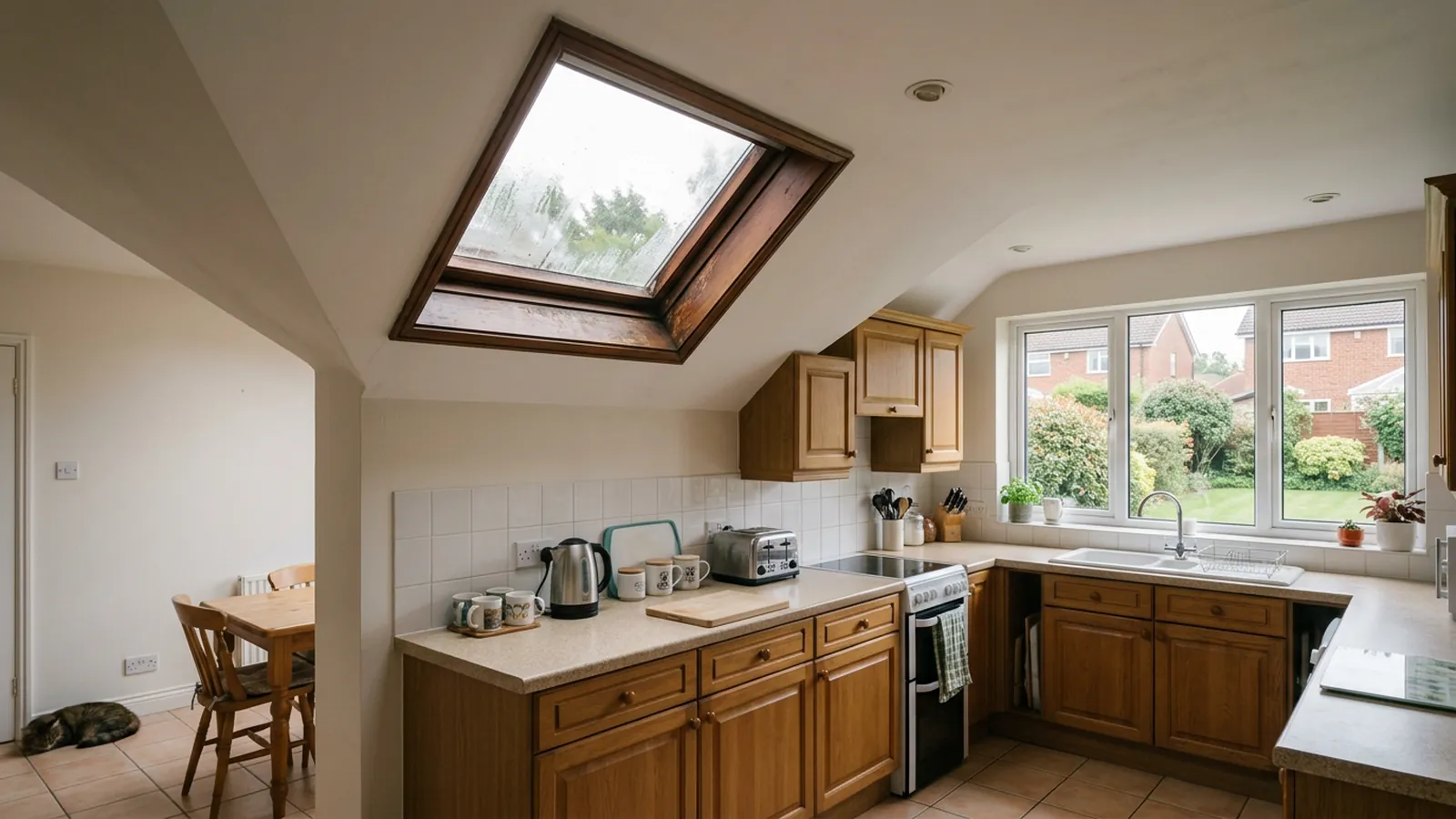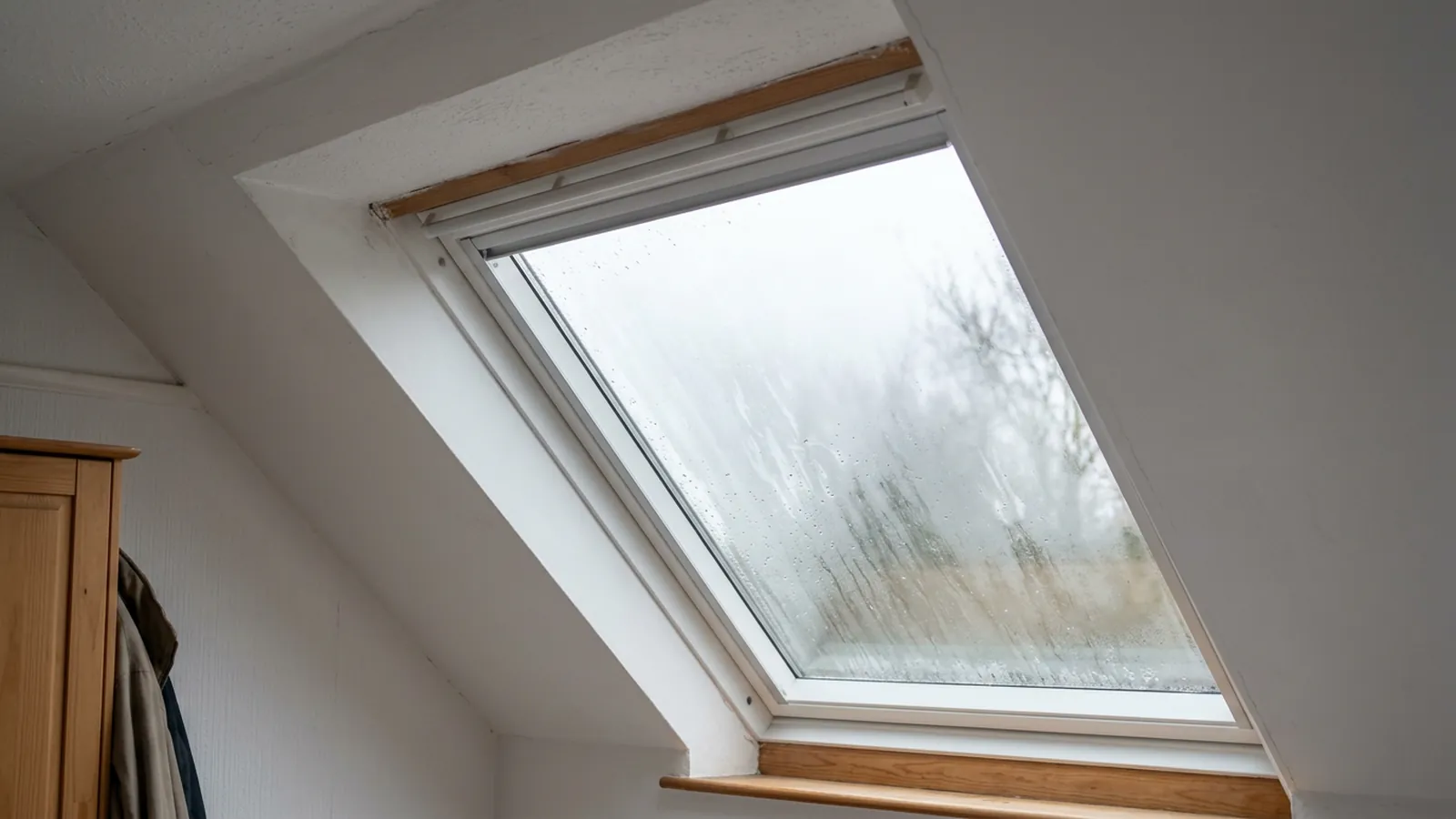
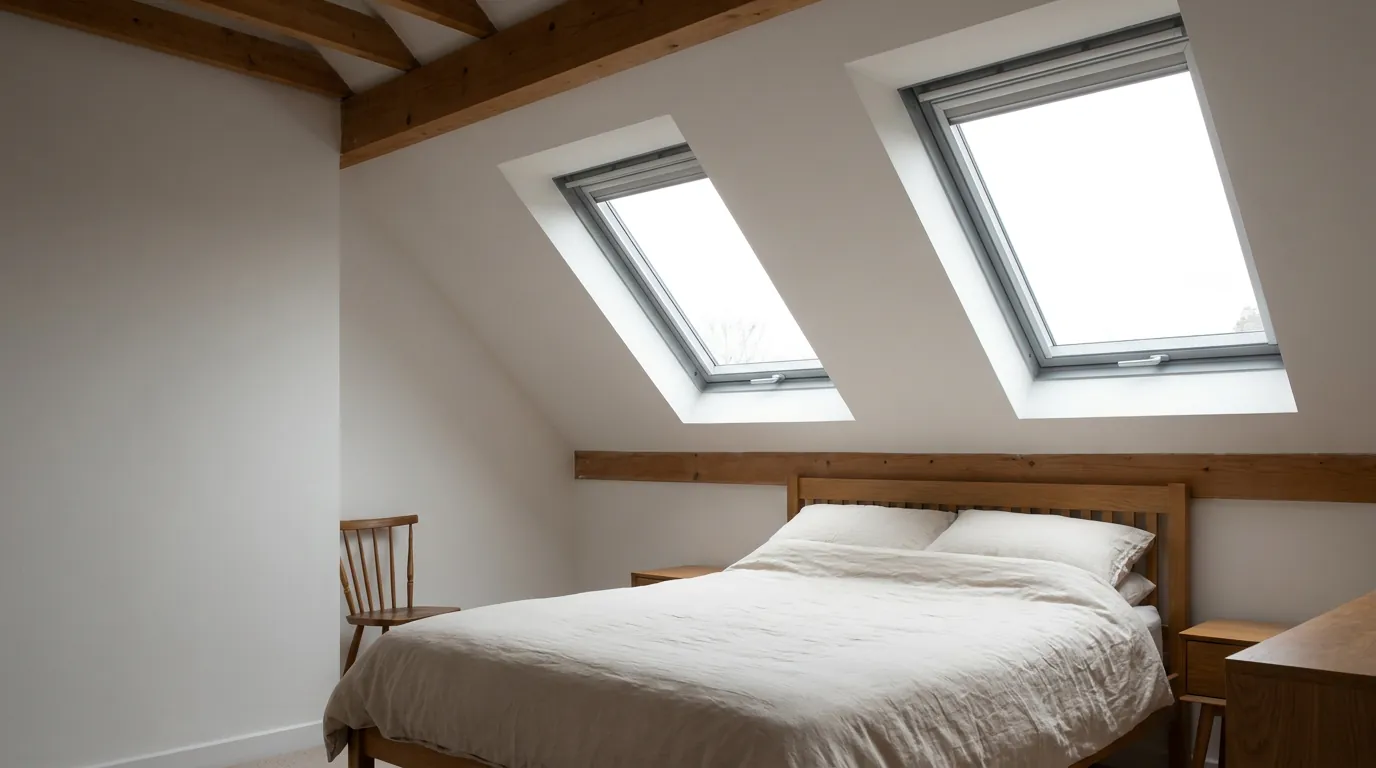
That fogged, milky look that no cloth will shift is one of the clearest signs a skylight has reached the end of its first life. Our page on misted and failed rooflight replacement covers the whole job; this answer stays with the narrower puzzle of why the mist is there at all, and what it is telling you about the glass above your landing, loft room or kitchen.
What sits between the two panes
A modern rooflight is glazed with a sealed unit rather than a single sheet. Two (sometimes three) panes are held apart by a spacer bar running round the edge, and the gap is filled with dry air or an inert gas such as argon. The spacer is hollow and packed with desiccant, a granular drying agent whose only task is to mop up the tiny trace of moisture sealed in at the factory. Round the outside of the spacer runs a bead of sealant that bonds the panes together and keeps the outside world out.
While that bead holds, the cavity stays bone dry and the glass stays clear in any weather. The moment it gives way, even along a short stretch, the cavity starts to breathe. Each warm afternoon pushes a little air out; each cold night draws a little back in, carrying moisture with it. The desiccant copes for a while, then saturates, and from that point every temperature swing leaves a film of droplets on the inside faces of the glass.
How a sealed rooflight unit works and fails
- Outer and inner glass panes, with the outer pane facing the weather
- Low-emissivity coating on one inner face, reflecting heat back into the room
- Warm-edge spacer bar holding the panes apart, filled with desiccant to soak up trace moisture
- Primary seal against each pane, backed by the secondary seal around the edge
- Dry sealed cavity, the insulating layer between the panes
- Broken edge seal: moist air gets in and the desiccant becomes saturated
- Mist and droplets trapped between the panes; they cannot be wiped off and the sealed unit needs replacing
- Inset: condensation on the room-side face of the glass is a ventilation or humidity issue, not a failed unit
Why the seal lets go
A sloping or flat roof is a harder place for a sealed unit than a wall. The glass faces the open sky, so it heats faster in sunshine and chills harder on a clear night than a window in an elevation would. That constant expansion and contraction works at the edge bond year after year. Rain sits on a shallow pitch for longer, and water lying against the bottom edge of the glazing tests the seal where it is weakest. Frame movement, a gasket that has hardened and shrunk, or a drainage path that has silted up all add to the load.
None of this means the unit was poor to begin with; every edge seal has a working life, and a rooflight simply asks more of it. The full list of causes, from sunlight on the sealant to a blocked frame drain, is set out in our answer on what makes a rooflight sealed unit fail, and the mechanics are explained step by step in the guide to why a sealed unit mists between the panes.
Worth knowing: the mist often comes and goes. It may be heavy on a cold morning and almost gone by a sunny afternoon, which tempts owners to think the problem has cleared itself. It has not. The moisture is still inside; the warmth has only turned it back to vapour for a few hours, and over time it tends to leave a permanent white bloom or streaks of residue on the inner glass.
Is it inside the unit or just on the surface?
Before blaming the seal, rule out ordinary condensation. A steamy bathroom or a bedroom with the door shut overnight will put droplets on the room side of any cold glass, and a heavy dew or frost can do the same on the outer face. Both wipe away. Mist between the panes never does.
| Test | Surface condensation | Failed sealed unit |
|---|---|---|
| Wipe the room side | Clears if it is on the inner face | Stays exactly as it was |
| Look from outside (where safely visible) | Dew on the outer pane dries as the sun comes up | Haze stays put whatever the weather outside |
| Improve ventilation for a few days | Droplets reduce or stop | No change at all |
| Look closely at the glass | Clean glass beneath the droplets | White bloom, tide marks or streaks you cannot touch |
If the droplets vanish under a cloth, the fix lies in ventilation and heating rather than new glazing. Our guide on telling condensation from a failed unit goes further into that, including trickle vents and extractor fans in rooms with a roof window.
Can the mist be removed?
Owners sometimes come across services that drill the pane, dry the cavity and plug the hole. On a vertical window that approach divides opinion; on a roof it is harder still, because the edge seal that let the moisture in is still broken, and a skylight faces far more weather than a wall window. The route that restores a truly sealed cavity is fresh glazing. Whether that can be done well on your particular rooflight is looked at in can misted rooflight glass be cleared?
What it means for your rooflight
A misted cavity is, first of all, a view and daylight problem: the glass scatters light, the sky disappears, and the room below feels greyer. It also tells you the unit is no longer insulating as it did, because a damp cavity that has lost its gas fill does less to hold heat in. Whether that is urgent depends on the rest of the window, which is the ground covered by is a misted rooflight a problem?
From there the choice is between two routes, and the age and make of the frame usually decide it:
- Look at the frame. If it is sound, the gaskets are supple and the flashing is sitting properly, the glazing alone may be the only part at fault.
- Check whether a pane is still made for it. Many branded roof windows accept a replacement pane for their model and size; older or unbranded units, and plastic domes, often do not.
- Weigh the rest of the window. A tired frame, a sticking hinge or old flashing points towards a whole new rooflight in the same opening, fitted with new flashing and linings made good inside.
- Confirm it on the roof. The survey settles which route fits, and the quote follows it in writing.
Getting it looked at
The glass will not clear by itself, so there is no gain in waiting for a better season to find out which route you are on. We come out and inspect the roof, the frame and the glazing before putting any figure in front of you, and if the work turns out to be notifiable, the Building Control side is dealt with as part of the job. Replacement work carries a 10-year workmanship guarantee (a guarantee from us, not insurance backed). When you are ready to see your roof window clear again, arrange a survey of the misted rooflight and we will tell you plainly whether it needs a pane or a whole new window.