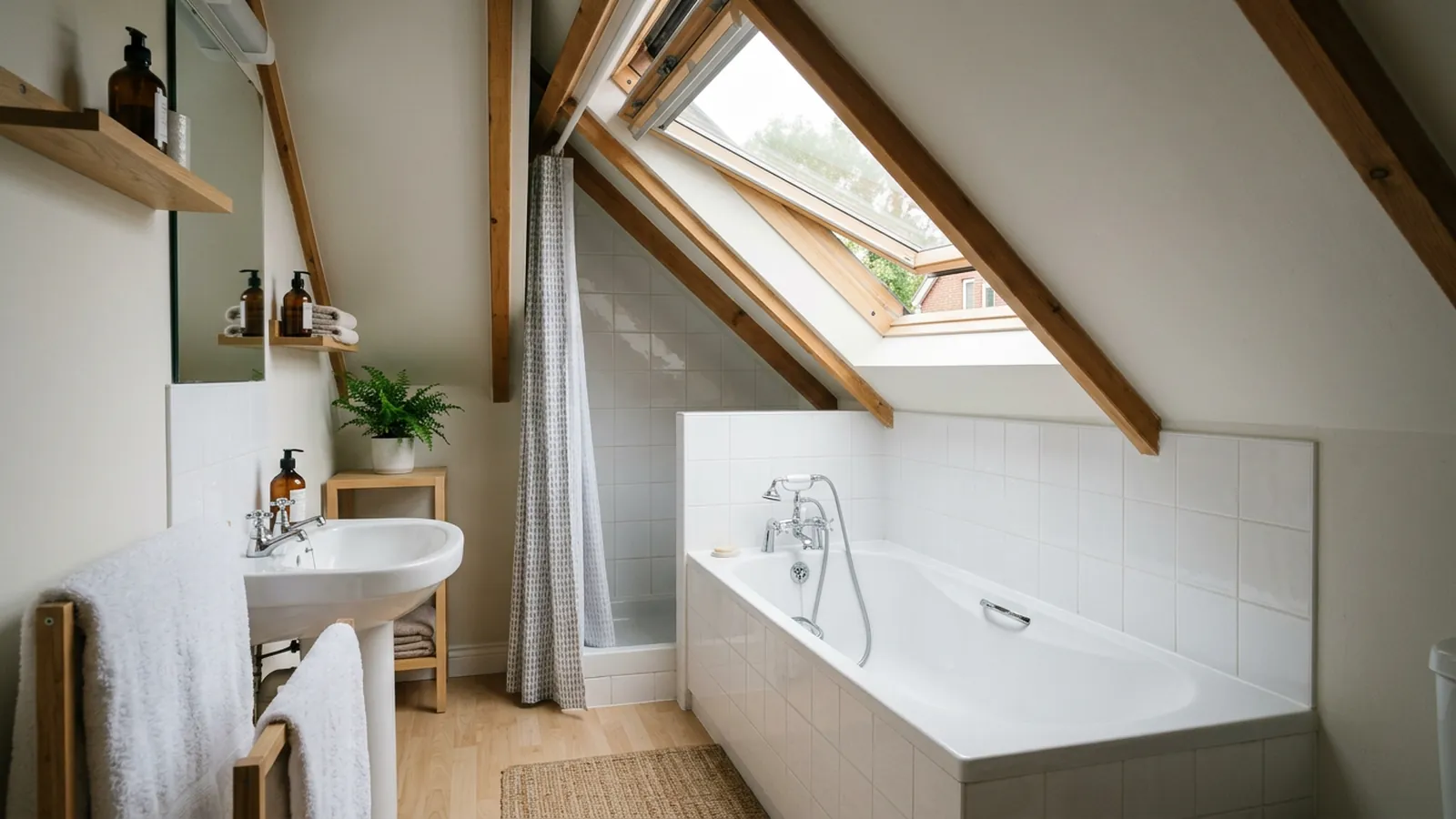
Bathrooms under a slope are common in Basingstoke loft conversions and in the upstairs of chalet bungalows, and the slope is often exactly where the bath or shower tray ends up. Our VELUX window installation page covers the fitting itself; this answer deals only with what changes when there is running water and steam under the glass.
Why steam is the real test
Water from the shower head rarely reaches the window. Warm, wet air does, every day. It rises to the highest point of the room, meets the coolest surface, and settles there as droplets. On a roof window that surface is the glass and the inside of the frame, so the frame material and the airflow around the opening matter far more than the glass itself. A skylight over a bath sees more moisture in a week than one over a landing sees in a year, which is why the specification starts from the humidity, not from the view.
Sizing a roof window to the truss bays
- Fink trussed rafter, factory made and designed to work as one whole frame
- W-shaped webs, joined at every node by pressed metal nail plates
- Tile covering on battens over the underlay
- Roof window set in the slope, fitted between trusses so the frame is untouched
- Narrow roof window sitting in the bay between two trusses
- Trusses at even 600mm centres along the roof
- No truss cut: the trusses either side of the window stay whole
- A wider window crosses a truss, so the cut needs designed trimming from an engineer or the truss maker
Choose the white polyurethane frame
VELUX makes its standard roof windows in two interior finishes: a clear lacquered pine and a white finish where the timber core is moulded inside polyurethane. The pine version is fine for a bedroom or a study. In a bathroom the polyurethane version is the one to specify, because the timber is sealed inside a moulded skin and there is no lacquer to wear or to take on moisture at the corners.
The rule: over a shower, a bath or anywhere the room stays humid, fit the white polyurethane frame. The exception is a large, well ventilated bathroom where the window sits well away from the wet area, and even there the polyurethane finish is the easier one to live with.
How those two finishes line up with the product codes is set out in our answer on the difference between VELUX GGL and GGU, so you can check the code on a quote or on the frame of a window you already have.
Reaching the window over a bath or tray
A roof window above a bath is usually out of reach once you stand back from the tub, and nobody wants to lean across a wet enamel edge to find a handle. That practical point decides the opening type and the control as much as the finish does.
| Option | How you open it | Where it suits |
|---|---|---|
| Centre pivot, manual | Handle along the top of the sash, reached by hand or with a rod | A window you can reach safely from standing, beside rather than over the bath |
| Top hung, manual | Handle at the bottom of the sash, and the sash swings out from the top | A low window on a shallow slope that you can reach without stretching |
| Electric or solar | Wall switch or remote, with a rain sensor that closes the window | A window directly over the bath or shower, or high on the slope |
The pivot and handle positions are compared in full in our guide to choosing between VELUX top hung and centre pivot. For a window you cannot reach at all, the powered versions are covered in VELUX INTEGRA electric and solar windows. The rain sensor is useful in a bathroom in particular, because a window left open to clear the steam will close itself if the weather turns while you are out.
Condensation and the extractor fan
A roof window lets steam out when it is open, but it does not replace mechanical extraction. A bathroom still needs its extractor fan, and the fan does the daily work of clearing wet air before it reaches the glass. The window adds daylight and a way to air the room on a dry day.
Some misting on the inside of the pane straight after a hot shower is normal, and it clears as the room dries out. Heavy, lingering droplets usually point to too little extraction, a cold spot where the lining meets the frame, or insulation that stops short of the window. The causes, and what to change, are in our answer on why condensation forms on a VELUX.
- Run the fan. Keep the extractor on through the shower and for a while after it, with the bathroom door closed.
- Use the ventilation flap. Leave the flap in the sash open so a trickle of air keeps moving past the glass.
- Air the room. Open the window on a dry day once the steam has gone, rather than during a hot shower.
- Wipe the frame. Dry the bottom edge of the frame now and then; the polyurethane finish wipes clean.
Privacy, safety glass and blinds
Because a roof window looks up at the sky, a bathroom rooflight is rarely overlooked the way a wall window is. Where a neighbouring dormer or a taller house can see in, obscured glass or a blind deals with it. Current VELUX glazing units carry a laminated inner pane, which holds together if it breaks, and that is the pane you want above a bath. A moisture resistant blind in the white frame colour gives privacy at night and suits the room; ask for one made for humid rooms rather than a fabric blind. If you already have a manual window and want it powered later, our answer on whether a manual VELUX can be made electric explains the conversion.
Wiring, linings and the notification
An electric window in a bathroom means cabling and a switch, and both have to sit in the right place for bathroom electrical zones, so that part is done by a qualified electrician. Inside, the lining around the window should be moisture resistant board with the joints sealed, and the insulation carried right up to the frame so there is no cold strip for steam to find. Fitting a new roof window is notifiable to Building Control, and we look after that notification as part of the job, alongside our 10-year workmanship guarantee on the installation.
What the survey settles
On the visit we look at where the bath or tray will sit, the pitch of the slope, the position of the rafters or trusses, and where the extractor fan and electrics will go. From that we suggest the width and height of window that fits the roof, the opening type you can actually reach, and whether a powered window is worth it. If you are planning a bathroom under the slope, arrange a survey before the tiling is chosen, while the window position is still easy to change.