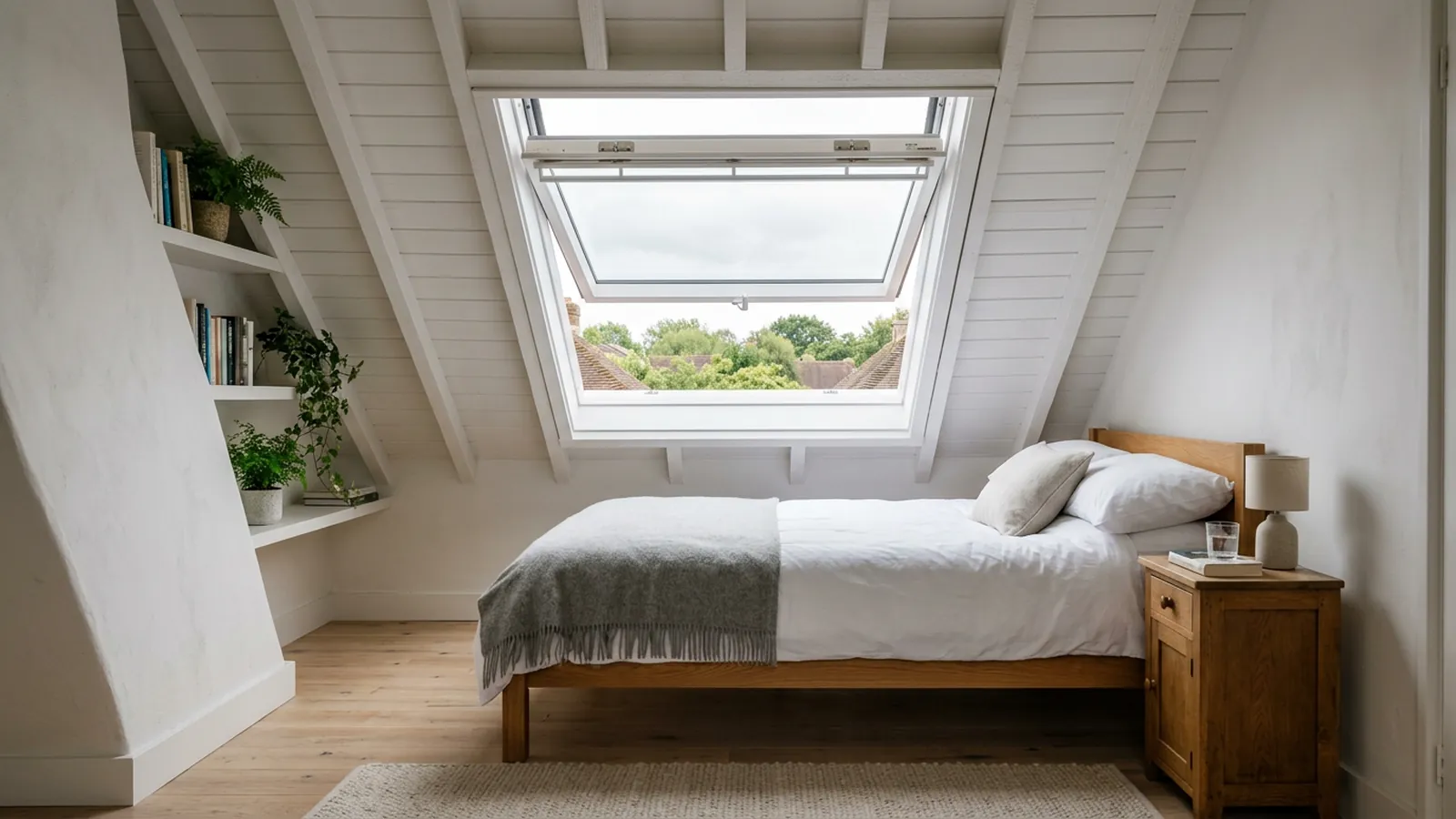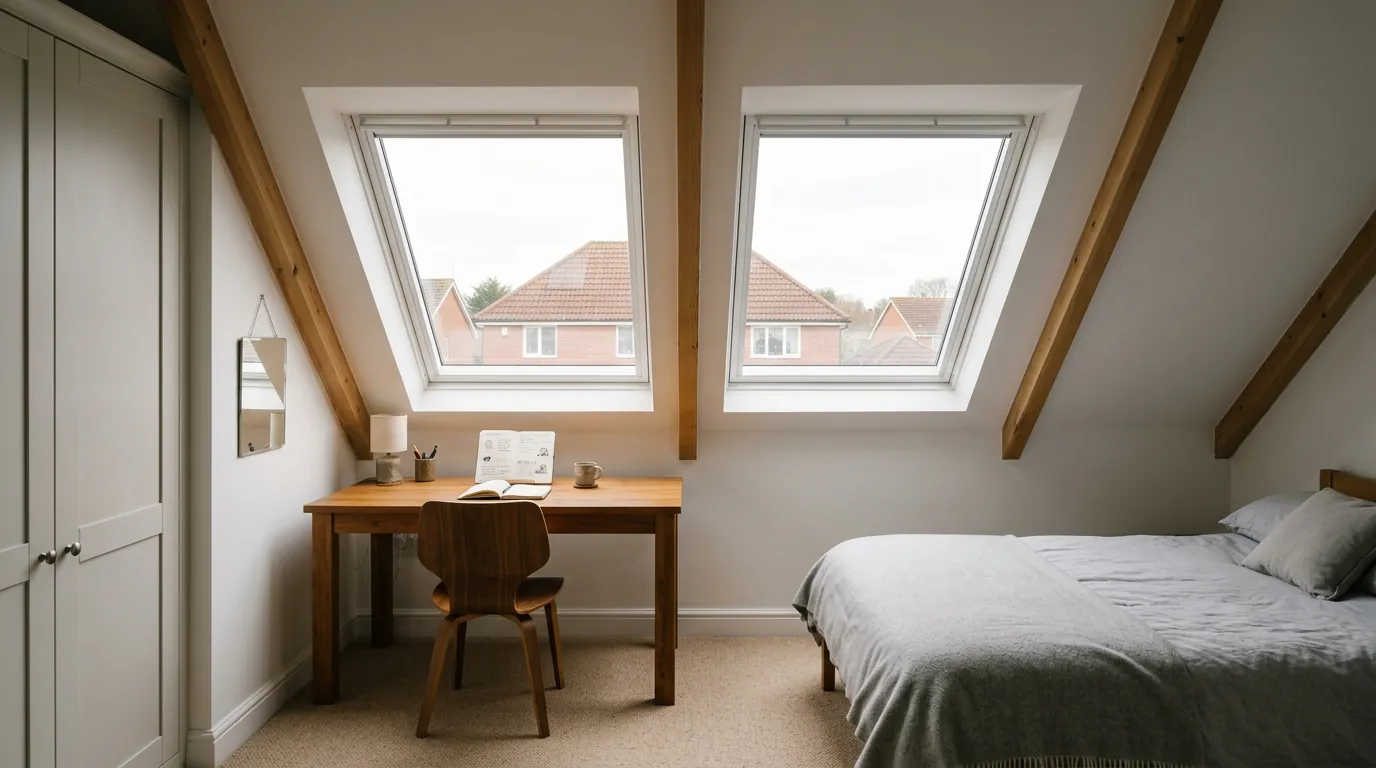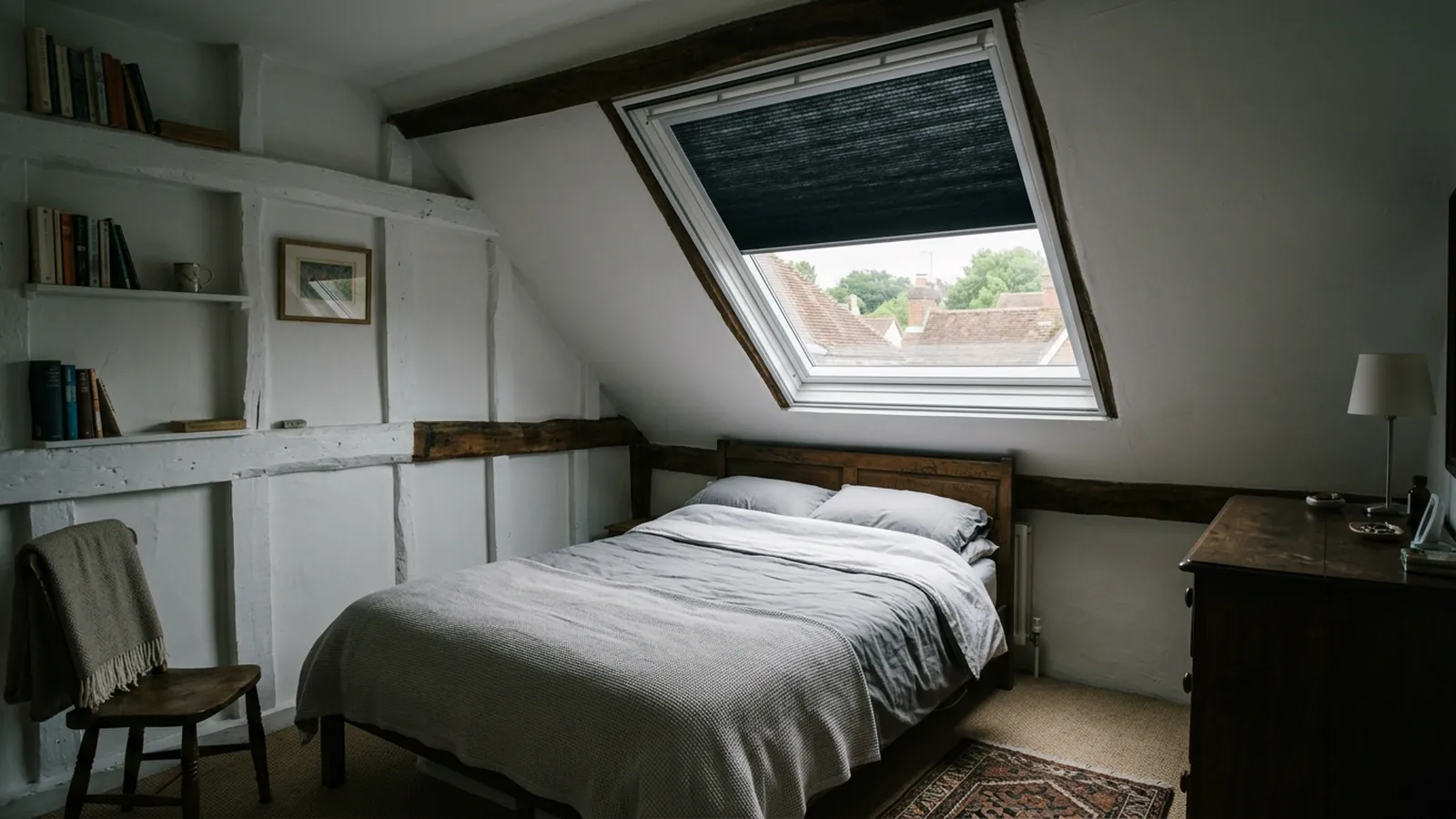
A roof window lets in more sky than an upright window of the same size, and on a summer afternoon that is exactly the problem. A south-facing loft bedroom in a Hatch Warren semi can be bright and pleasant at ten in the morning and too warm to sleep in by bedtime. A nursery under the slope of a Popley townhouse wakes with the dawn in June. The glass is doing its job; what the room is missing is control over it.
That control comes from the blind or shutter chosen for the frame. This guide sets out which VELUX accessory does which job, why a blind on the inside and a shade on the outside behave so differently with heat, how blackout is actually achieved on a sloping window, and what to decide before the window goes in so the right option simply clicks into place later.
Glare, heat and darkness are three separate jobs
Owners often ask for "a blind" when they really want one of three different outcomes, and the product that solves one can do very little for the others.
Glare is about light in your eyes or on a screen. It is solved by diffusing the daylight, so the room stays bright but soft. Heat is about solar energy passing through the glass and warming everything it lands on. It is solved by stopping the sun before it reaches the pane, which an interior blind cannot do. Darkness is about sleep: a bedroom that needs to be properly dark while it is still light outside, which calls for a fabric that blocks light and a frame that closes the gaps around it.
Deciding which of the three matters most for each room is the first step. A home office under a west slope is mostly a glare question. A loft bedroom on the south side of a trussed estate roof is heat and darkness together. A bathroom skylight may need privacy more than any of them.
A north-facing slope changes the brief again. It gets steady, even light with little direct sun, so heat protection is rarely the issue there, and a simple light-filtering or blackout blind usually covers everything the room needs.
How a sealed rooflight unit works and fails
- Outer and inner glass panes, with the outer pane facing the weather
- Low-emissivity coating on one inner face, reflecting heat back into the room
- Warm-edge spacer bar holding the panes apart, filled with desiccant to soak up trace moisture
- Primary seal against each pane, backed by the secondary seal around the edge
- Dry sealed cavity, the insulating layer between the panes
- Broken edge seal: moist air gets in and the desiccant becomes saturated
- Mist and droplets trapped between the panes; they cannot be wiped off and the sealed unit needs replacing
- Inset: condensation on the room-side face of the glass is a ventilation or humidity issue, not a failed unit
The VELUX range at a glance
VELUX makes its own blinds, shades and shutters to fit its roof windows, each sized to the window's code, and they are part of any VELUX roof window fitting specification from the start. The main families are set out below with the job each one is built for.
| Accessory | Where it sits | Main job | Worth knowing |
|---|---|---|---|
| Blackout blind | Inside, in side channels on the frame | Darkening a bedroom | Runs in aluminium side rails so light cannot creep round the edges |
| Duo blackout blind | Inside, two fabrics on one frame | Darkness at night, soft light by day | A pleated layer and a blackout layer, used separately or together |
| Roller blind | Inside | Diffusing glare | Light filtering rather than dark; suits studies and landings |
| Pleated blind | Inside | Softening light, decoration | Can be parked anywhere on the pane, useful for privacy |
| Venetian blind | Inside | Angling light, privacy in wet rooms | Aluminium slats wipe clean, which suits a bathroom |
| Heat protection awning blind | Outside, over the glass | Cutting solar heat | A mesh that keeps some view while shading the pane |
| Roller shutter | Outside, over the whole window | Heat and full darkness together | Electric or solar powered; also dulls the sound of heavy rain |
There are also insect screens and combined packs, but for heat and blackout the choice almost always comes down to an inside blackout blind, an outside awning blind, a roller shutter, or a pairing of an inside and an outside product.
Why the outside of the glass matters for heat
An interior blind stops sunlight from reaching you, but the heat has already passed through the glass. The fabric absorbs it, warms up, and gives that warmth back to the air in the room. A pale blind reflects some of it back out, yet much of the energy is now trapped between the blind and the pane, and in a small loft room that is felt quickly.
An external shade works the other way round. The mesh or shutter catches the sun on the roof side of the glass, so most of the heat stays outside and is carried away by the air moving over the slope. That is why VELUX sells its awning blind and roller shutters specifically as heat protection, and why a blackout blind alone, however good, will not keep a south-facing loft room cool.
An inside blind decides how light the room is; only something outside the glass decides how warm it gets.
Glazing plays its part too. A pane with a solar control coating reflects more of the sun's energy before any blind is involved, and the choice between glazing types is covered in our guide to VELUX glazing options. On a new window, glazing and shading are best specified together.
Getting a sloping window properly dark
A flat blind on a sloping window has a problem an upright window never has: gravity pulls the fabric away from the glass unless it is held. VELUX blackout blinds solve this with side channels that run up both edges of the frame, so the fabric is guided the whole way and light cannot leak round the sides. The bottom bar locks into position wherever it is stopped, including part way down.
That gives a room that is dark enough for most sleepers. For a child who wakes at first light, or anyone working nights, a roller shutter on the outside takes it further, because it closes over the entire window including the frame. Many owners pair the two: the shutter for summer mornings, the blackout blind for the rest of the year when the shutter can stay open.
The rule: for a bedroom, a blackout blind in side channels is the baseline, and it is chosen at the same time as the window. The exception is a room that faces the morning sun hard or is used for daytime sleep, where an outside roller shutter is the more complete answer.
Manual, electric or solar operation
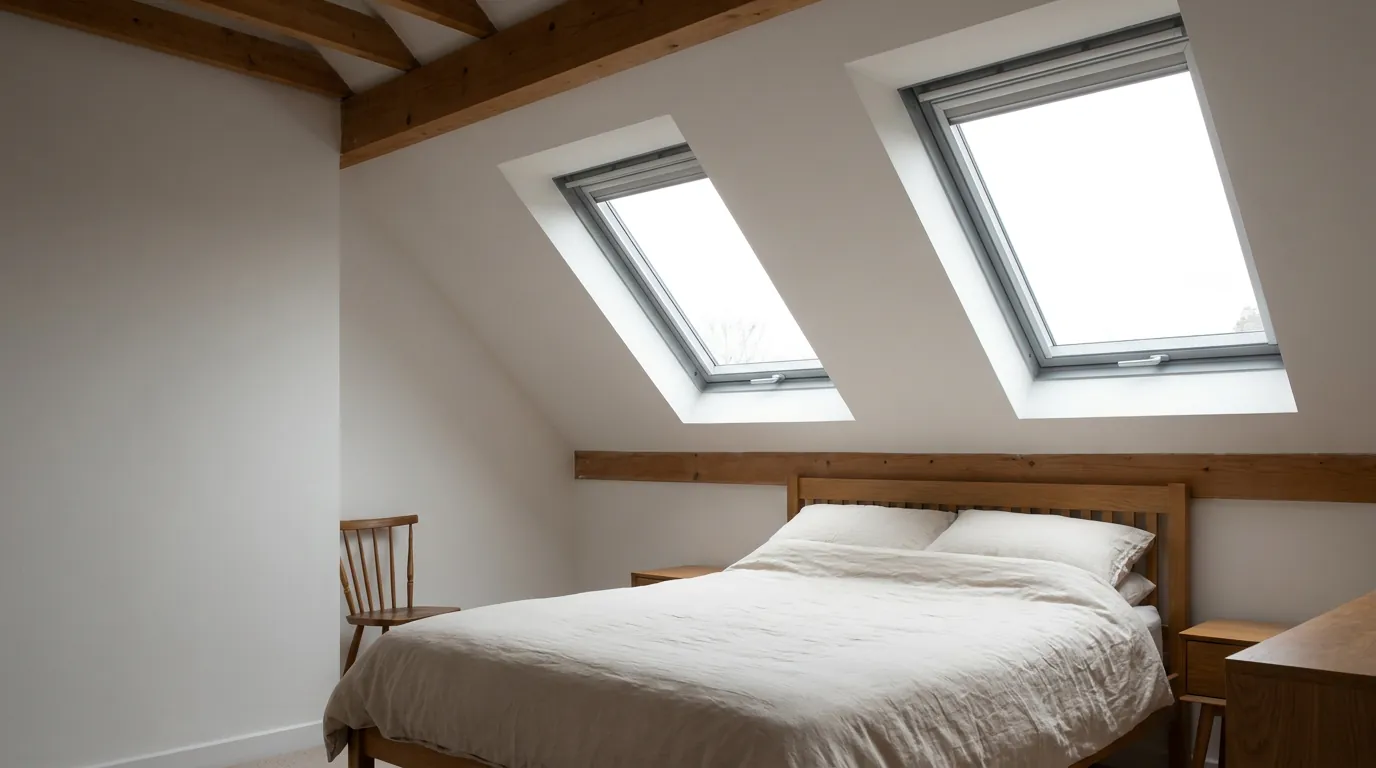
How a blind or shutter is worked depends largely on how high the window sits. A window within easy reach can take a manual blind moved by its handle bar. One set high in a vaulted ceiling or over a stairwell needs a rod, or a motor.
Electric and solar versions exist for the main blind types and for the shutters. A solar blind carries its own small panel and battery, so it needs no wiring and can be fitted to an existing manual window. An electric version draws power through the window's own control system and suits an INTEGRA window already wired in. Our guide to VELUX INTEGRA electric and solar windows covers how those systems are controlled, and the answer to can a manual VELUX be made electric? explains the conversion route if you are starting from a manual frame.
An outside roller shutter is always motorised, electric or solar, because nobody should be reaching out onto a roof to pull it down. Several shutters and blinds can be grouped on one control, which is useful where a pair of windows sits side by side in adjacent truss bays.
The size code decides what fits
Every VELUX blind and shutter is made to match one window size, and the link between them is the code printed on the frame's data plate, visible when the sash is opened. A blind for a CK02 fits a CK02 and nothing else. If you are buying an accessory later for an existing window, that code is the first thing to find; our answer on what the code on a VELUX means shows where to look and how to read it.
Current VELUX windows come with brackets already built into the frame, so a matching blind clicks into place in minutes without tools on the sash. Older windows may need a different bracket or a version of the blind made for the earlier frame type, and some very old frames have no current match at all. In that case the better move is often to replace the window itself, which is set out in our guide to upgrading an old VELUX in the same opening. The new frame then takes the full current range.
How the opening type affects the blind
A centre pivot window and a top hung window both take the same VELUX blinds, because the blind is mounted on the sash and travels with it when the window opens. On a centre pivot, the sash turns over for cleaning and the blind goes with it. On a top hung window, which opens outwards from the top and gives a clear view, the blind sits on the sash in the same way.
Where the opening type matters more is with outside products. An awning blind or roller shutter is fixed over the frame and must be open, or raised, when the sash is opened fully. That is managed by the control, but it affects how you use the window on a hot day. The wider choice between the two opening styles is covered in choosing between VELUX top hung and centre pivot.
Blinds in bathrooms and on cold nights
A skylight over a bath or shower brings its own conditions: steam, splashes and cleaning products. Aluminium Venetian blinds and moisture-resistant fabrics suit those rooms best, and keeping the room ventilated matters more than the blind itself. The question of where a roof window can sit over wet areas is answered in is a VELUX suitable over a shower or bath?
Blackout blinds closed on a winter night also hold a pocket of air against the glass. That adds a little insulation, but the air trapped there is cooler, so moisture in the room can settle on the pane by morning. Opening the blind for part of the day and running ventilation reduces it. Our answer on why condensation forms on a VELUX explains the causes in full.
Planning the shading when the window goes in
Blinds can be added at any time, but a few decisions are far easier to take before installation. Running through them at the survey keeps later choices open.
- Which way the slope faces. A south or west slope points towards outside shading; a north slope rarely needs more than an inside blind.
- What the room is for. Bedrooms get a blackout blind specified from the start; offices and landings a glare blind.
- How high the window sits. Out-of-reach frames are planned with solar or electric operation rather than a rod.
- Whether power is wanted. If an INTEGRA window or a wired shutter is likely, the supply route is agreed before the lining goes in.
- The lining and reveal. Side channels and bottom bars need clean, square reveals to run smoothly, so the internal finish is planned with the blind in mind.
That last point is often overlooked. The inside finish around the frame is covered in our guide to recessed installation and VELUX linings, and it is worth reading alongside this one if the room is still being built.
Putting the right shade on your rooflight
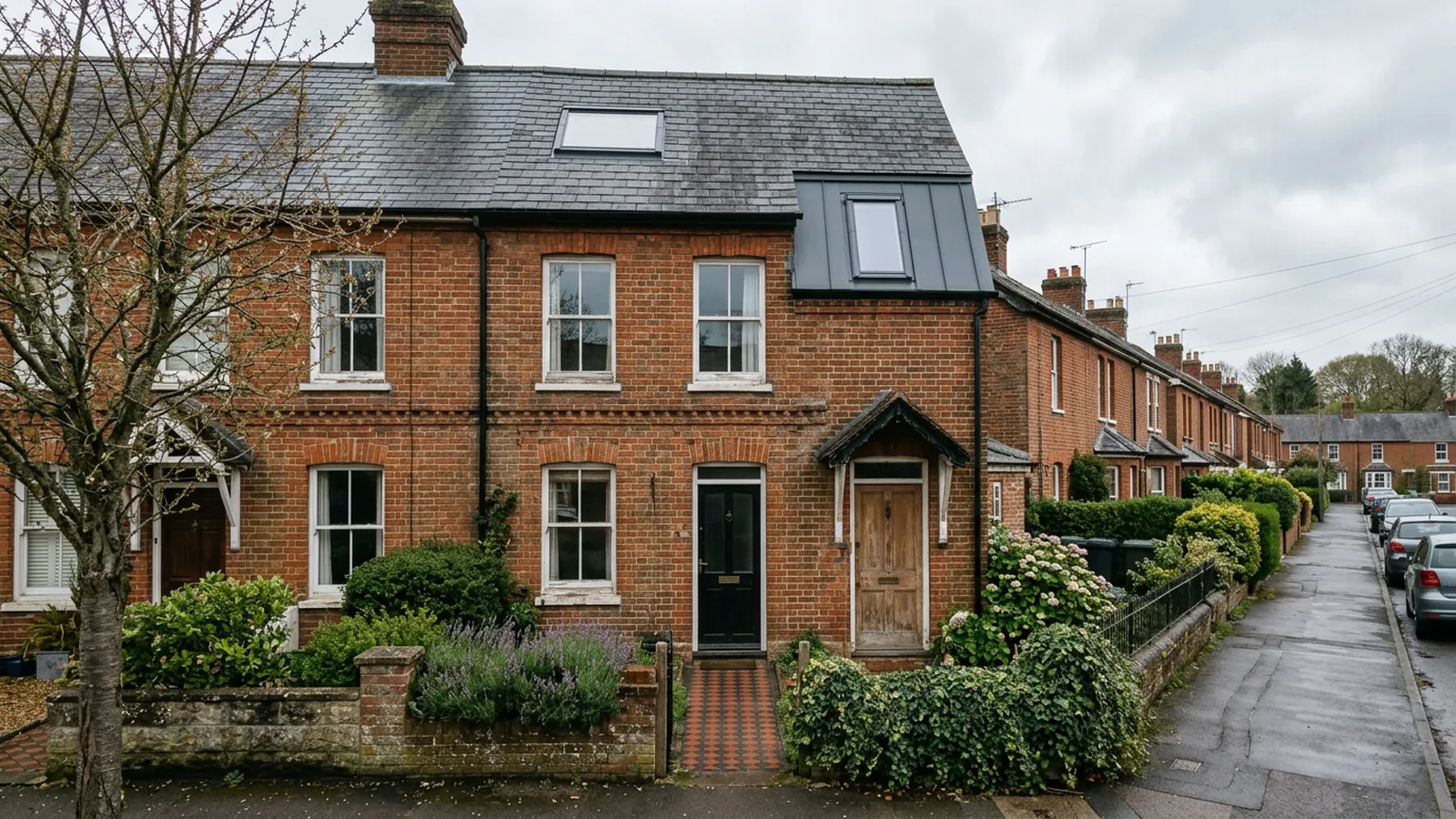
For heat, look outside the glass: an awning blind if you want to keep a view, a roller shutter if you also want the room dark. For darkness alone, a blackout blind in side channels, chosen when the rooflight is specified. For glare and privacy, a roller, pleated or Venetian blind to suit the room. Most loft bedrooms end up with two layers, one inside and one out.
Our VELUX window installation page sets out the full job from survey to finished lining, and every roof window we fit carries a 10-year workmanship guarantee. If you would rather start with the wider picture, the skylight installation Basingstoke homepage explains how the roof itself shapes the choice. When you know which rooms need what, arrange a survey of your roof and the shading can be written into the specification from day one.