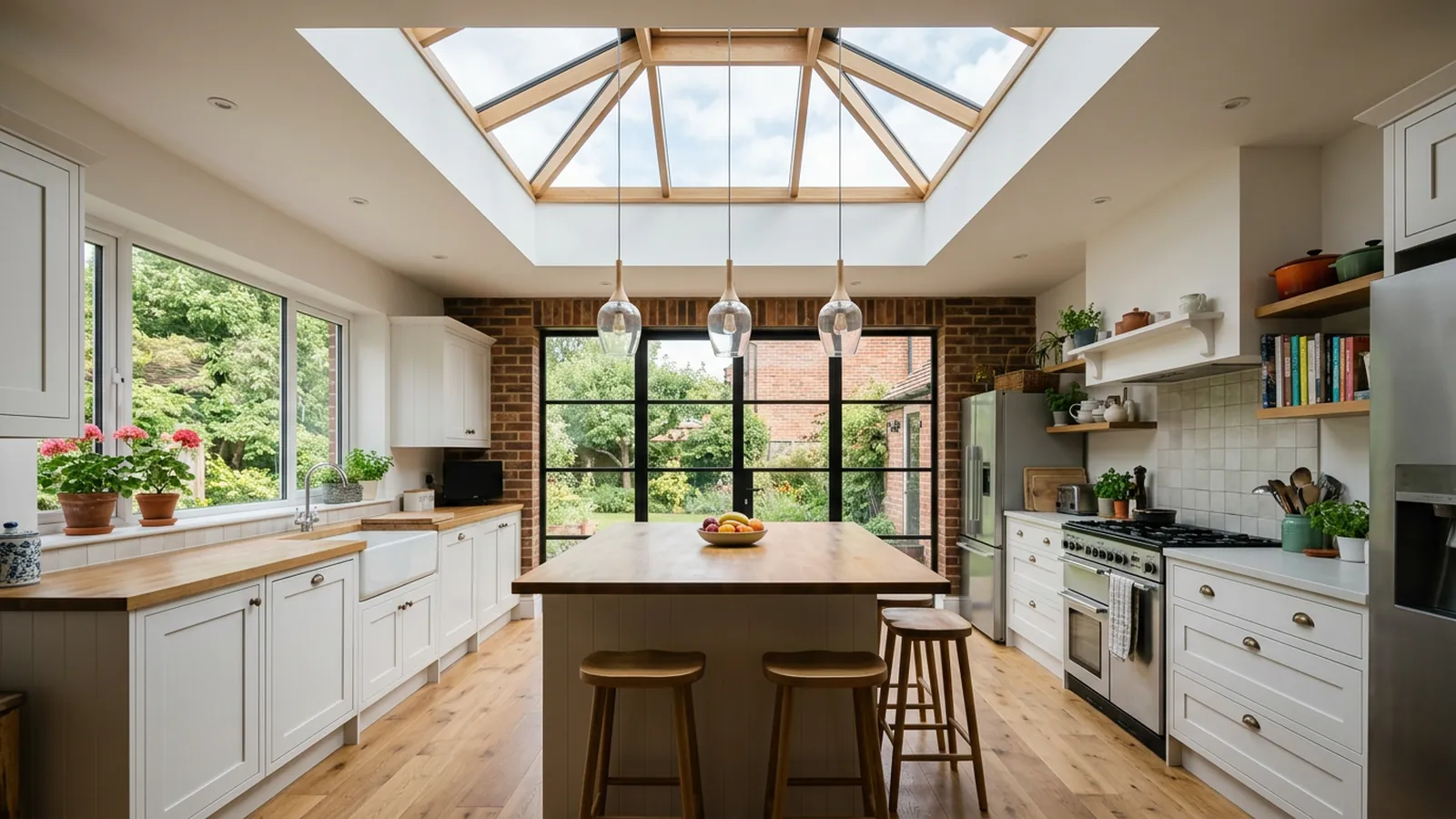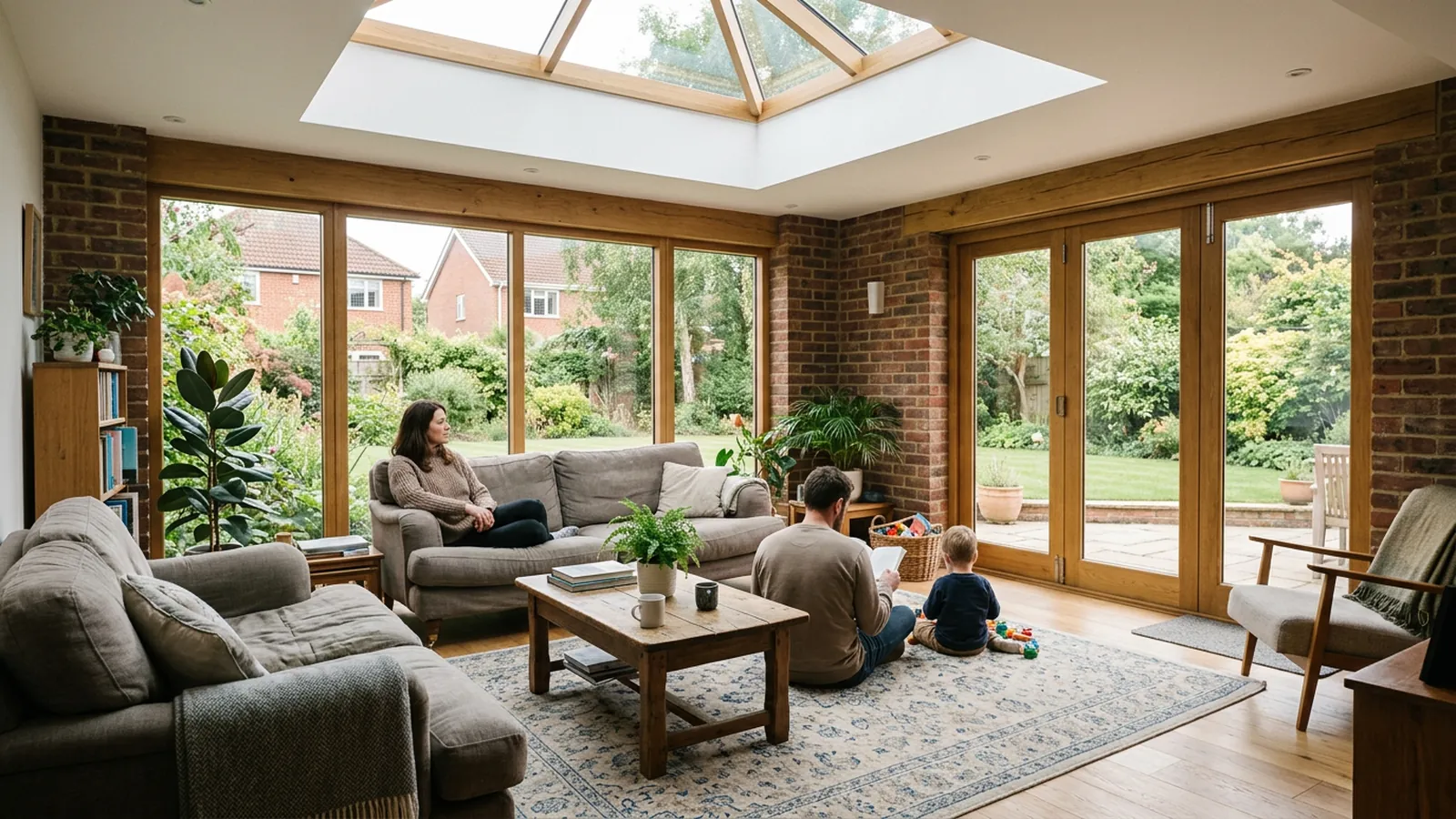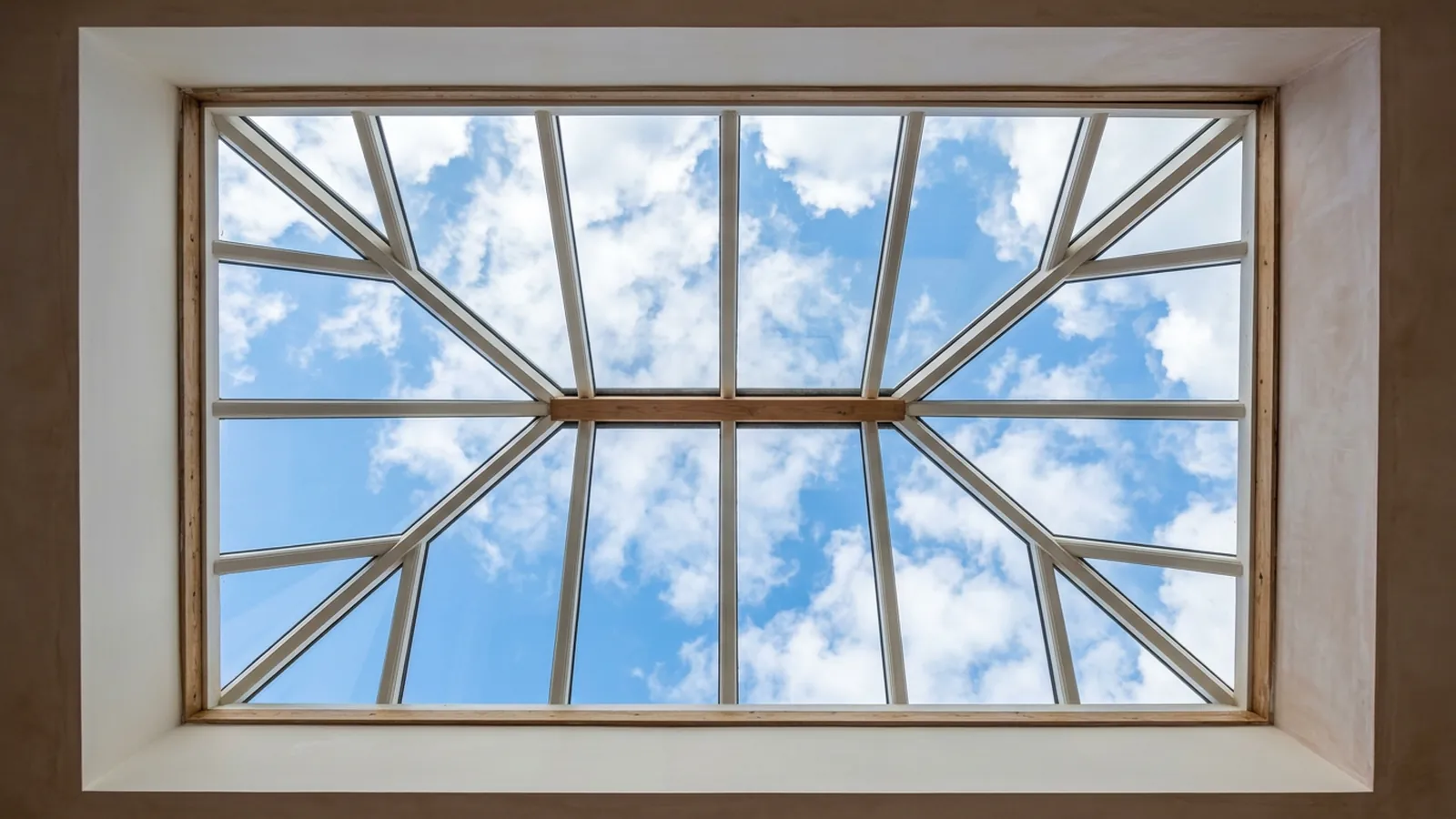
Stand under a roof lantern and look up. The first thing you notice is not the glass. It is the frame: the ridge along the top, the hips at each end and the run of bars that come down from them to the kerb. Those bars decide how much sky you see, how the lantern copes with a cold January night, what colour the underside reads as from the kitchen table and how the whole thing looks after years of sun on a flat roof. This guide sets the two common bar materials, aluminium and uPVC, side by side so the choice is made on the room and the roof, not on a brochure.
Neither material is the wrong answer, and both are fitted as part of our roof lantern installations. Each suits a different kind of extension, and the right pick depends on the span, the finish you want inside and what the rest of the back of the house is made of.
What the glazing bars on a lantern are actually doing
A lantern is a small pitched roof made of glass. The ridge carries the top edge of every pane, the hip bars carry the corners, and the rafter bars in between hold the long edges of the glass on each slope. Down at the bottom, a ring beam sits on the kerb and takes everything that the bars pass down to it. So the bars are structure first and trim second: they carry the weight of the double or triple glazed units, and they resist the push of wind and the load of snow lying on the slopes.
They are also the lantern's weakest point for heat. Glass units have a measured thermal performance; the frame around them is where warmth escapes and where cold shows up as a line of damp on the inside face. That is why the material and the way the bar is built matter more on a lantern than on a single flat rooflight, which has one frame around one pane rather than a lattice of bars across the whole roof.
How a roof lantern sits on a flat roof
- Ridge, where the glazing bars meet at the top
- Hip bar, closing each sloped end of the lantern
- Glazing bar, holding the edges of the glass
- Glass panel, sealed double or triple glazed units
- Eaves or perimeter frame, which the whole lantern stands on
- Insulated kerb (upstand), raising the lantern clear of the roof
- Flat roof covering, dressed up the kerb and under the frame
- Plastered reveal, lining the lantern well into the room below
The two systems in plain terms
Aluminium bars
An aluminium lantern is built from extruded aluminium sections. Because the metal is stiff and strong for its size, the bars can be slim and still span a long slope. A good aluminium system has a thermal break: a strip of insulating material that separates the outside face of the bar from the inside face, so cold on the roof side does not travel straight through to the room. The finish is a powder coat baked onto the metal, and it can be a different colour outside from inside.
uPVC bars
A uPVC lantern uses plastic profiles for the visible faces of the bars, ridge and hips. On its own, uPVC is not stiff enough to carry glass over a long span, so these systems are built around an internal reinforcement, usually an aluminium or steel core hidden inside the plastic cladding. PVC is a poor conductor of heat, which helps the bar stay warmer on the room side. The colour is either the plastic itself, typically white, or a foil laminate applied over it.
Some systems blur the line, with an aluminium structure and a PVC or insulated cover on the inside. When you compare quotes, ask what the bar is made of all the way through, not only what you can see from below.
Aluminium against uPVC, point by point
The table sets out how the two compare on the things that change what living under the lantern is like. It is a general comparison between well made systems of each kind; the specific product chosen after the survey is what counts.
| Consideration | Aluminium bars | uPVC bars |
|---|---|---|
| Bar width from below | Slimmer, so more glass and less frame in view | Chunkier, because the plastic has to wrap its reinforcing core |
| Span and size | Suits longer slopes and larger lanterns | Comfortable on modest sizes; larger ones need heavier bars |
| Heat through the frame | Depends on a proper thermal break in every bar | PVC insulates well on its own; the core sits inside it |
| Colour | Powder coat in a wide range, with a different colour inside and out | White as standard; other colours by foil |
| Matching nearby frames | Lines up with aluminium bi-folds and sliding doors | Lines up with white uPVC windows and French doors |
| Long term finish | Powder coat holds its colour under sun | Modern white PVC is UV stabilised; older grades could dull |
| Cost position | Generally the higher of the two | Generally the lower of the two |
Sightlines: how much sky you actually get
From the room, a lantern is judged by the ratio of glass to frame. On a small lantern over a narrow galley kitchen the difference between the two materials is modest, because there are only a few bars in view. As the lantern gets longer and wider, the bar count rises and each bar has to be deeper to carry its span. That is where aluminium earns its keep: it holds the same load with a narrower profile, so the lantern reads as a sheet of sky with fine lines through it rather than a grid.
On a lantern, the frame is the part you look at every day; choose it for the view from the chair, not the view from the garden.
uPVC bars are wider on the inside face, and that can suit a room. A white bar against a white ceiling can look soft and traditional, closer to a conservatory roof, which suits a house where the rest of the back elevation is white plastic windows. The point is to decide which look you want before you pick the material, not after.
Span, size and what sits on the kerb
How long and wide a lantern can be depends on the system, the glass and the bar material together. Aluminium systems generally stretch further before the bars need extra depth or an intermediate support, which is why large lanterns over open plan kitchen diners are often aluminium. A uPVC lantern of the same size needs heavier bars and reinforcement, and there is a point at which a manufacturer will not offer it at all. How big a roof lantern can be covers the size limits in more detail.
Weight follows the glass more than the frame. Double or triple glazed units are the heavy part, and the kerb and the roof structure beneath have to carry them whichever bar you choose. Our answer on how heavy a roof lantern is explains what that means for the flat roof below. The size itself should come from the room rather than the roof, which is the whole argument of sizing a roof lantern to the room below.
Cold bars, warm rooms and condensation
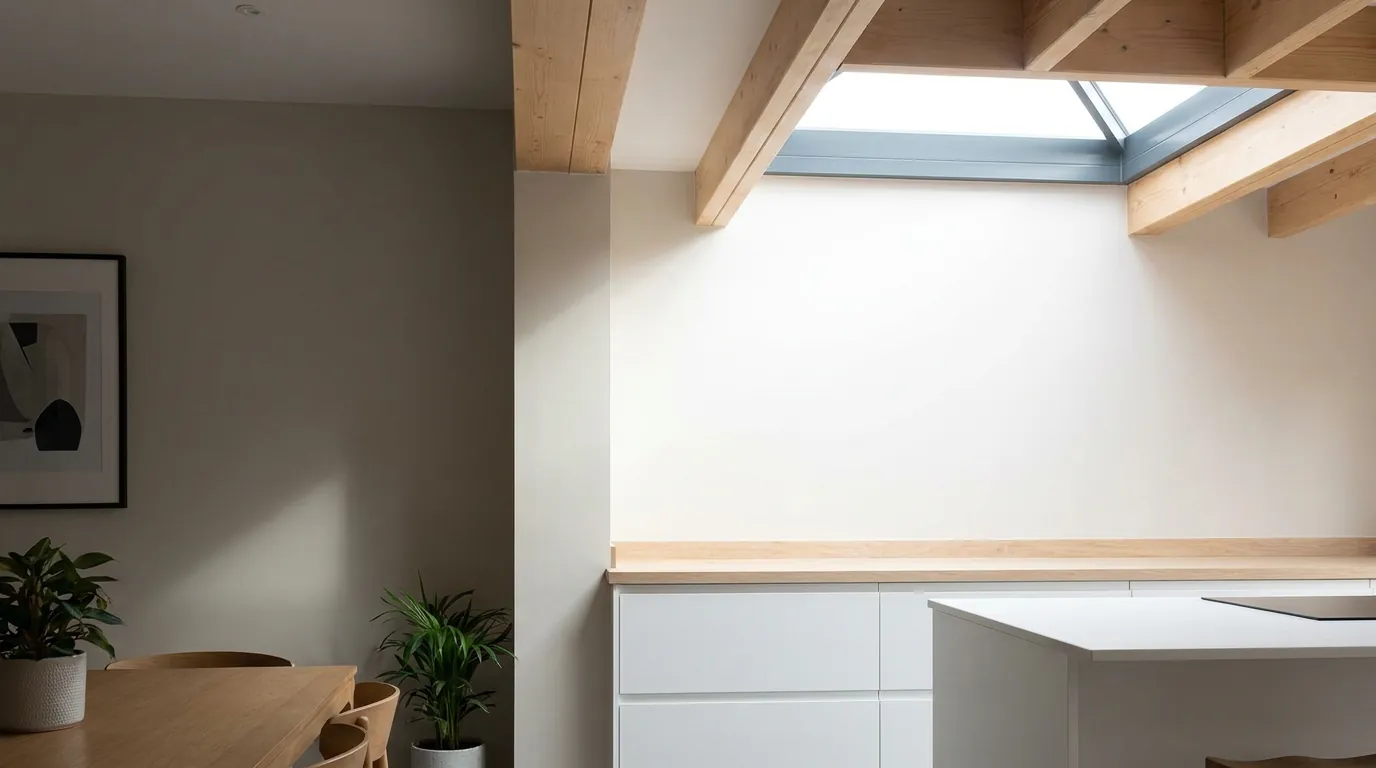
On a cold night, the inside face of the lantern is the coldest surface in the kitchen. Warm, moist air from cooking and washing meets it, and if any part of the frame is cold enough, water forms on it. Glass units with a warm edge spacer resist this at the edges of the panes; the bars are where it shows first if the frame lets cold through.
With aluminium, the thermal break is what stops that. A properly broken bar keeps the outer and inner metal apart, so the room side stays nearer to room temperature. uPVC starts with an advantage because the plastic itself insulates, though its metal core still needs to sit inside the PVC and not touch the room side.
The rule: never accept an aluminium lantern without a thermal break in the ridge, hips and bars. The exception is not a material but a room: even a well broken frame will gather moisture if the kitchen has no extraction or trickle ventilation, so the room's airflow has to be right too.
Ventilation is its own subject, and condensation, ventilation and Part F under a roof lantern goes through it. For the heat side of the whole roof, the energy efficient rooflights service explains how glass and frame are rated together.
Colour, finish and matching the back of the house
A lantern is rarely seen on its own. From the garden it sits above a run of doors, and from inside it sits above the same doors and the kitchen units. The frame colour should belong to that picture.
Aluminium is powder coated, and the choice of colours is wide. Anthracite and other dark greys are a common pairing with aluminium bi-folds, and a dual colour finish lets the outside match the doors while the inside stays white or a light tone so the ceiling does not feel heavy. Powder coat is a hard, even finish that holds its colour on a sunny south or west facing roof.
uPVC is white unless a foil is applied. Foiled finishes in grey or wood effects exist, though the range is narrower and the foil sits on the outer faces. On an extension where the windows and French doors are white uPVC, a white uPVC lantern ties in without any matching to think about. If the doors are aluminium, a white plastic lantern above them can look like two different builds, which is a reason to take the bars in aluminium too.
How each ages on an estate extension
Around Basingstoke, a roof lantern often sits on a single storey kitchen extension at the back of an estate house: 1970s semis in Brighton Hill, terraced townhouses in Oakridge and Popley, and newer detached houses in Hatch Warren and Chineham. The flat roof on those extensions sits in full sun for much of the day and takes rain, frost and leaf litter in turn.
A powder coated aluminium bar is largely indifferent to that. It is cleaned with water and a soft cloth and keeps its finish. White uPVC made to current standards carries UV stabilisers and holds its colour well; the dull, yellowing white on some older conservatory roofs came from earlier grades of plastic and from polycarbonate sheet, not from the modern profiles fitted with glass today. If your extension still carries an old polycarbonate lantern, swapping a polycarbonate lantern for glass sets out what changes.
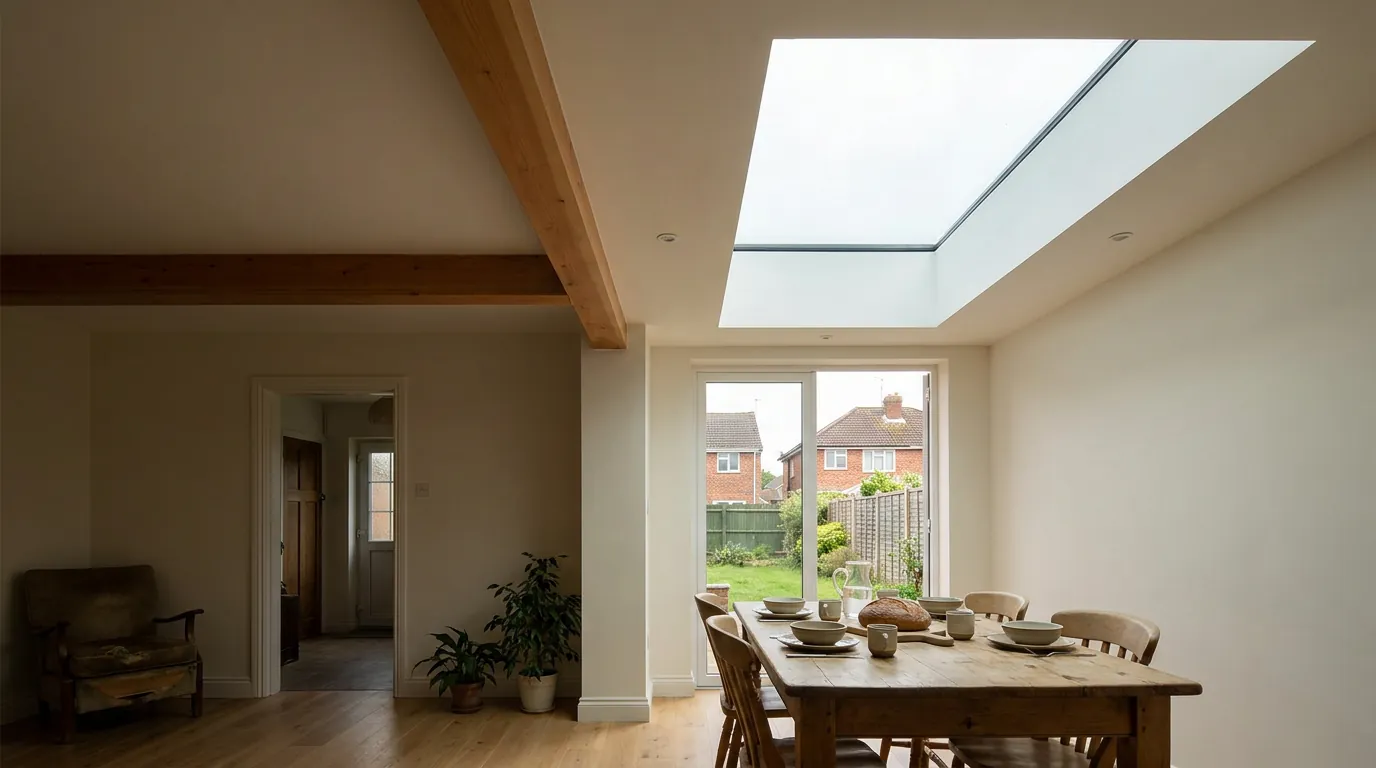
Either way, the bars need the same simple care: keep the kerb and the roof around it clear, and clean the glass and frame from a safe position. How to clean a roof lantern safely covers that.
The glass sits in the bars, so choose them together
The bar material and the glass specification are two halves of one decision. Heavier triple glazing or larger panes push towards a stiffer bar; solar control coatings on a south facing lantern change how warm the frame and the room get in summer. It pays to read the bars and the glass as one package when a quote lists them.
| Glass decision | What it asks of the bars |
|---|---|
| Triple glazed units | More weight per pane, so a stiffer bar or shorter spans |
| Larger single panes | Fewer bars, each carrying more, which favours aluminium |
| Solar control coating | No change to the bar, but a cooler room in summer |
| Self cleaning outer pane | No change to the bar; less time spent on the glass |
For the glass itself, see what glass goes into a roof lantern, and for summer heat, solar control glass under a roof lantern.
Working out which suits your extension
If you are still undecided, run through these in order. Each one narrows the choice, and by the end the answer is usually plain.
- Look at the doors below. Aluminium bi-folds or sliders point to aluminium bars; white uPVC French doors point to uPVC, unless you plan to change them.
- Measure the room, not the roof. A long open plan space needs a longer lantern, and length favours the slimmer, stiffer bar.
- Decide the inside colour. If you want a dark frame outside and a light one inside, that is a dual colour powder coat, which means aluminium.
- Check the thermal detail. Whichever you choose, ask how the ridge, hips and bars stop cold reaching the room side.
- Set it against the budget. uPVC generally comes in lower; aluminium buys sightlines, span and colour choice.
- Let the survey confirm it. The kerb, the joists and the roof finish are measured before any system is ordered.
What moves the price between the two
The frame material is only one line in the cost of a lantern. Aluminium systems generally cost more than uPVC for the same size, and dual colour finishes add to that. But the size of the lantern, the glass specification, whether the flat roof needs a new opening trimmed in the joists, the kerb, the access to get the lantern up there and the making good inside all move the figure too, and often by more than the choice of bar. Our answer on how much a roof lantern costs to install lists those factors in full. We give a written quote only once the roof has been seen.
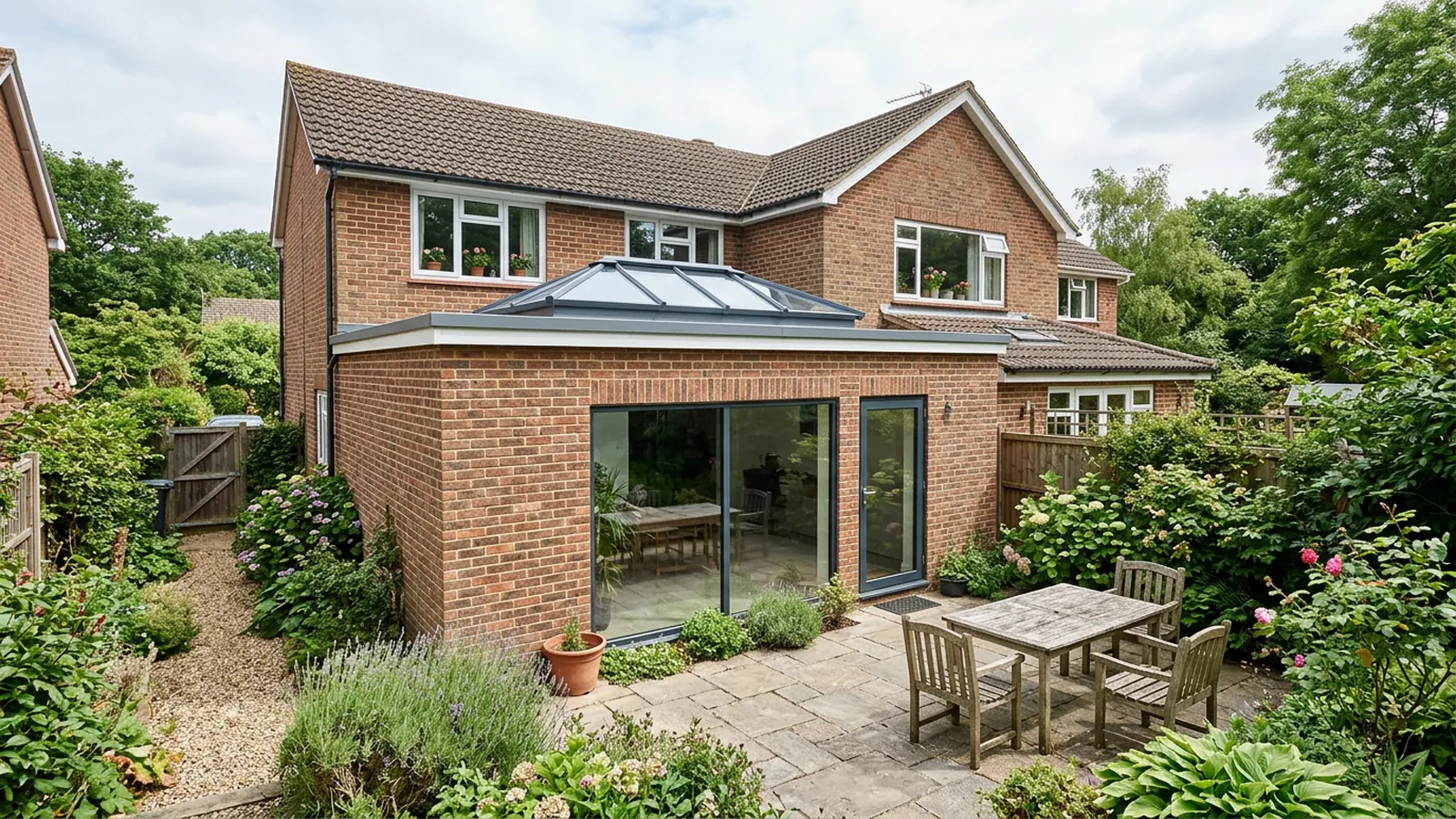
Where the survey comes in
A catalogue can tell you what a bar looks like. It cannot tell you whether your extension's joists run the right way for the opening, how high the kerb has to be above the roof finish, or whether the room below would be better served by a longer lantern or a wider one. The survey answers those, and the bar material is settled alongside them rather than in isolation.
The work that follows is notifiable in many cases, and the Building Control side is dealt with by us as part of the job. The installation carries a 10-year workmanship guarantee, which is not insurance backed. For the full picture of how a lantern goes in, from opening to finished kerb, start at our roof lantern installation service, and for rooflights and skylights across the rest of the house, the Everlight homepage has every option in one place. When you know roughly the look you are after, arrange a visit to the roof and bring the question of aluminium or uPVC with you.