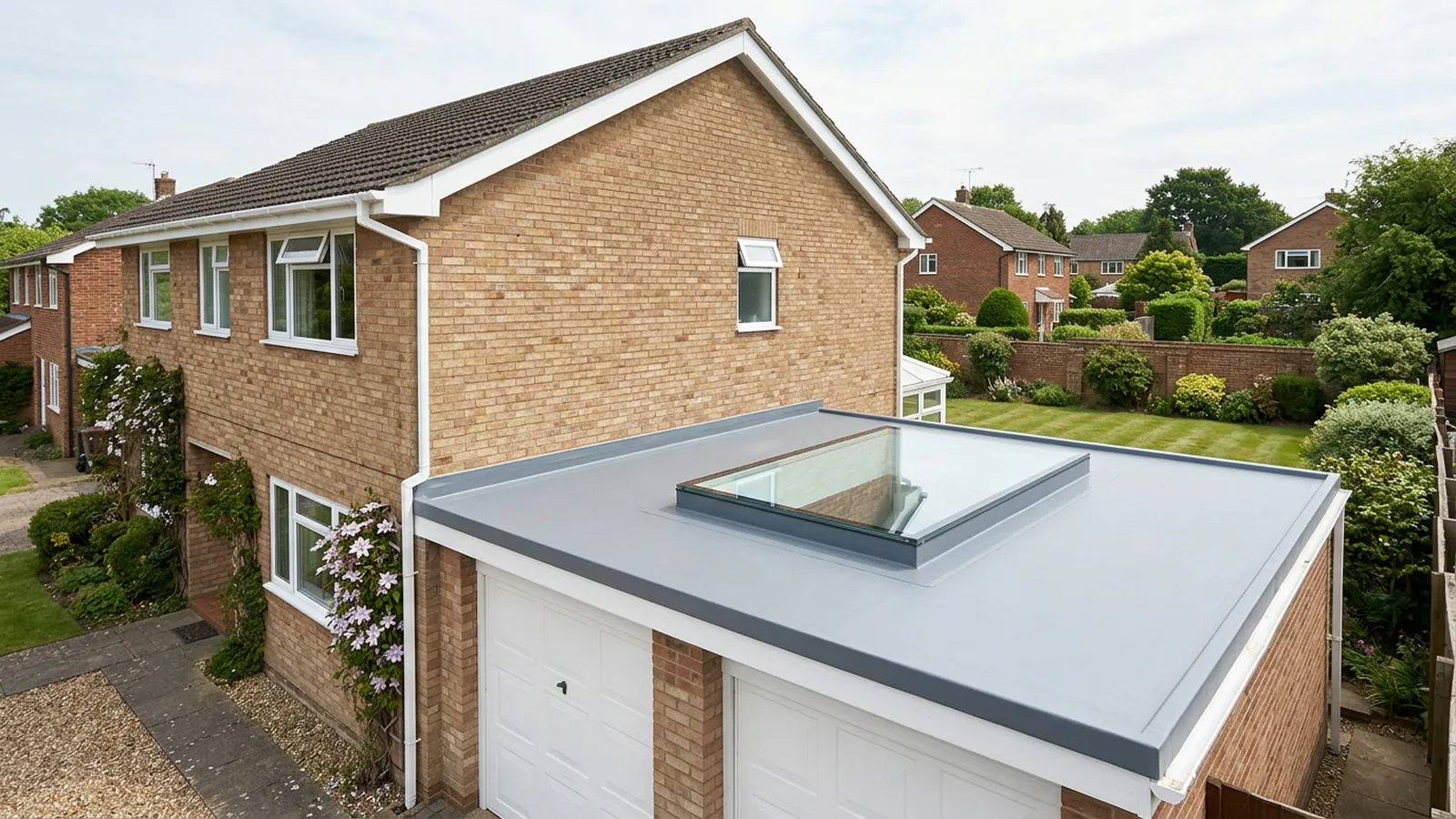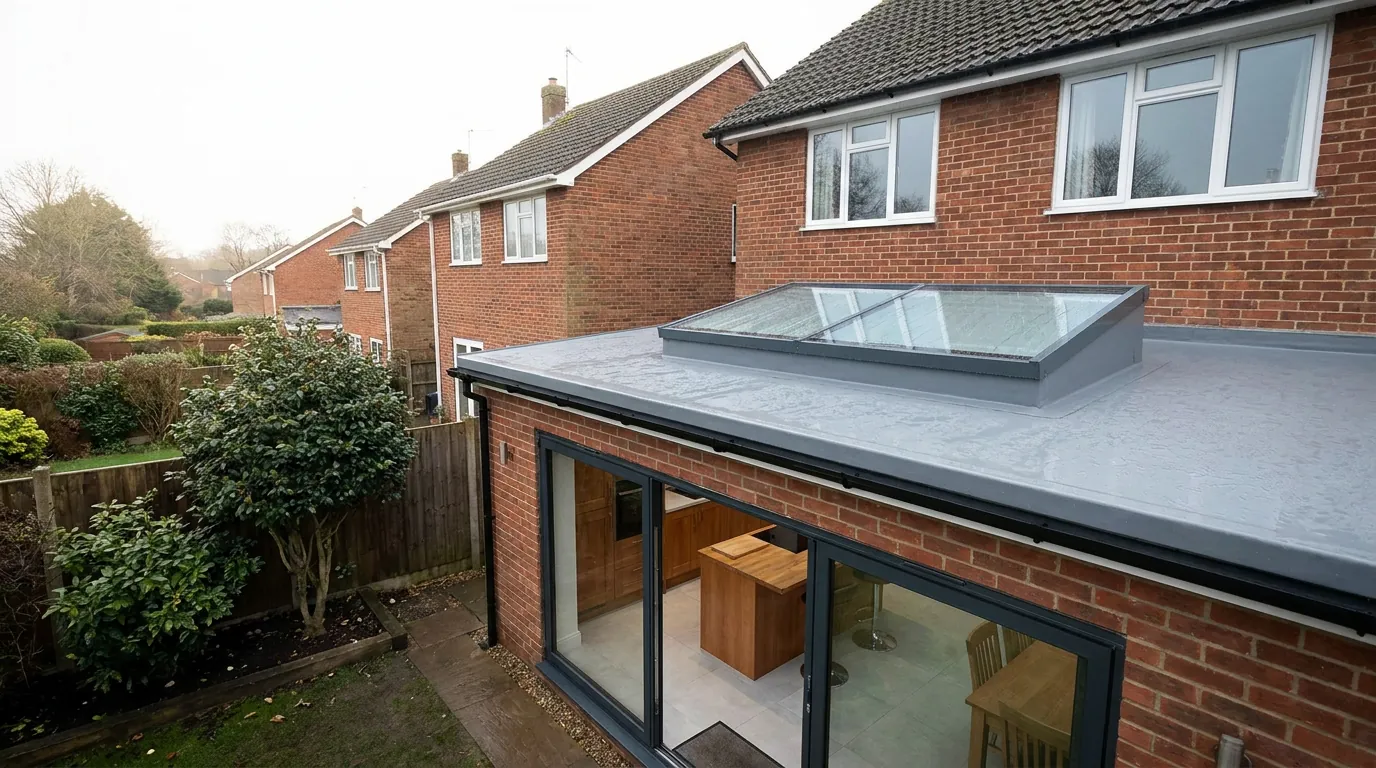
Winter is often when people notice the problem. Cold glass shows misting and condensation far more clearly than a summer pane does, so the question arrives just as the weather turns. Our page on misted and failed rooflight replacement covers the whole service; this answer deals only with the season, and with what a cold, wet month means for getting the old unit out and the new one in.
Why the season matters less than the day
Swapping a rooflight in its existing opening is a contained job. The old frame comes out, the new skylight goes into the same hole, the flashing is dressed to the covering and the inside is made good. The roof is exposed for part of one working day, not for weeks, so what counts is a single suitable day with dry conditions and manageable wind.
A British winter still has plenty of those. A cold, bright, still morning after a frost has lifted is often a better working day than a gusty one in spring. Summer brings its own interruptions too, from thundery showers to heat that makes tiles and leadwork awkward to handle. The detail of reading forecasts and choosing dates sits in our guide to replacing a failed rooflight around the weather and the season.
How a sealed rooflight unit works and fails
- Outer and inner glass panes, with the outer pane facing the weather
- Low-emissivity coating on one inner face, reflecting heat back into the room
- Warm-edge spacer bar holding the panes apart, filled with desiccant to soak up trace moisture
- Primary seal against each pane, backed by the secondary seal around the edge
- Dry sealed cavity, the insulating layer between the panes
- Broken edge seal: moist air gets in and the desiccant becomes saturated
- Mist and droplets trapped between the panes; they cannot be wiped off and the sealed unit needs replacing
- Inset: condensation on the room-side face of the glass is a ventilation or humidity issue, not a failed unit
What cold, wet weather actually affects
Each winter condition touches a different part of the work. None of them rules a job out; each one shapes when and how it is done.
| Condition | What it affects | How the job allows for it |
|---|---|---|
| Frost and ice | Footing on tiles and ladders, and brittle concrete or clay tiles that crack when lifted | Work starts once the roof surface has thawed and dried, never on a frozen slope |
| Rain | An open roof, wet timber and flashing that will not bond to a damp surface | A dry forecast for the working day, with sheeting ready in case a shower arrives |
| Wind | Safe handling of a large glazed unit on a pitched roof, and loose sheeting | A calmer day is chosen; bigger units wait for one |
| Low temperatures | Sealants, adhesives and flat roof membranes, which each carry a maker's minimum application temperature | Products are used within their stated range, and bonding waits if the day is too cold |
| Short daylight | The working window on the roof itself | An early start so the opening is closed well before dusk |
Pitched roof windows and flat rooflights in winter
A roof window in a tiled or slate slope
On a pitched roof the replacement window and its flashing kit are mechanical: the frame fixes to the timbers and the flashing pieces interlock with the tiles or slates. That makes the pitched swap the more winter-tolerant of the two, provided the tiles are dry and free of frost when they are lifted. Where the new frame is the same size as the old one, the tiles around it are disturbed only slightly, which our guide to replacing a failed rooflight in the same opening explains.
A flat rooflight on an extension
A flat roof is the more weather-sensitive case. The new rooflight sits on an upstand, and the roof membrane has to be dressed and bonded up to it. Membranes and their adhesives need a dry surface and a temperature within the manufacturer's range, so a flat rooflight in December may simply wait a few days longer for the right morning than a roof window in the slope would.
How the room is protected while the roof is open
Cold air and a chance shower are the two winter worries once the old unit is out. The sequence below is how the opening stays covered and the house stays warm.
- Order first. The new rooflight is measured at survey and delivered before any date is fixed, so the old one never comes out while the replacement is still on order.
- Clear and cover inside. Furniture below is moved or sheeted and dust sheets go down, and the room door is kept shut so the rest of the house holds its heat.
- Out and in on one visit. The failed unit is removed and the new one fitted in the same session, so the hole is not left open overnight.
- Weather protection on hand. Heavy sheeting is kept ready at the opening in case a shower arrives unannounced.
- Close and finish. Flashing is dressed, the inside lining is made good and the room is tidied before the light goes.
When waiting for spring is fine, and when it is not
If the only sign is misting between the panes, the unit has lost its seal but is still keeping the weather out. That is a nuisance for light and heat rather than a threat to the room, so choosing a milder month is a reasonable call; our answer to is a misted rooflight a problem? sets out why. Cracked glass is a different matter, and how long a cracked rooflight can wait covers when to act sooner.
Water marks spreading on the ceiling, a frame that has swollen or rotted, or a pane that has shifted are reasons not to wait for better weather. In those cases the right step is to book the survey now and pick the first dry, calm day after it.
Infographic
How a rooflight job runs, from survey to guarantee
Roof survey
We look at the structure, the covering and the room below before anything is priced.
Specification
A size, type and position that fits your roof, and whether the work is notifiable.
Paperwork
Building Control notified where the work needs it, and planning checked where it applies.
Installation
Opening formed, frame fixed, flashed or dressed in, then lined and finished inside.
Sign-off and guarantee
Completion paperwork where needed and a 10-year workmanship guarantee.
Timing, notification and what stays the same
Winter does not change the paperwork. Where replacing the rooflight counts as notifiable work, we look after the Building Control notification whatever the month. The finished installation carries the same 10-year workmanship guarantee in January as in July; it is not insurance backed. How long the swap itself takes depends mainly on the type and size of the unit, which is covered in how long replacing a misted rooflight takes.
The one real difference is patience with dates: in a wet spell a booked day may move by a few days to find a dry one. For homeowners in Basingstoke looking at a replacement skylight or rooflight, the practical step is the same in any season. Let us see the roof first, then fix the day. Arrange your survey here and we will plan the swap around the forecast.