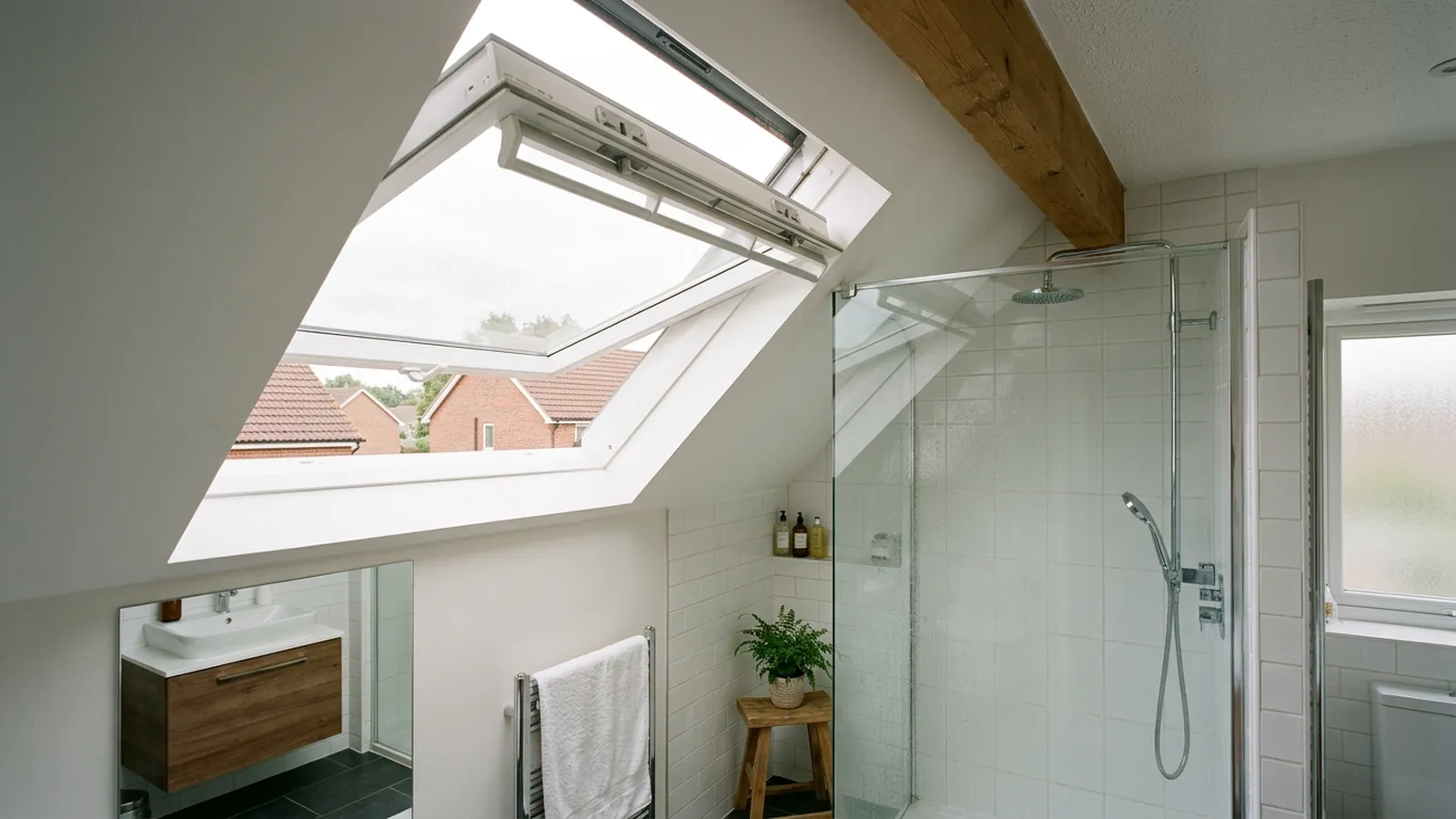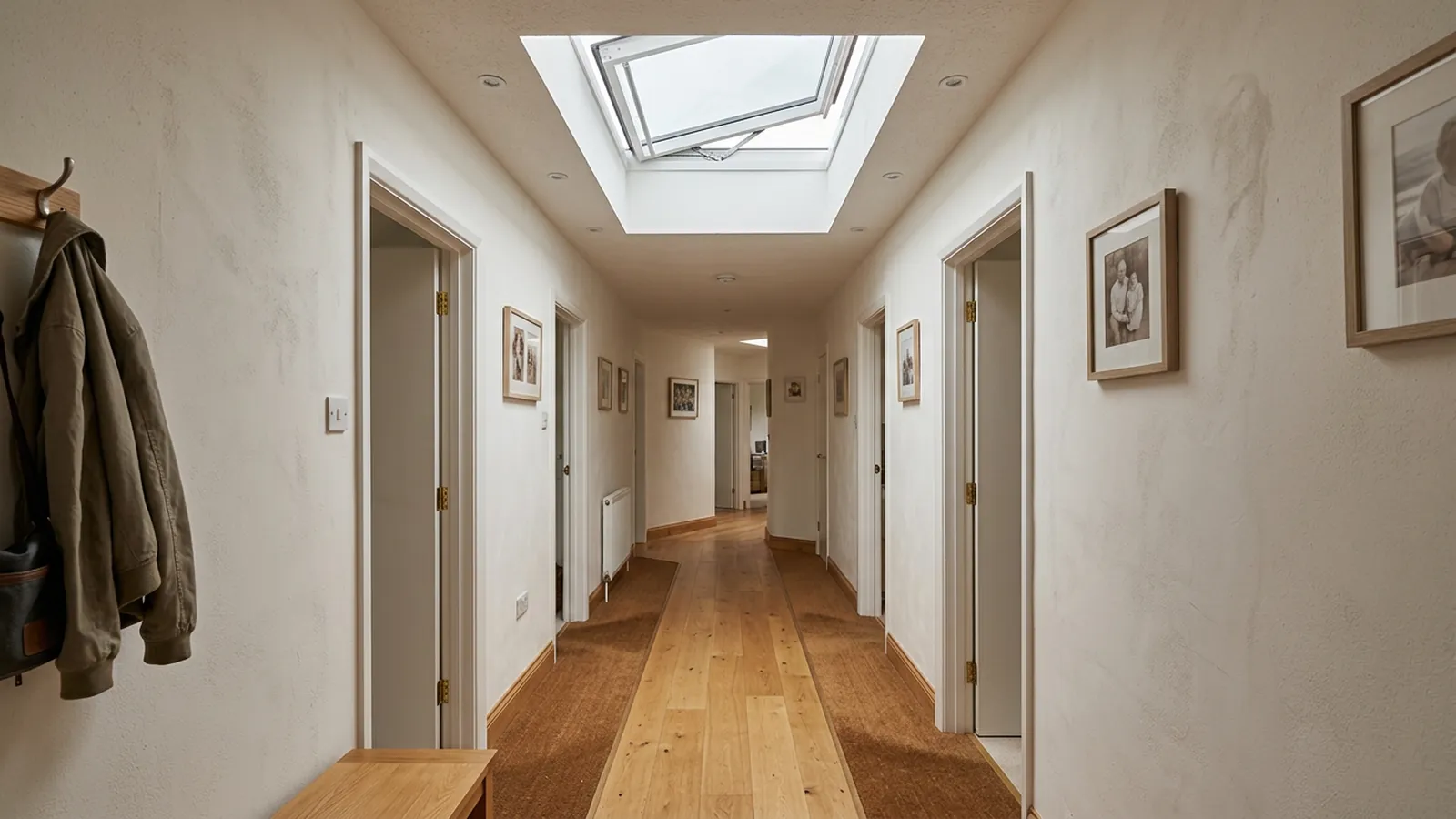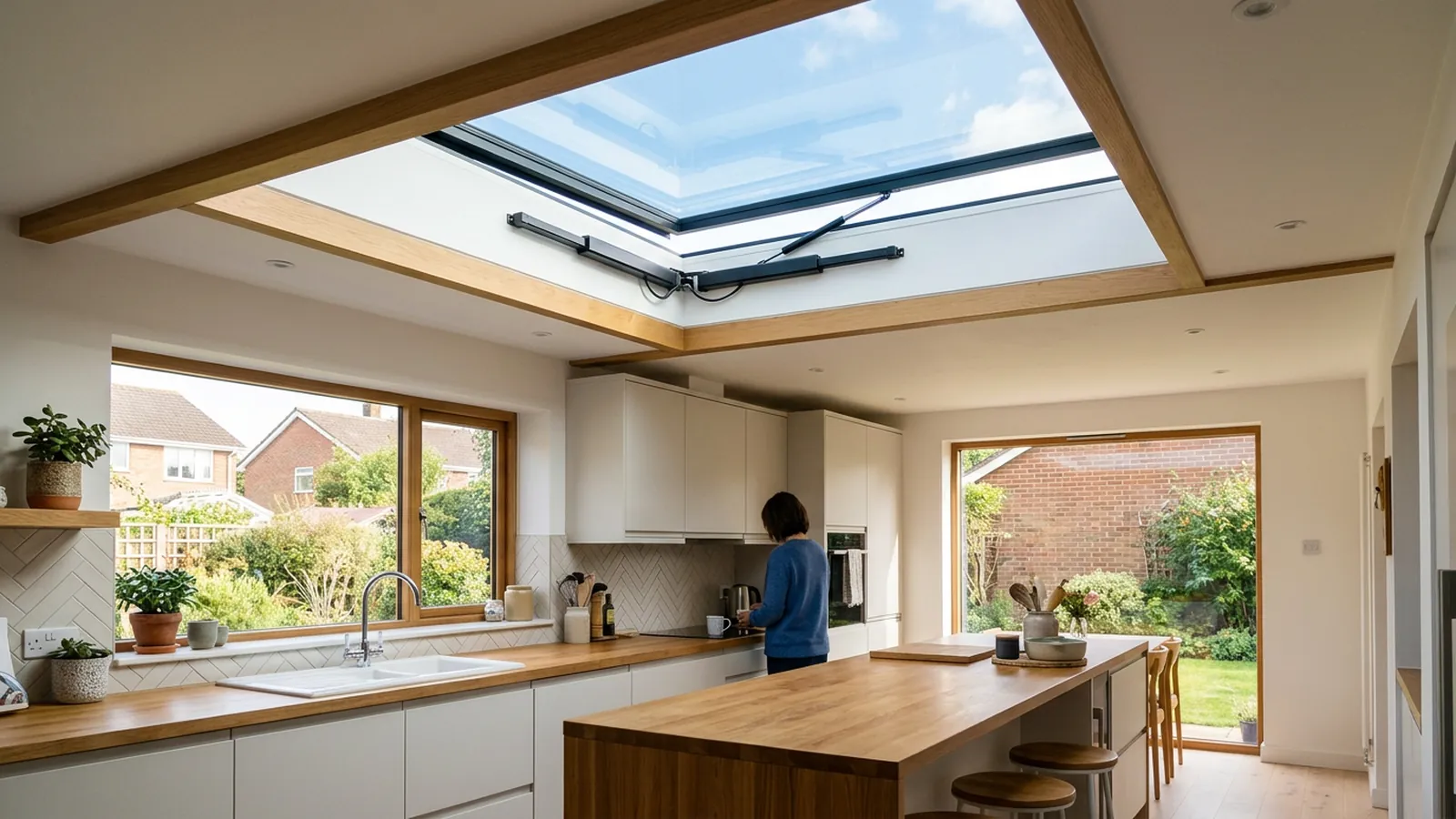
The worry makes sense. A panel the size of a paperback, facing a grey Hampshire sky in December, does not sound like much of a power station. The good news is that it does not need to be one. This page deals with the winter question only; the wider choice between battery and mains power, and how an opening unit gets onto your roof, sit with our electric and opening rooflight installation service.
How a sealed rooflight unit works and fails
- Outer and inner glass panes, with the outer pane facing the weather
- Low-emissivity coating on one inner face, reflecting heat back into the room
- Warm-edge spacer bar holding the panes apart, filled with desiccant to soak up trace moisture
- Primary seal against each pane, backed by the secondary seal around the edge
- Dry sealed cavity, the insulating layer between the panes
- Broken edge seal: moist air gets in and the desiccant becomes saturated
- Mist and droplets trapped between the panes; they cannot be wiped off and the sealed unit needs replacing
- Inset: condensation on the room-side face of the glass is a ventilation or humidity issue, not a failed unit
What changes between June and December
| Factor | Summer | Winter |
|---|---|---|
| Hours of daylight | Long days give the panel a long charging window | Short days give it far less time to refill the battery |
| Sun angle | High sun reaches most roof slopes | Low sun is blocked more easily by chimneys, trees and neighbouring roofs |
| How often it opens | Often, sometimes left open for hours to cool a room | Usually briefer airing, to clear steam or stale air |
| Cold | No effect on the battery | Batteries give up their charge less readily in hard frost |
The two columns partly cancel each other out. Winter brings less charge in, but it also tends to bring less demand, because nobody props a loft window open for an afternoon in January. That is why a well-placed battery rooflight generally carries on through the dark months without anyone noticing a difference.
Where a solar unit struggles in the cold months
The weak spot is the combination of heavy use and poor light. A bathroom or kitchen extension where the rooflight is opened several times a day to clear condensation, on a slope that loses the low sun behind a taller building or a mature tree, can drain the battery faster than a short grey day refills it. A north-facing pitch gets only reflected and diffused light through the whole of winter, which charges the panel, but slowly.
The rule: on an open, south or west facing slope, a battery rooflight copes with winter as it comes. The exception is a shaded or north-facing roof where the window is also the main way a steamy room is aired every day; there, a wired motor is usually the calmer choice.
Rain sensors are worth a word here. A sensor that closes the sash when the first drops land needs a little power to stay alert, and the unit keeps back enough charge to shut the window when it senses rain. How that sensor behaves, and why it overrides the remote, is covered in our guide to rain sensors and automatic closing.
Keeping the panel working through winter
The panel is on the outside of the frame, so it collects whatever the roof collects. A few habits keep it charging well:
- Keep it clear. Fallen leaves in autumn and lying snow in a cold snap both cover the cell; once they slide off or melt, charging picks up again.
- Watch for moss and grime. A panel on a slope below trees can gather a film that cuts the light it receives. It can be wiped when the glass is cleaned.
- Ease off in a dark spell. If the remote shows a low battery, open the window less for a few days and let the panel catch up.
- Know the override. Most units can be opened or closed by hand if the battery is flat, so the room is never stuck.
That last point is explained properly in our answer to does an electric rooflight have a manual override? A flat battery behaves much like a cut to the mains, and what the sash does in that moment is set out in what happens to an electric rooflight in a power cut?
Reading your own roof before you choose
The build era of a Basingstoke house rarely decides this one; the orientation of the slope does. A 1970s semi in Brighton Hill and a new home in Hatch Warren can sit on the same street pattern yet have their rear pitches facing opposite ways. So before choosing battery over wire, look at where the window will go and ask three plain questions: does that slope see the sun in winter, is anything tall close by to the south, and will this room need airing every day or only now and then?
If the answers are sunny, open and occasional, a solar rooflight is a tidy way to add an opening skylight with no cable run through the ceiling. If they are shaded, crowded and daily, a mains motor removes the question altogether. Motors on both types are built for years of use, and our answer on how long an electric rooflight motor lasts covers what wears first.
Infographic
How a rooflight job runs, from survey to guarantee
Roof survey
We look at the structure, the covering and the room below before anything is priced.
Specification
A size, type and position that fits your roof, and whether the work is notifiable.
Paperwork
Building Control notified where the work needs it, and planning checked where it applies.
Installation
Opening formed, frame fixed, flashed or dressed in, then lined and finished inside.
Sign-off and guarantee
Completion paperwork where needed and a 10-year workmanship guarantee.
What we look at on the roof
At the survey we check the pitch and the direction the slope faces, note chimneys, dormers, trees or neighbouring gables that would throw winter shade over the frame, and talk through how you plan to use the room. That is what settles whether a battery unit makes sense or a wired one is better value over the long run. You get a written quote after that visit, with the reasoning for the power choice set down in it.
Wondering whether your own slope catches enough low winter sun? Arrange a survey and we will judge it from the roof itself, not from a guess at the kerb.