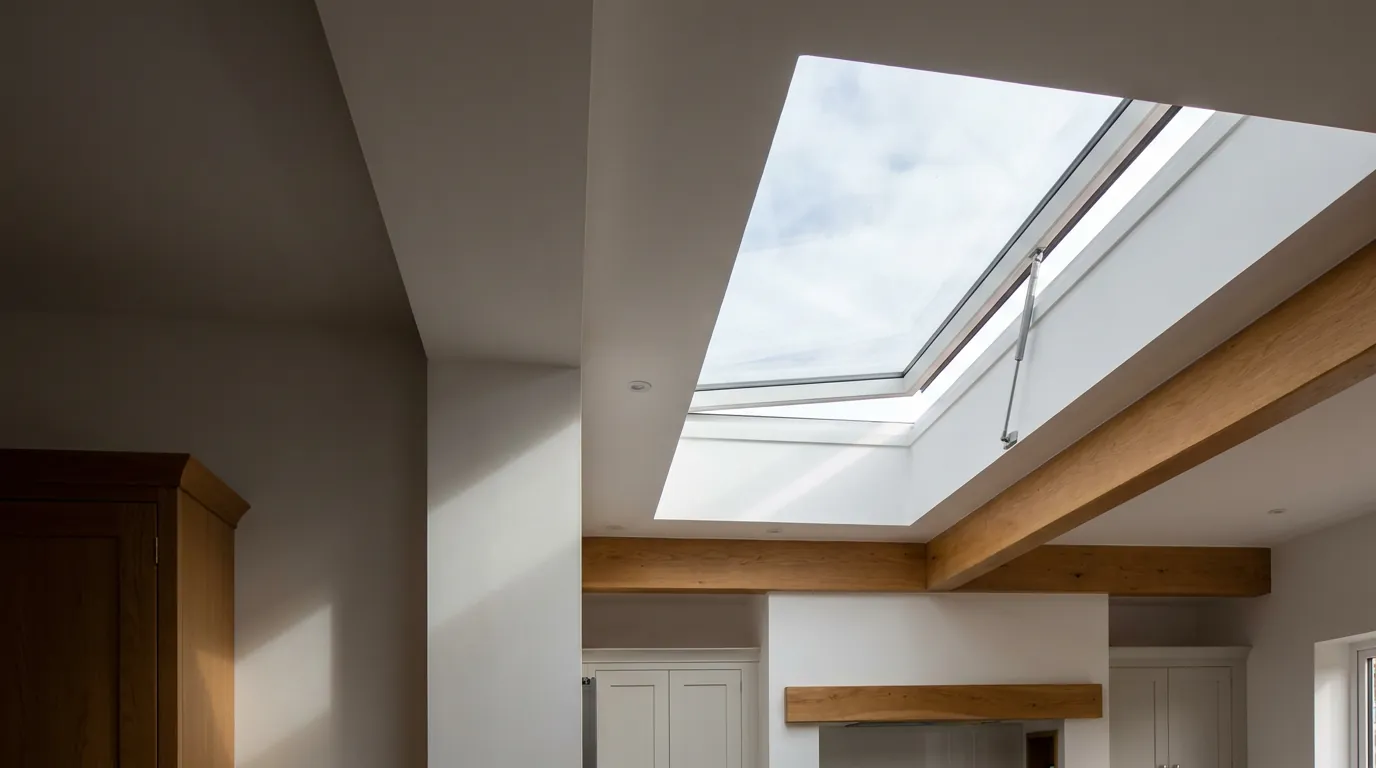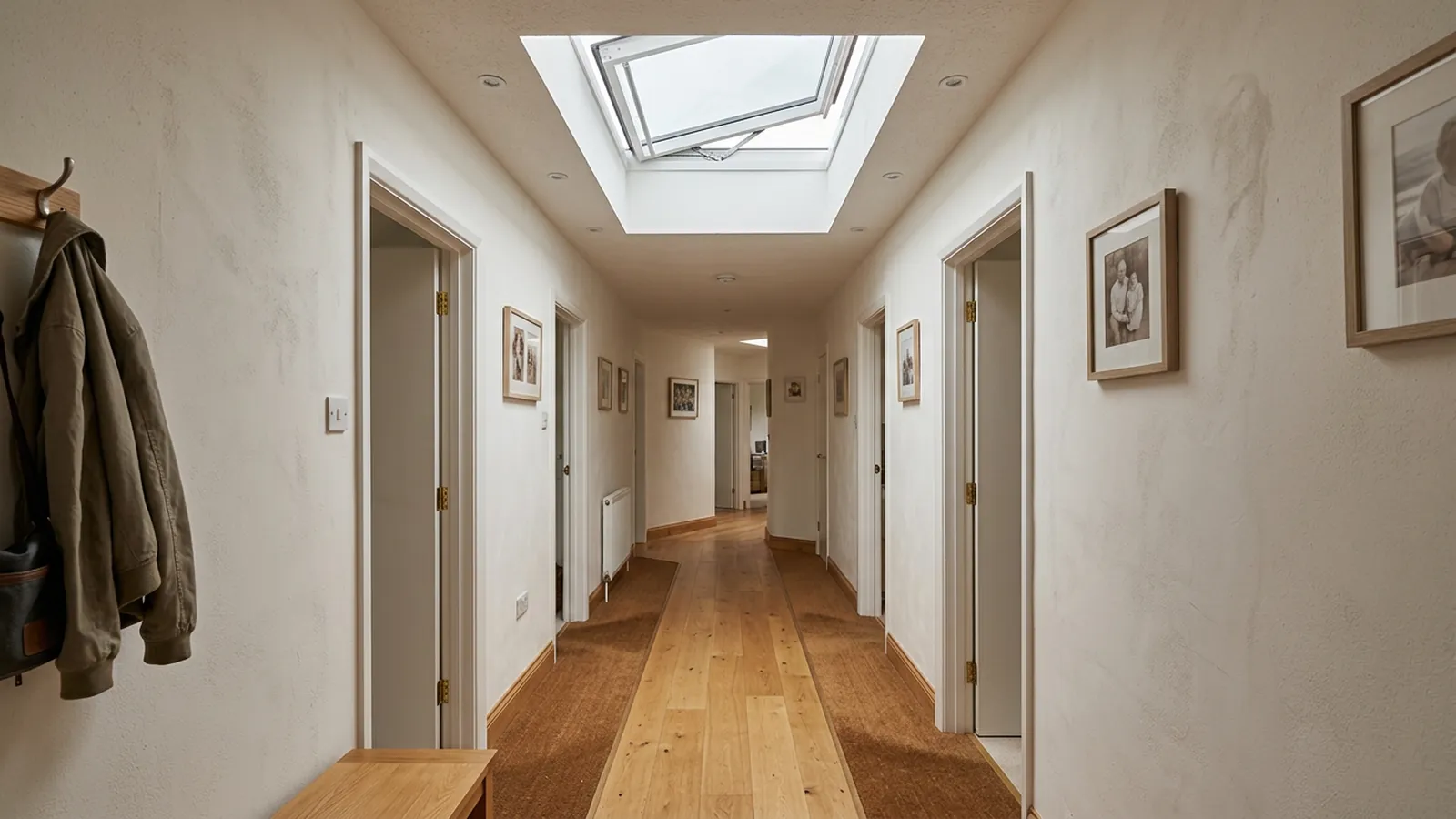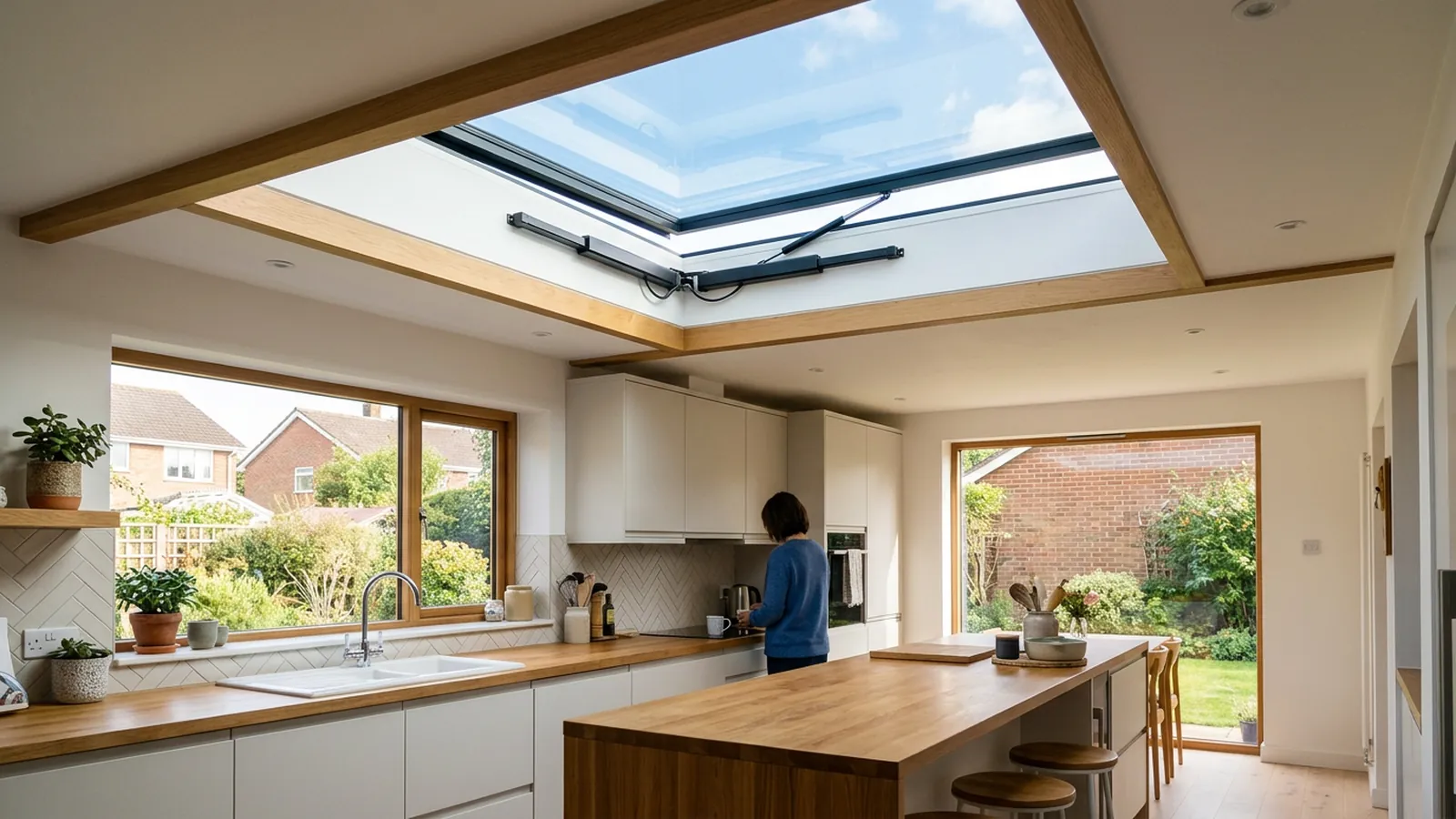
An opening rooflight with a motor needs power from somewhere, and there are only two places it can come from: a cable run back to the house supply, or a small panel on the frame that charges a battery from daylight. Both open the glass at the touch of a button, both can close themselves when rain starts, and from inside the room they look almost identical. The difference is in what happens behind the plasterboard, and in how the unit behaves on a grey week in January. This guide sets the two side by side so you can pick the one that suits your roof, your ceiling and the way you will use the window.
If you are still deciding whether you want a motor at all, the comparison of winders, poles and motors is the place to start. This page assumes the motor is settled and the question is how to feed it.
Two ways to drive the same motor
Inside the frame, a solar powered rooflight and a mains one use the same kind of drive: a small electric actuator that pushes the sash open and pulls it shut. What changes is the supply. A mains unit takes low-voltage power from a control box, and that box is wired into the house electrics, usually from a fused spur. A solar unit carries its own slim photovoltaic strip on the outer frame, which tops up a rechargeable battery tucked into the head of the window. The actuator draws from that battery, not from the house.
That single difference ripples out into everything else: how much disruption the fitting causes inside, whether an electrician is involved, how the unit copes with long dull spells, and what is left to replace years down the line. None of it changes how much daylight comes in, which is decided by the glazing and the size of the opening. Both types are covered by our opening rooflight installation service, both are sold as roof windows for pitched roofs, and both are available as opening flat rooflights for extensions, although the range of sizes and styles differs by make.
How a sealed rooflight unit works and fails
- Outer and inner glass panes, with the outer pane facing the weather
- Low-emissivity coating on one inner face, reflecting heat back into the room
- Warm-edge spacer bar holding the panes apart, filled with desiccant to soak up trace moisture
- Primary seal against each pane, backed by the secondary seal around the edge
- Dry sealed cavity, the insulating layer between the panes
- Broken edge seal: moist air gets in and the desiccant becomes saturated
- Mist and droplets trapped between the panes; they cannot be wiped off and the sealed unit needs replacing
- Inset: condensation on the room-side face of the glass is a ventilation or humidity issue, not a failed unit
Side by side: what each type involves
The table sets out the practical differences. It describes the general pattern across the common makes; the exact kit varies by manufacturer and model, and the survey confirms which versions suit your opening.
| Point | Solar powered | Mains powered |
|---|---|---|
| Power source | Panel on the outer frame charging an internal battery | House supply via a control unit, usually from a fused spur |
| Cabling inside | None to the house circuits | A cable route from the frame to the control unit and supply |
| Making good | Limited to the lining around the window | Lining plus any chasing or ceiling openings for the cable |
| Electrician | Not needed for the power side | Needed for the connection to the house supply |
| Dull weather | Battery charge can run low after long grey spells | Unaffected by weather |
| Power cut | Carries on working from its battery | Stops until power returns, unless it has a backup |
| Part to renew later | The rechargeable battery | No battery, unless a backup pack is fitted |
| Controls | Wireless keypad or remote, often app linkable | Wireless keypad or wall switch, often app linkable |
Read down the columns and a pattern appears. Solar trades a little uncertainty about charge for a much simpler install. Mains trades a more involved install for power that never depends on the sky.
Where solar earns its place
The strongest case for a solar unit is a finished room where nobody wants cables pulled through. Picture a loft conversion that is already plastered and decorated, with a fixed roof window in the slope that the owners would now like to open without a pole. Running a mains feed to that window means finding a route from the frame down to a socket circuit or a spur: along the rafter, behind the knee wall, through the floor void. On a trussed estate roof that route is often awkward, and every metre of it is a line of plaster that has to be cut and made good.
A solar powered rooflight sidesteps all of that. The window is swapped or fitted, the lining is finished around it, and the keypad goes on the wall with a couple of screws. There is no connection to the house electrics to plan, and so no electrician to book for the power side of the job.
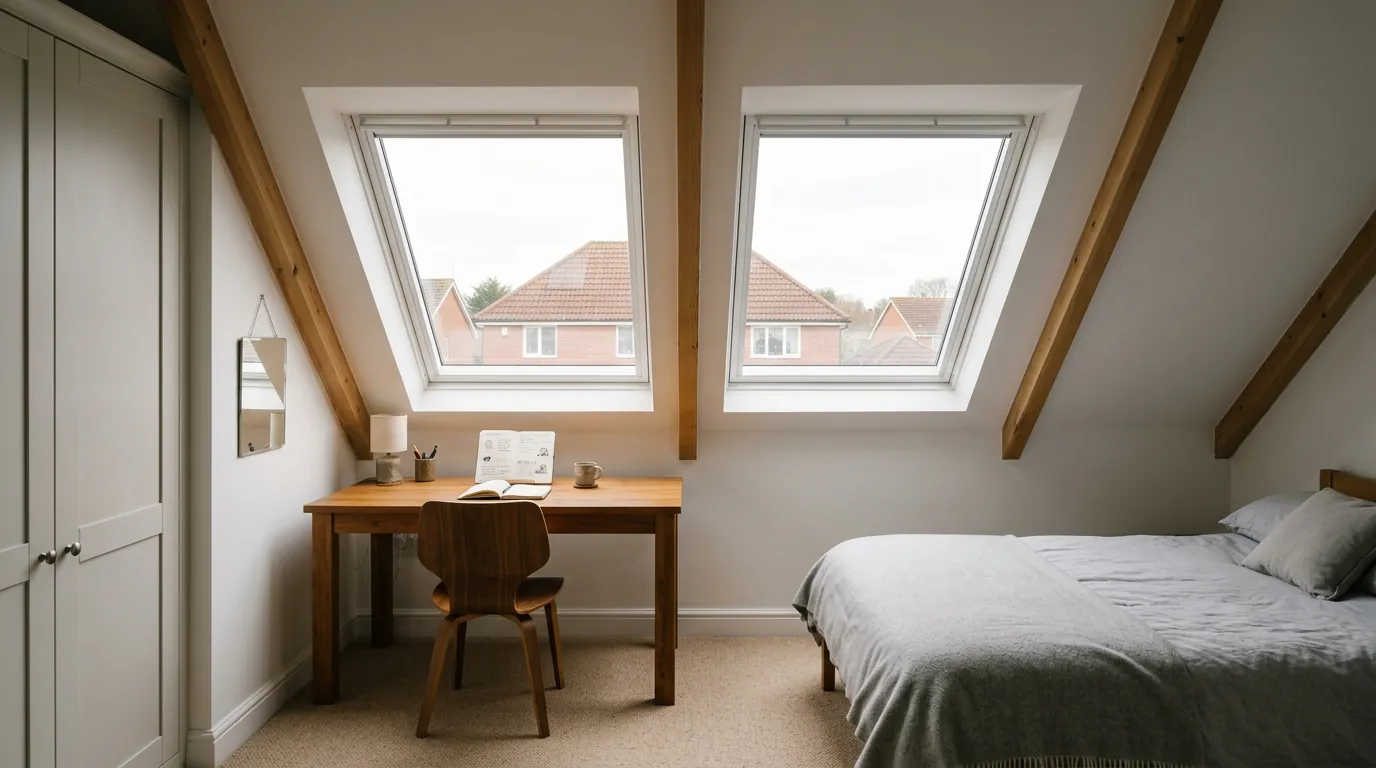
Solar also suits windows that open now and then rather than all day. A rooflight over a stairwell that is cracked open on warm evenings, or a bathroom window used after a shower, asks little of its battery. The panel has hours of daylight to replace what a handful of short movements used.
Where mains is the better call
Mains power earns its keep when the window works hard or when the room is still open. If the ceilings are down, the loft is being converted, or the extension is still a shell, a cable can go in before the plasterboard at almost no extra disruption. At that stage the main argument for solar (avoiding making good) has gone.
Mains is also the steadier choice for a unit that moves many times a day, is driven by an automation schedule, or is linked to a heating or ventilation system that opens and closes it on its own. A battery charged from a small panel has a finite budget, and a busy routine through the darker months can spend it faster than the panel refills it. Where an opening rooflight is wanted as part of a smoke ventilation arrangement, that is a separate specification with its own control gear, covered in whether an electric rooflight can be a smoke vent.
Larger and heavier sashes, including some big opening flat units over kitchen extensions, are commonly offered only with a mains drive. Where that is the case, the size you want settles the question before the power debate starts.
The rule: if the plaster is already up and the window opens a few times a day, lean towards solar; if the room is open or the window will be busy all year, lean towards mains. The exception: a north-facing slope in deep shade can starve a solar panel even on a light-duty window, so a mains feed can be worth the extra work there.
Solar through a Hampshire winter
This is the doubt that most shapes the choice, and it deserves a straight answer. The panel charges from daylight, not only from direct sun, so an overcast day still puts some charge back. What reduces it is a run of short, dark days, or a panel that sits in shadow from a chimney, a taller neighbouring roof or a tree. In those conditions the battery can drop to a point where the unit protects itself: it will close the window and keep enough in reserve to do so, but may refuse to open until it has recharged.
Orientation matters more than location. On a Basingstoke estate the same house type can face any direction, so two identical semis can have roof slopes with quite different light. A south or west slope with a clear sky above it gives a solar panel the best chance; a north slope under a taller gable gives it the least. The fuller picture of charging on short days is in do solar rooflights work in winter, and it is worth reading if your chosen slope faces away from the sun.
A solar rooflight is charged by the slope it sits on, so the direction of that slope matters more than the weather forecast.
Power cuts, batteries and backup
Here the two types swap places. A mains unit relies on the house supply, so in a power cut it stays wherever it was when the supply went. If it was open and rain arrives, the rain sensor has nothing to drive the motor with. Some mains systems accept a backup battery in the control unit for exactly this, and most have a manual release so the sash can be closed by hand. What a given model offers, and how to use it, is set out in what happens to an electric rooflight in a power cut.
A solar unit shrugs off a power cut because it never used the house supply in the first place. The cost of that independence is the battery itself. Rechargeable cells lose capacity with age, so at some point it will be replaced. On the common makes it sits behind a cover in the frame head and is designed to be changed from inside the room. Motors wear too, whatever feeds them; how long an electric rooflight motor lasts covers what shortens and extends that.
Rain sensors and control on both types
Both types normally come with a rain sensor on the outer frame that tells the motor to close when drops land on it. On a solar unit the sensor draws on the same battery, which is one more reason the unit keeps a reserve for closing. How the sensors behave in drizzle, and why the window may close a touch slower than you expect, is covered in the guide to rain sensors and automatic closing.
Controls are similar across the two. A wireless keypad is the usual starting point, and many systems link to a hub so the skylight can be opened from a phone, on a timer or alongside blinds. That side of things sits in app and smart home control of opening rooflights. The one difference to note is that a solar unit set to open and close on a busy automation schedule is spending battery each time, so keep the routine modest on a shaded slope.
Wiring, notification and the paperwork
With solar, there is no connection to the fixed wiring of the house, so the electrical side raises no notification question at all. The roof work is a different matter: putting a new roof window into a pitched roof, or changing the structure around an opening, is building work in its own right, and where it is notifiable we notify Building Control as part of the job.
With mains, a qualified electrician makes the connection. Whether that electrical work is itself notifiable depends on what is done, for example adding a new circuit or working in a bathroom. Is an electric rooflight notifiable under Part P explains where the lines fall. The practical detail of where the cable runs and where the control unit lives is set out in wiring, power and where the controls go.
Choosing for your roof: the survey order
We do not recommend one type across the board. The answer comes from the room, the slope and how the window will be used, and those are things we check on the roof before any quote is written.
- Room state. We note whether the ceiling is finished or open, and where a cable would have to go if the unit were mains.
- Slope and shade. We look at which way the roof faces and what overshadows it: chimneys, higher roofs, trees.
- Use. We ask how often the rooflight will open, whether it will be automated, and whether it serves a bathroom, a bedroom or a stairwell.
- Size and make. We check which drives are offered at the size that fits between your rafters or trusses, since some sizes come in one version only.
- Recommendation. We put the solar or mains choice in writing with the reasons, so you can see why before you decide.
Where you already have a fixed unit and wonder about adding a motor, whether an electric rooflight can go into an existing roof covers the retrofit route, and solar is often the neat answer there.
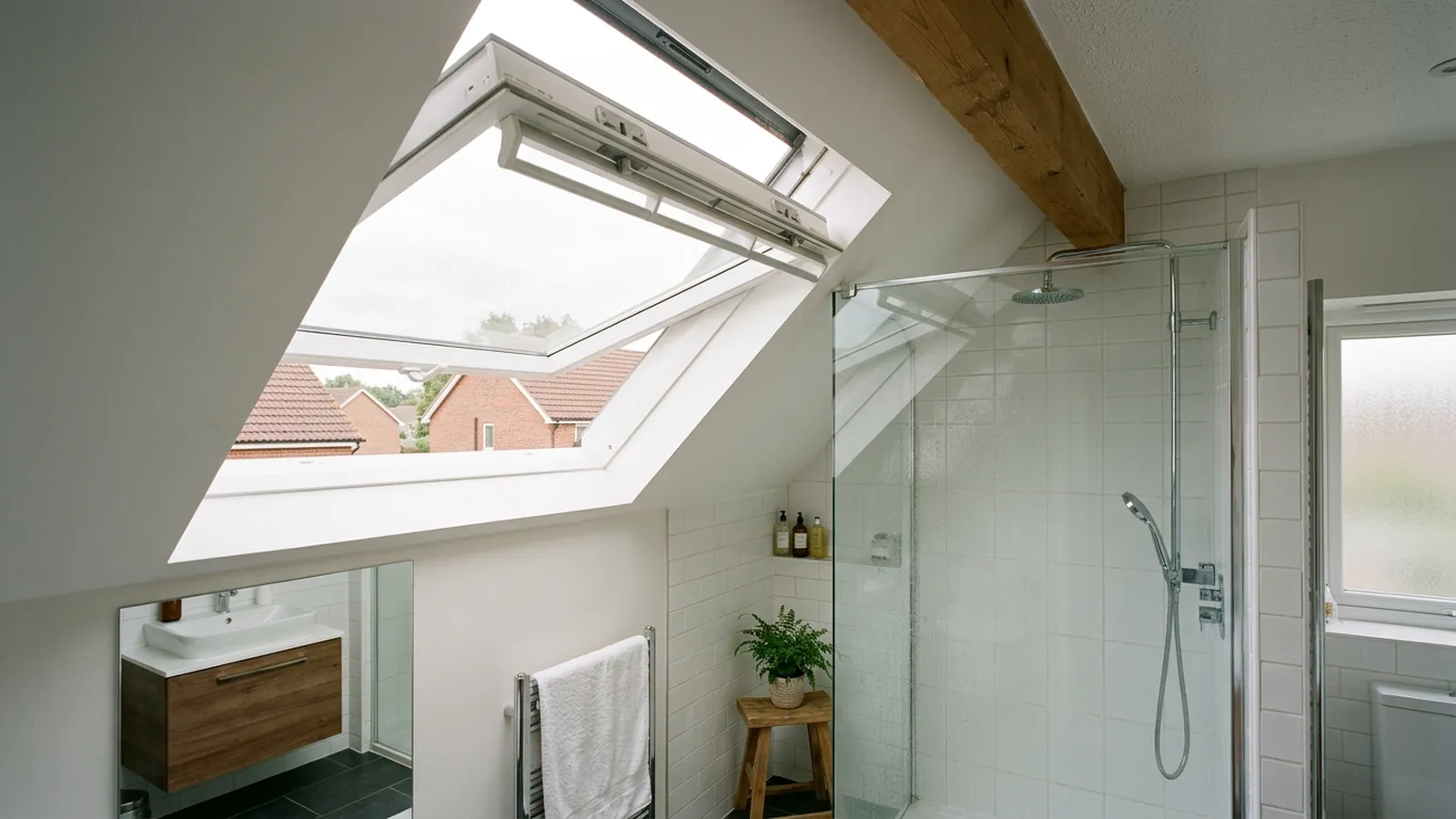
The short version, and the next step
Solar keeps the house wiring out of it, carries on through a power cut and suits finished rooms and lighter use, at the cost of a battery that ages and a panel that needs light. Mains gives steady power for busy windows and bigger sashes, at the cost of a cable route and an electrician. Both give the same daylight and the same rain protection. Whichever you choose, the fitting carries our 10-year workmanship guarantee; it is a promise about our work and is not insurance backed.
For the wider picture of opening units, see electric and opening rooflight installation, and for everything else Everlight fits, the skylight installation homepage is the front door. When you want an answer for your own slope, arrange a survey and we will tell you which supply suits it.