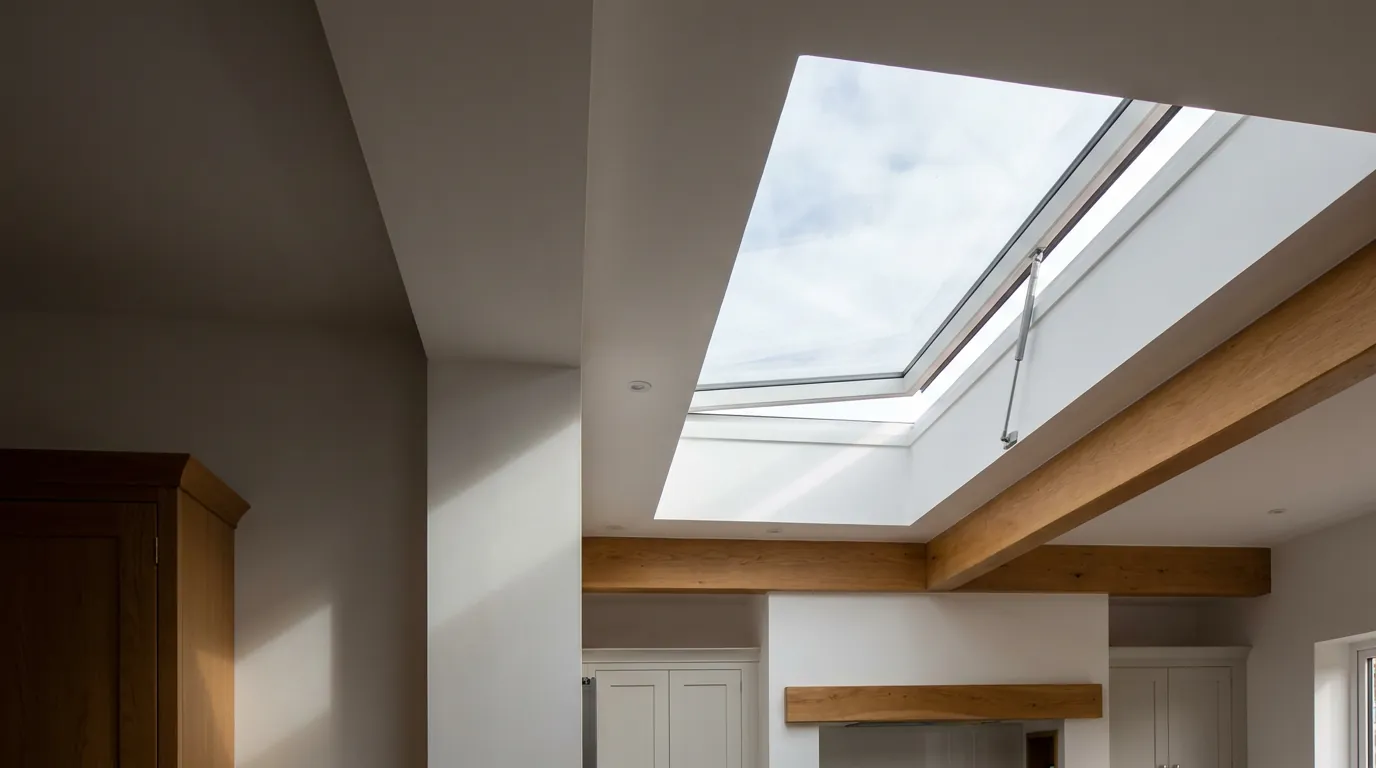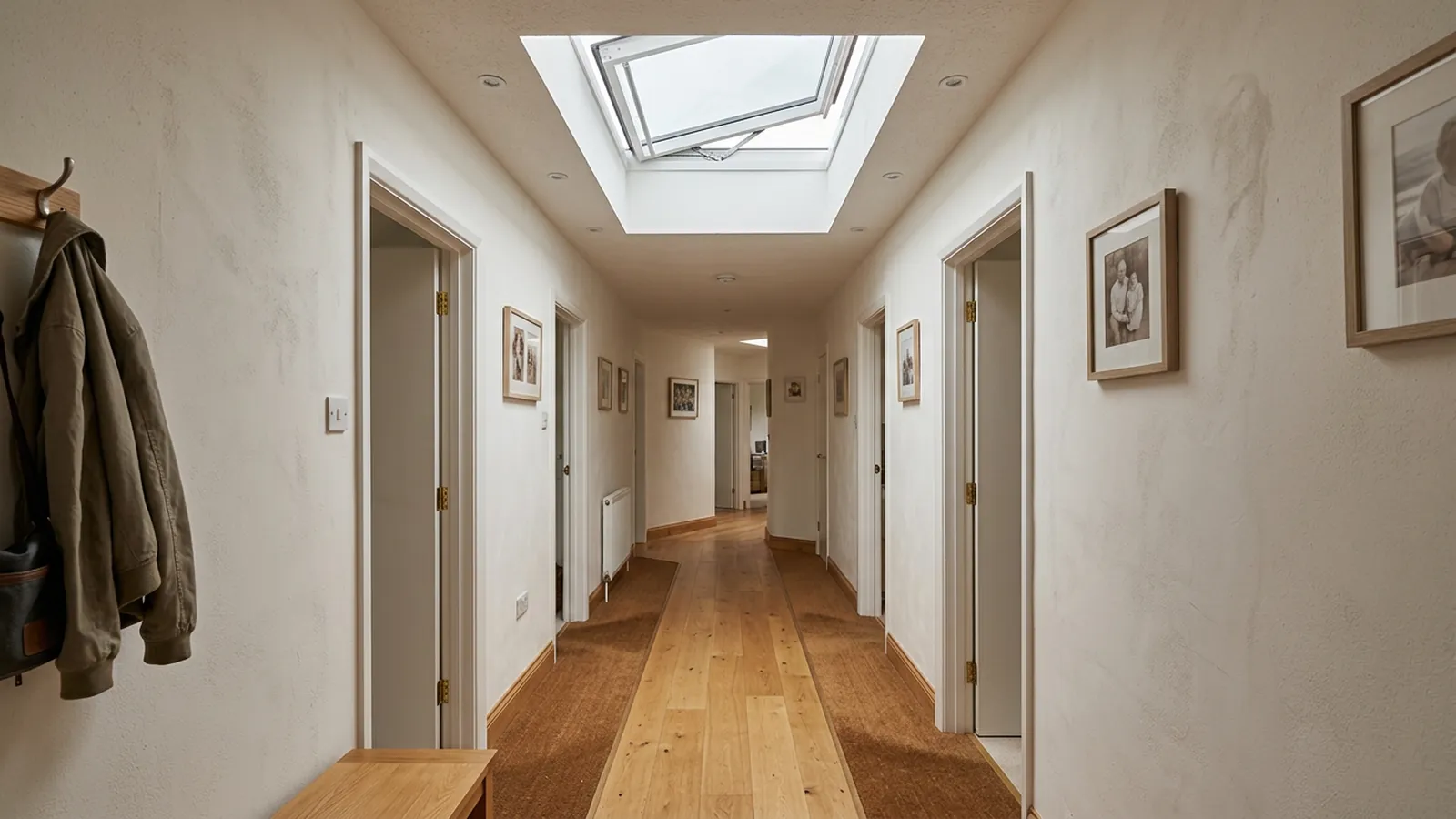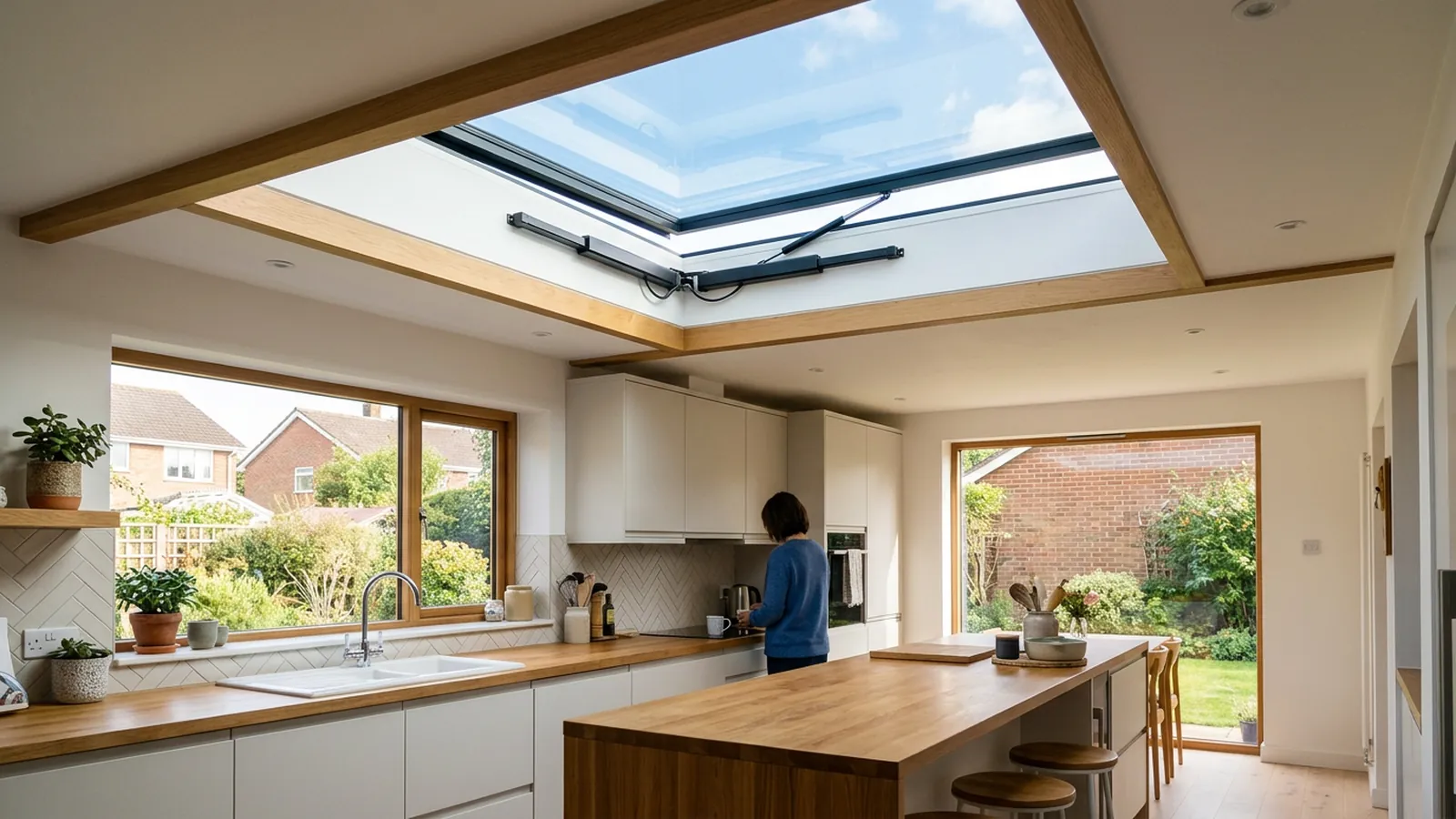
A roof window that opens itself is lovely until the afternoon you are at work and a shower blows in from the west. The small grey pad on the top of the frame is what stands between that shower and your carpet. This guide is about that pad, the rain sensor, and the automatic closing it triggers: how it detects water, what it can and cannot sense, where it should sit on a pitched or flat roof, and what to ask about before an opening rooflight goes in above a bed, a desk or a kitchen worktop.
It sits alongside our page on electric and opening rooflight installation, which covers the wider choice of motors and frames. Here the focus is narrower: the one component that decides whether you can leave a skylight open and walk away.
What a rain sensor on a rooflight does
A rooflight rain sensor is a small detector mounted outside, on the frame or kerb of the window, wired back to the motor's control unit. When water lands on it, the control unit receives a signal and tells the actuator to drive the sash shut. On a hinged roof window that means the top-hung or centre-pivot sash swings closed; on a flat rooflight with a chain or spindle actuator, the glazed lid lowers onto its seals.
The sensor does not decide anything by itself. It is a trigger. The logic lives in the control box: whether rain closes the window fully or to a trickle position, whether a person can reopen it while the sensor is still wet, and whether the system waits for the pad to dry before allowing another open command. Those rules differ between makers and between product generations, which is why the same phrase, "rain sensing", can mean quite different behaviour from one skylight to the next.
What it gives you is permission to use the window properly. Without one, an opening rooflight over a stair or a loft bedroom tends to stay shut whenever the house is empty, and the ventilation you paid for goes unused.
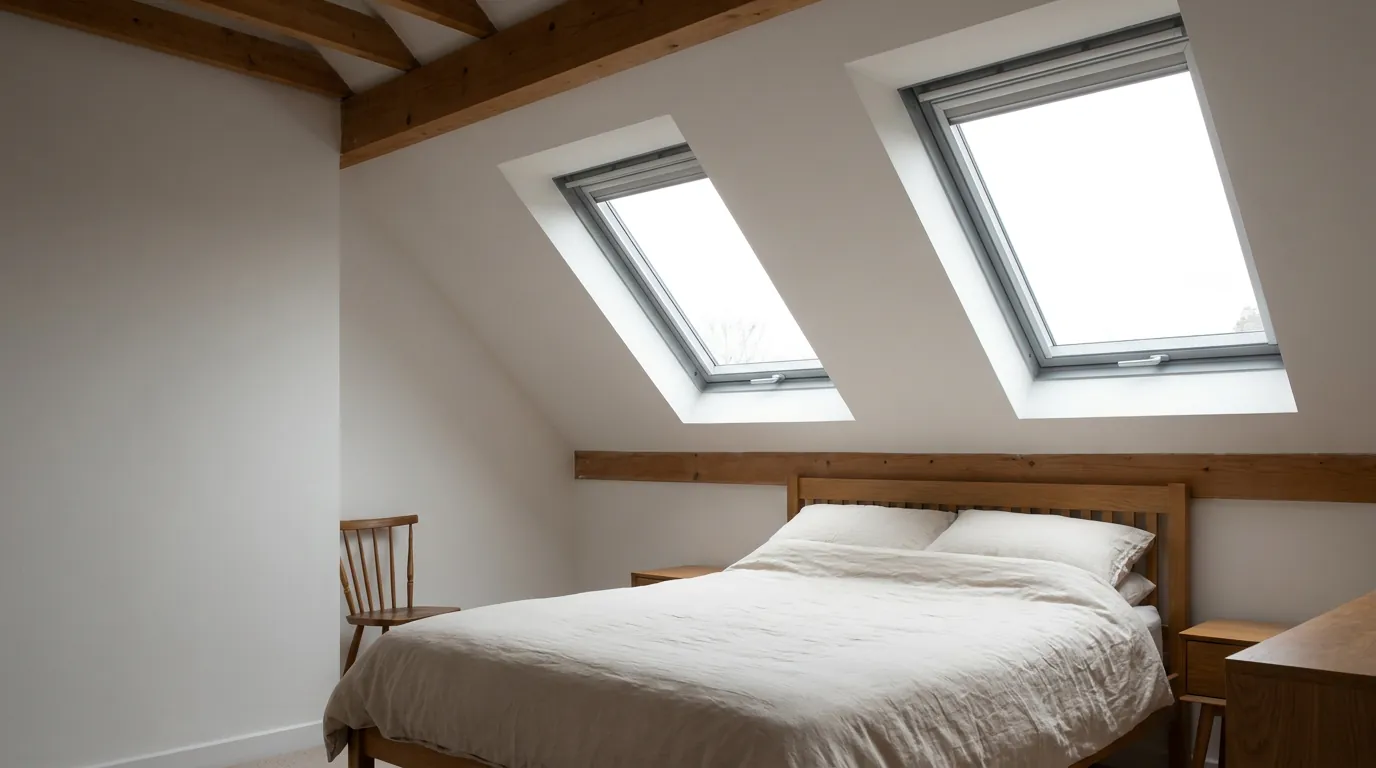
How rooflights and roof windows open
- Centre-pivot sash, turns so the lower edge tips out and the top swings in, handy for cleaning from inside
- Pivot point, the hinge line across the middle of the sash
- Top-hung sash, swings outward clear of the opening for a wider view
- Top hinge, where the sash is hung from the head of the frame
- Fixed rooflight, glazing sealed to the upstand with no moving parts
- Electric opening rooflight, the glazed lid lifts from one edge for ventilation
- Motorised chain actuator, pushes the lid open and draws it closed
- Rain sensor, closes the rooflight automatically when it starts to rain
How the sensor detects water
Most rooflight rain sensors work on conductivity. The pad carries two interleaved metal tracks with a small gap between them. Dry air does not conduct across that gap; a raindrop bridging it does. The control unit reads the change and treats it as rain. It is a simple, well-proven principle, and it is why the pad looks like a tiny circuit board rather than a camera or a lens.
Many sensors include a gentle heater under the pad. Warmth does two jobs: it clears dew and light condensation so a clear night does not register as a downpour, and it dries the pad after the rain stops so the system can release its lock sooner. The flip side is that a heated pad needs a constant small supply, which matters on a solar-powered unit.
A few control systems also accept other inputs, such as a wind sensor or a temperature sensor, so the window can close in a gale or open when a loft room overheats. Those are separate devices. A rain pad on its own reads water and nothing else.
Rain sensor types compared
The table sets out the arrangements you are likely to be offered. The right one depends on the rooflight, how the motor is powered, and whether other windows in the house are on the same system.
| Arrangement | Where it sits | Suits | Worth knowing |
|---|---|---|---|
| Integrated pad on the frame | Built into the top of the window frame or its cover | Pitched roof windows with a factory motor | Tidy and pre-wired; the pad sits where the rain actually falls on that window |
| Sensor on the kerb or upstand | Fixed to the side or top of the flat rooflight kerb | Opening flat rooflights and hinged lids | Must face the open sky, clear of parapets and ponding water |
| Separate roof-mounted sensor | On its own bracket on the roof, cabled to the control unit | Several rooflights run from one control panel | One sensor can close every window on the circuit together |
| Solar unit with built-in pad | On the window, sharing the battery with the motor | Retrofits where running a cable is awkward | Closing relies on the battery holding charge; see the power notes below |
On a single pitched roof window with a factory motor, the sensor usually comes with it and there is nothing to choose. The choices open up on flat roofs and on houses with more than one opening skylight.
What automatic closing looks like in practice
The sequence is worth understanding, because it explains both what the system protects against and where its limits are.
- First drops land. Rain reaches the pad at the same moment it reaches the open sash. A small amount of water can blow in during the seconds before the sash is shut; the sensor limits exposure rather than preventing every drop.
- The control unit reads the signal. It overrides whatever the window was last told to do and sends a close command to the actuator.
- The sash travels shut. The motor runs at its normal speed. On a wide-open flat lid or a high roof window this takes longer than on a window opened a crack.
- The seals engage. The window closes onto its gaskets, and on many systems the motor confirms the closed position before stopping.
- The lock holds while wet. While the pad reads water, most systems ignore or restrict open commands, so a remote tap cannot reopen the window into a storm.
- The pad dries and control returns. Once it is dry, normal opening is allowed again. Some systems reopen automatically to the previous position; most wait for you.
Two practical points follow. Opening a rooflight only part of the way when you are going out shortens the closing time. And a room where a few drops would matter, such as a loft study with papers on the sill, is a reason to think about the ventilation position rather than the fully open one. Our answer on whether an opening rooflight can be left open in the rain covers the short version.
Where the sensor should go on your roof
A rain sensor only works if the rain reaches it before, or at the same time as, it reaches the opening. Position is the part owners rarely think about and installers must.
On a pitched roof
On a trussed estate roof, such as a 1970s semi in Brighton Hill or a newer house in Chineham, the factory pad on the head of the window frame is normally in the right place: it catches rain on the same slope and at the same height as the sash. Things to check at survey are overhanging trees, a neighbouring higher wall on a terrace, or a dormer cheek that shelters the pad from a prevailing wind direction.
On a flat roof
Flat roofs over rear extensions are where placement goes wrong. A sensor tucked low on the kerb behind a parapet, or on the leeward side of a lantern, can stay dry while rain slants into the open lid. It also should not sit where water ponds or where a nearby downpipe splashes it on a dry day. The sensor wants the open sky, on the weather side, above standing water. Our guide to opening flat rooflights over a kitchen extension goes into the extension roof itself.
A rain sensor is only as good as the stretch of open sky above it.
Power, batteries and what happens in a power cut
Automatic closing needs power at the moment the rain arrives. That is obvious once said, but it shapes the choice between mains and solar more than anything else.
A mains-powered skylight closes on rain whenever the supply is on. If the supply fails while the window is open, a unit without backup simply stays where it is until power returns. Some control units carry a backup battery that allows a final close; it is worth asking whether yours does. The detail is in our answer on what happens to an electric rooflight in a power cut.
A solar unit runs its motor, its heater and its sensor from a battery charged by a small panel on the frame. In a dull spell, the battery has less to give, and the maker's logic usually protects enough charge to close the window before it allows further opening. That is a sensible design, but it means a solar rooflight over a north-facing slope or under trees deserves a frank conversation at survey. The comparison of solar-powered and mains rooflights sets out when each makes sense.
The rule: automatic rain closing is only as dependable as the power behind it. The exception: a manual override lets you close the window by hand if the motor cannot, so know where yours is and how it works before you rely on the sensor. Our answer on whether an electric rooflight has a manual override explains the usual methods.
Snow, leaves, dew and false alarms
Rain sensors respond to water on the pad, so anything that puts water there, or keeps it off, affects behaviour.
- Dew and mist. A heated pad handles most of it. An unheated pad may close the window on a still autumn morning with no rain at all. Annoying, but on the safe side.
- Snow. Snow is not conductive until it melts. A heated pad melts the flakes that land on it and reacts; an unheated one may not respond until thaw. In snowy weather, closing the window yourself is the sensible habit.
- Leaves and debris. A wet leaf lying on the pad can hold the system in its rain state after the weather has cleared. On a roof under trees, a glance at the pad during gutter clearing is enough.
- Bird droppings and grime. A dirty pad can read damp for longer than a clean one. Wipe it gently with water and a soft cloth; avoid anything abrasive on the tracks.
- Wind-driven rain. Rain arriving sideways may reach the opening before it wets a sheltered pad. That is a placement question, covered above.
None of these are faults. They are the natural behaviour of a simple sensor, and knowing them stops the window from surprising you.
Controls, schedules and smart homes
The rain sensor sits in the same control chain as your wall switch or remote, and the order of priority is usually clear: rain beats everything. A timer set to open the loft room at nine, or a voice command through a smart speaker, will not reopen a sash while the pad is wet on most systems.
Where several rooflights share a control panel, one sensor can close them all. That is neat over a long galley extension with two or three opening flat units, and it means you are not relying on each window's own pad being well placed. Where rooflights are on separate systems, each needs its own sensor.
If you plan to link the windows to an app or a home hub, ask how rain status is reported. Some systems show a "closed due to rain" state, which is useful when you check from work. Our guides on app and smart home control and on wiring and where the controls go cover the rest of that chain.
Adding a rain sensor, or choosing one at survey
Factory-motorised roof windows generally come with a sensor, and on many ranges it is part of the product rather than an optional extra. Upgrade kits that add a motor to an existing manual roof window usually include one too. Whether a particular older frame can take a kit depends on its make, age and condition, which is something to confirm on the roof rather than from a catalogue. If the choice between a winder, a pole and a motor is still open for you, our guide to manual winder, pole or motor weighs them up.
For opening flat rooflights, the sensor is part of the actuator package, and the survey settles where it will be mounted, how its cable reaches the control unit, and where the unit itself sits inside. On a Basingstoke estate extension with a warm flat roof, that usually means a short run through the kerb; on an older cut-rafter roof in Old Basing or Overton, the route is planned around what is already there. Either way, if a new circuit or a new spur is involved, the electrical side is its own question, answered in whether an electric rooflight needs an electrician.
Everlight looks at the roof before any price is given, and the fitting work carries a 10-year workmanship guarantee (not insurance backed). Where the rooflight work is notifiable, the Building Control side is organised as part of the job rather than left for you.
If a skylight that closes itself is the thing that would let you open it at all, arrange a survey and we will show you where the sensor should sit on your roof and how it will behave. Everlight works across the town and the villages around it, and the homepage sets out the whole range. For the motors, frames and fitting steps that sit around the sensor, go back to the opening rooflight service page.