Think of it as the arm of the window. The glazing, the frame and the flashing are the same whether a rooflight opens by hand or by motor; the actuator is the part added to do the lifting, and choosing the right one for the sash is part of any electric rooflight installation. This answer explains what the unit is, the types you will meet, where it goes and what to ask before you pick one.
What sits inside the unit
Open the casing of a typical actuator and you find four things: a compact electric motor, a gearbox that trades speed for pushing force, the drive itself (a chain, a threaded spindle or a rack), and a small circuit that tells the motor when to stop. That last part matters. End-of-travel limits stop the motor when the sash is fully open or fully closed, and a load cut-out stops it if the sash meets something it should not be pushing against, such as a hand or a branch.
Most units run at low voltage from a control box or transformer, which in turn takes its supply from the house circuit. Some are fed by a small solar panel and a battery instead. Either way, the actuator only does what the controls tell it: a wall switch, a handset, an app, a rain sensor or a thermostat.
How rooflights and roof windows open
- Centre-pivot sash, turns so the lower edge tips out and the top swings in, handy for cleaning from inside
- Pivot point, the hinge line across the middle of the sash
- Top-hung sash, swings outward clear of the opening for a wider view
- Top hinge, where the sash is hung from the head of the frame
- Fixed rooflight, glazing sealed to the upstand with no moving parts
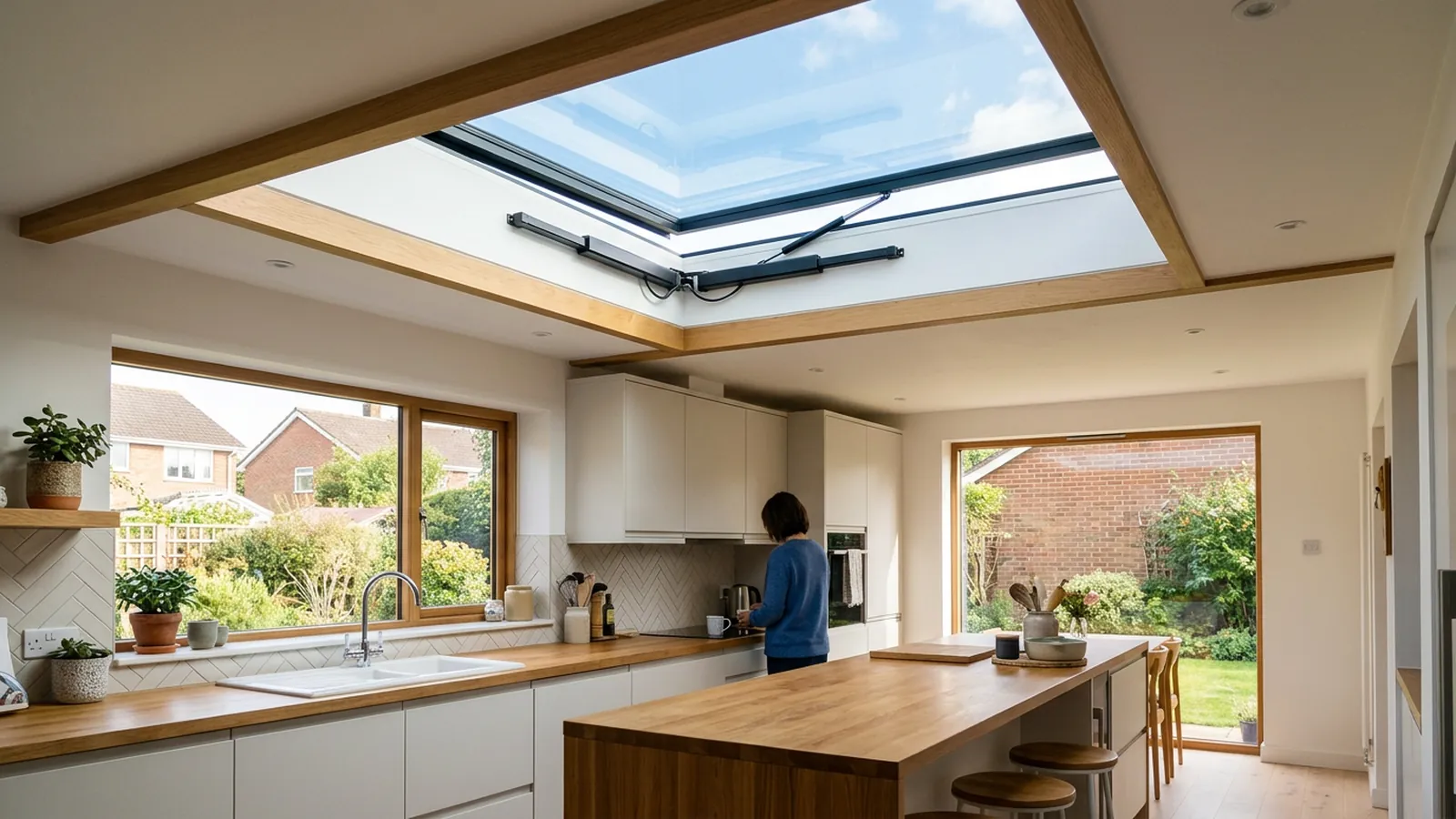
- Electric opening rooflight, the glazed lid lifts from one edge for ventilation
- Motorised chain actuator, pushes the lid open and draws it closed
- Rain sensor, closes the rooflight automatically when it starts to rain
The three kinds you will meet
The drive decides the shape of the unit and the kind of window it suits.
| Actuator | How it moves the sash | Where it suits |
|---|---|---|
| Chain actuator | A stiff folding chain feeds out of a slim box and pushes the sash outward, then winds back in | Pitched roof windows and hinged flat rooflights where the box can sit neatly along one frame edge |
| Spindle actuator | A threaded rod extends from a tube, like a piston, pivoting at both ends | Heavier hinged flat rooflights and hatches, fitted inside the upstand |
| Sliding drive | A motor runs the glazed panel along tracks rather than lifting it | Sliding flat rooflights and larger access openings onto a flat roof |
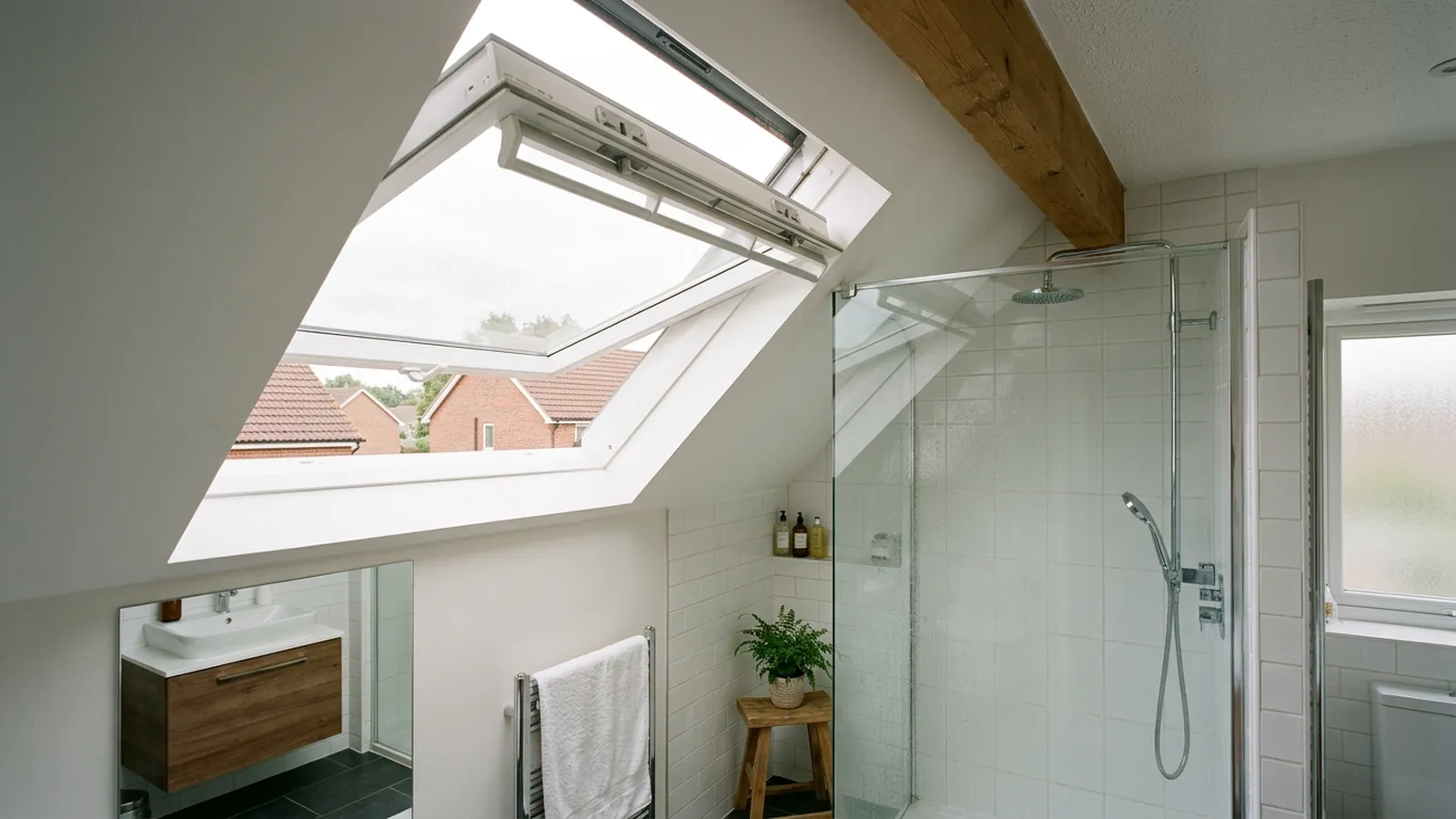
On a pitched roof window the chain unit is usually tucked behind the top of the frame, so from the room you see little more than a neat bar. On a hinged flat rooflight over an extension, the unit hides within the kerb, where a spindle can take the weight of a larger double or triple glazed sash. The wider comparison of hinged and sliding sashes sits in our guide to hinged and sliding opening rooflights.
How the actuator is matched to the window
An actuator is not a universal part you bolt onto any frame. The window maker specifies which unit suits each sash, and three things drive that choice: the weight of the glazed sash, the length of travel you want, and the room there is to mount the unit without it showing or fouling a blind.
Stroke, the distance the chain or spindle pushes out, sets how wide the sash opens. A longer stroke gives a wider gap and more airflow; a shorter one keeps the opening modest, which can suit a bedroom or a child's room. Our answer on how far an opening rooflight opens takes that point further. Weight matters just as much: an undersized unit strains, slows and wears early, so the factory pairing is the one to use.
The rule: fit the actuator the rooflight maker lists for that sash size and glazing. The exception is a replacement motor on an older unit where the original is no longer made; then the survey checks the stroke, the force and the fixing points before a compatible alternative is chosen.
Adding one to a window that already opens
Many roof windows fitted by hand crank or pole can take a motor kit later, because the maker designed the frame with fixing points for it. Where that is the case the job is mostly electrical and inside the room: the unit fixes to the frame, the cable runs to a control box, and the sash carries on as before. A hinged flat rooflight is a different case, as the actuator usually has to go into the upstand, which can mean lifting the sash and sometimes changing the unit altogether. If you are still weighing up a crank, a pole or a motor, choosing how a rooflight opens sets the options side by side.
Power, cabling and the controls
The motor itself is small, so the questions are practical ones: where the cable runs, where the control box lives, and where the switch goes so it is easy to reach. A mains unit needs a supply brought close to the window, usually through the ceiling void or down a lining, while a solar kit carries its own panel and battery and needs no house wiring. How the supply is routed and whether an electrician is involved is covered in the guide to wiring and controls for an electric rooflight.
- Survey. We look at the sash, the roof and the room, and note where a supply or a solar panel can go.
- Specify. The actuator, control box and any rain sensor are chosen from the maker's range for that window.
- Fit. The unit is fixed to the frame or kerb and the cable is hidden in the lining or void.
- Test. The sash is run open and shut, the limits are checked and the rain sensor is proved to close it.
When the power goes, and when the motor wears
An actuator holds the sash where it stopped, so a power cut leaves the rooflight open or closed as it was. Most units have a release or winding point so the sash can be closed by hand, and battery backed control boxes can shut the window when the supply drops. Our answer on whether an electric rooflight has a manual override explains how that works on different makes.
The actuator is also the part of an electric skylight that does the most work, so it is the part most likely to be swapped over the life of the window. A slower, noisier or hesitant stroke is the usual sign. Motors are made as separate units so a new one can go in without disturbing the glazing or the roof covering, which is covered in how long an electric rooflight motor lasts.
Getting the right unit on your roof
On a trussed estate roof or a flat roof extension, the rooflight is chosen for the opening first and the actuator follows from the sash it has to move. We confirm both at a survey, before any quote, and the fitting carries our 10-year workmanship guarantee. To have the window, its motor and its controls specified together, arrange a survey of your roof.